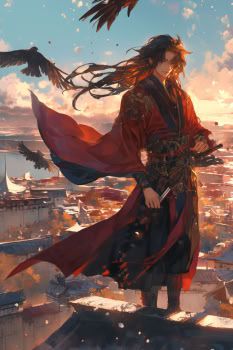
Chapter 9
In order to earn two jin of rice, Henry Clark's hands were covered in blisters, his shoulders chafed raw by the carrying pole. When sweat stung the wounds, the pain was piercing. Life had always been full of hardship—Henry Clark knew this. So even though carrying firewood was exhausting, he gritted his teeth and never uttered a word of complaint. He ate his own food, bore his own burdens, did his own work. From his previous life onward, he had already come to this realization.
Morning broke again. Henry Clark struggled to get up from the bamboo bed; a new day was about to begin. After washing up, he made breakfast for Jack, quickly kneaded two rice balls, wrapped them in lotus leaves, glanced at the grain sack that now held only a handful of rice, sighed, and stepped out the door. He planned to chop two loads of firewood today, so the family would have some reserves. That way, if it rained and they couldn’t chop wood, the two brothers wouldn’t have to go hungry together.
As soon as William Clark left, the little yellow dog crawled out from under Jack’s quilt, wagging its short tail eagerly, waiting for Jack to get up as well.
Jack Clark watched Henry Clark disappear into the morning mist and muttered to the little yellow dog, “The more I interact with people, the more I like dogs. But big brother isn’t like that, don’t you think?”
Chapter Six: The Seed of Reading
Henry Clark came once again to borrow a hatchet. The old clan leader seemed to see through Henry Clark’s intentions, smiling as he lent him his own hatchet, even patting him on the shoulder and saying, “Young people have plenty of strength. As long as you’re willing to work, you won’t starve. Today, I happen to be going to the village head’s banquet. I’ll help you get your household registration sorted. That way, you’ll have at least a small plot of mountain land to farm. If you’re diligent, you’ll soon be able to start a family and establish yourself.”
Henry Clark thanked the old clan leader, reported both his own name and Jack Clark’s to him, and, seeing the old man muttering the names over and over to memorize them, found a small wooden board and some charcoal, wrote both brothers’ names on it, and handed it to the old clan leader.
“You can read?” The old clan leader was surprised for the first time, his mouth agape. He snatched the hatchet from Henry Clark’s hand, tossed it into a bamboo basket, and dragged Henry Clark up to his bamboo house.
“Confucius said: ‘To learn and practice what is learned at due times, is this not a pleasure? To have friends come from afar, is this not a joy? To remain unperturbed when others do not understand, is this not the mark of a gentleman?’”
“Master You said: ‘A person who is filial and respectful to elders, and yet likes to defy superiors, is rare; one who does not like to defy superiors and yet likes to stir up trouble, has never existed. A gentleman focuses on the fundamentals. When the fundamentals are established, the Way is born. Filial piety and brotherly respect—are these not the roots of benevolence?’”
Henry Clark was familiar with these common passages from the Analects. He was just puzzled as to why the old clan leader insisted on swaying his head so dramatically while reading this tattered stitched book.
Moreover, the old clan leader clearly didn’t understand what he was reading, yet he still put on an intoxicated expression, as if savoring fine wine, swaying along with Henry Clark.
After being entangled by the old clan leader for quite a while, and seeing the sun climbing toward the mountaintop, Henry Clark couldn’t sit still any longer. He cupped his hands to the old man and said, “It’s getting late. I still need to go into the mountains to chop firewood. As you know, there’s no grain left at home for tomorrow. If I don’t chop wood, we’ll go hungry. Of all things, eating is the most important. I’ll take my leave now.”
The old clan leader, who was rummaging through his chests, burst out laughing at Henry Clark’s words. He carried a large bundle over to William Clark, carefully unwrapping it. Whatever was inside, it was wrapped in several layers of blue printed cloth.
When the last layer was finally opened, Henry Clark let out a surprised “ah!” There were no treasures inside, only a few stitched books with curled corners. The one on top, and also the most tattered, turned out to be a Tongshu—a traditional almanac. The ancients used this book to determine when to farm, hunt, travel, marry, or hold funerals. Henry Clark picked it up, flipped through a couple of pages, found the date for the coming days, and joked to the old clan leader, “Today is an auspicious day, good for banquets, weddings, and prayers for blessings. The only downside is a risk of financial loss, so be careful.”
Henry Clark said this as a joke to the old clan leader; he himself never believed in such things.
Who would have thought the old clan leader would jump up, point at the northern mountain, and rant in the local dialect for a long time, his expression extremely agitated. As someone skilled at reading people, Henry Clark could sense a kind of anger in the obvious pressure of his presence. The old man was cursing someone! As for who he was cursing, William Clark didn’t care, as long as it wasn’t himself.
The old clan leader ranted for quite a while before finally calming down, panting. Henry Clark poured a cup of water from a nearby clay jar and handed it to him to help cool off.
“The village head is black-hearted. The old man is marrying off his son today, so of course he’d pick a day good for banquets, blessings, and weddings. For us, it’s a day of great financial loss. The book is right—whatever we do in the future, we should listen to what’s written in the book. If anyone in the village dares to mess around, I’ll break his dog legs. I’m telling you, all these years, the village has been full of girls because people have been living their lives all wrong.”
Henry Clark’s eyes were starting to swirl. No matter how he thought about it, he couldn’t figure out how not following the almanac could have anything to do with giving birth to boys or girls.

