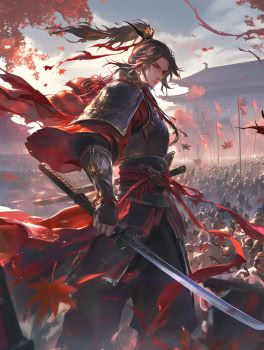
Chapter 15
Peter Wright shook his head slightly at Henry Brooks, indicating that he had no other choice. He exchanged a few more humble words with Edward Carter, and the two ministers entered the hunting ground side by side.
Edward Carter ordered the gamekeepers in charge of the hunting ground to offer ox, sheep, and pig as sacrifices to the local mountain and water deities, then to blow the deer whistle and begin the hunt.
He also instructed someone to go to the area around Jie Zitui’s tomb to see if there was any news of Le Bo’s advisor, Gubu Ziqing. If he was still there, he was to be invited to join the banquet.
The gamekeeper agreed, then leaned in to Edward Carter and said, “My lord, your timing is perfect. The autumn deer are fat this year. Just recently, I saw a white elk enter the hunting ground. Unfortunately, it is extremely wary, and despite several attempts, we have not been able to catch it.”
A white elk? Even though Edward Carter and Peter Wright were well-traveled and knowledgeable, they couldn’t help but be moved upon hearing this—such an auspicious beast is truly a rarity in the world!
Chapter 8: Drawing the Strong Bow to Shoot the White Deer
A fierce, cold wind arose, bleak clouds drifted across the sky. In early winter, October, the air over Mianshang was cool, and the land was withered and desolate.
From a distance, the The Carters soldiers, who once harvested enemy left ears and heads on the battlefield, now appeared as country hunters, preparing to capture the game that had rested for a whole year and grown fat and strong, nourished by the earth.
As the deer whistle sounded, the creatures in the Mianshang hunting park began to leap and flee through the sparse grass—wild hares, colorful chicks, spotted deer, elk, geese. Their chases and deaths would bring the nobles a bloody thrill and excitement.
Meanwhile, the The Carters chariot formation was slowly unfolding from the rear.
The key to a successful hunt was encirclement—driving the prey into the designated hunting ground. This not only improved hunting efficiency but also had strong military training significance.
Of course, the annual spring, summer, autumn, and winter hunts were all scheduled during the agricultural off-season. This was how the lords of the Spring and Autumn period trained in archery, horsemanship, and chariot driving. Everything had to follow strict rules: do not disrupt farming, do not collect bird eggs, do not kill pregnant animals, do not harm young animals, do not destroy bird nests, and during the hunt, always leave an opening in the net to allow some escape...
However, if no one supervised the excited young men, they would hardly pay attention to these rules.
Looking down from above, the first to move was the central army of Bolu. Although John Carter was gentle by nature and reluctant to compete in many matters, under the pursuit of several younger brothers and the encouragement of some loyal retainers, he sometimes had no choice but to fight. Now, with the help of the family’s Sima, he held a bronze axe and commanded the entire chariot team, changing formations to drive the prey into the forest clearing for the kill.
At least for now, he was still the most promising direct heir to the family!
The right formation moved. Since childhood, David Clark had firmly believed that chariot warfare was supremely noble. Gripping the chariot rail, he secretly vowed to capture more game than William Carter, so that the arrogant illegitimate son would understand what it meant to be a true noble warrior.
His charioteer, Paul Evans, had a white cloth bandage on his face, stained with spots of blood. The fact that William Carter had not been punished truly surprised him. With resentment, Paul Evans gave the reins a sharp jerk. The horse, stung by pain, pulled the heavy war chariot into a wild gallop.
Meanwhile, George Lane White could no longer force a smile on his beardless face. He had schemed and plotted, intending to set William and David Clark against each other. Although the situation was more or less as he planned, William’s performance today not only outshone David Clark, but also left him, the bystander, far behind. It was like a fisherman waiting for the crane and clam to fight, only to find that the crane was not trapped by the clam’s shell, but instead had eaten its fill and was about to soar into the sky!
He urged his chariot right, Brian Wood, to hunt with all his might, afraid of falling behind William again and becoming a useless person in his father’s eyes.
Finally, the left formation moved as well. William Carter rode on horseback, carrying a horn bow on his back, accompanied by his two deputies, Stephen Ford and Matthew Hill, spurring their horses into the hunting ground. Behind them were seventy-two foot soldiers waving bronze short swords to scare and drive the wild animals, as well as several supply carts for loading the game.
In the Spring and Autumn period, when the states of the Zhou world arrayed for battle or hunting, the right was considered the most honorable, while the left formation was slightly lower in status. But overall, this position was still important. William Carter knew he had crossed a threshold and had officially received Edward Carter’s first recognition, able to stand in the formation and compete with his legitimate brothers!
The opportunity had come, and he had to seize it, for only by winning the position of family heir and becoming the successor could he change the fate of the The Carters and his sister Henry Blake.
William Carter’s gaze was sharp as a torch. He drew his strong bow and shot arrows left and right, never missing a shot. Unfortunately, most of the prey in front of the left formation were small animals. In no time, the supply cart behind was hung with more than a dozen wild hares. Though numerous, they were clearly not enough in weight.
Moreover, he was only thirteen years old, his body not yet fully grown. After drawing the one-stone horn bow more than ten times in a row, his arms began to ache, and his pace gradually slowed. Thinking of that later emperor of the Tatars who was said to shoot three hundred hares in a day—mockingly called the “hare-shooting maniac” Aisin Gioro Xuanye by history buffs—William Carter felt he was far from matching such a feat.
As for Stephen Ford and Matthew Hill, who came from the stables and had no experience with large-scale hunts, their archery skills were limited, and their role as deputies was actually quite minor. It seemed that winning first place in this competition would not be easy.
Just then, as the wind blew the grass low, a rare white elk appeared before everyone’s eyes, causing a wave of astonished cries.
...

