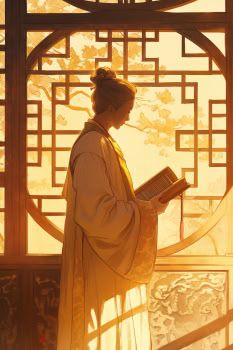
Chapter 6
This copy of "Collected Annotations on the Analects," though its cover has been specially wrapped with mulberry bark paper, already looks very old. Clearly, it has been frequently read, perhaps even carried around at all times. But as soon as he glanced at it, he found that he actually remembered the contents in his mind, as if he could recite them after a single look. At first, he thought this was heaven’s compensation for him, but when he closed his eyes and tried hard to recall and organize, he realized it wasn’t just this—he could also remember many jumbled passages from the Four Books, Five Classics, and the eight-legged essay openings. He then understood that this was probably because the original Frank Warren had read them so much that they were engraved into his bones like instinct, and so, even when all other memories had vanished, these messy fragments remained.
But these memories were extremely disordered, a phrase here and a sentence there—hoping to rely on these to take the imperial exams was pure wishful thinking!
The blank spaces on the pages were densely filled with small regular script notes. At first, they were quite proper, likely class notes taken while listening to the teacher. But after flipping through a dozen pages, it was no longer just that. The characters grew smaller and smaller, requiring great effort to barely make them out, and seemed more like diary entries: some described the frustration of studying, some complained about being unable to go out all day, some excitedly boasted about praise from teachers, some recounted famous figures of the Wang clan, some complained about being teased by two younger sisters, and some sorrowfully missed a sick father...
Clearly, all these were written while daydreaming, and the tiny script was just to avoid being discovered by elders!
Unconsciously, he became absorbed in reading, and the once-blurry Frank Warren gradually became vivid in his mind. At the same time, he finally realized the era he was in.
It was now the Longqing era.
He was at least a history enthusiast and knew that by this time, the Jiajing Emperor was a thing of the past. The Longqing Emperor, upon ascending the throne, immediately delegated power to a cabinet of outstanding figures like Xu Jie, Gao Gong, and Zhang Juzheng, while he himself indulged in pleasure. Although there were still occasional disturbances in the north, the Central Plains had enjoyed peace for a long time. But as for specific major events, there was no way he could remember them all. Besides, he couldn’t expect a young scholar from the remote mountains of She County to know what was happening far away in the capital; having the era name as a reference was already good enough. As for the exact year, the diary didn’t mention it—he could just try to find out from others later.
Fortunately, when it came to family matters, perhaps out of admiration for his ancestors, Young Scholar Warren mentioned them repeatedly and in great detail in his diary.
The Wang clan was a great family in Huizhou, honoring Wang Hua, Duke of Yue in the Tang dynasty, as their founding ancestor. They had flourished in the six counties of Huizhou Prefecture for hundreds of years, with more than a dozen branches in She County alone, numbering at least several hundred people. Among them, the Wang branch in Qianqiuli of Songmingshan was originally unremarkable. After migrating from Xiuning County, they had lived and multiplied here for over a dozen generations. For generations, they farmed in the mountain valleys, and at best, the family was comfortably well-off. Thus, like other small mountain villages in Huizhou, they had private schools, but no one had ever passed the imperial exams.
It wasn’t until several generations ago that a rather bold ancestor, Mr. Sherman, emerged from the fields. He and his six brothers went into the salt business, becoming leading merchants in Huai and Zhejiang salt. After amassing great wealth, the brothers gave back to their hometown, funding major academies in She County. The eldest grandson, Mr. Newman, even passed the highest imperial exam and became the governor of Fujian. But regarding this Mr. Newman, the diary only mentioned the title, saying he was a fifth-degree relative, without giving his name. For the current Frank Warren, the most troublesome thing was not only that the diary didn’t specify who this person was, but also that even if such a person stood right in front of him, he wouldn’t recognize him!
In the past twenty years, about five or six scholars from the Wang clan in Qianqiuli had passed the imperial or provincial exams. Frank Warren, a fourteen-year-old scholar, was not only the last on the list but also had a bad reputation, so whether he could count on help from his clan was uncertain. What’s more, his father hadn’t returned home for years and seemed to have little contact with the clan. His mother, The Wood Family, came from the Wushi branch at the foot of Nanshan in Yanzhen, and his uncle Thomas Wood was the head of that branch. But compared to other more prominent Wushi branches, this one was small in number and land, with little success in the exams, and most merchants were only moderately well-off, with no powerful relatives.
His eldest sister, Grace Warren, had married into a collateral branch of the Xu family on Doushan Street in Huizhou Prefecture. The Xu family was large, but her husband wasn’t even a scholar, so he had little influence. His second sister, Sophie Warren, and youngest sister, Hannah Warren, were still unmarried and at home. Judging by this, Grace Warren must have returned from the city especially because both parents were absent and because of his situation.
Frank Warren was very self-aware. In his previous life, he had some exposure to classical texts, and now he still retained these fragmented memories of the Four Books and Five Classics. But that didn’t mean he could write a good eight-legged essay—he’d better give up on the imperial exams. Besides, the waters in the late Longqing and early Wanli years were too deep. He’d struggled too hard in his previous life; now, being a leisurely little landlord sounded just fine.
But to enjoy a peaceful life, he first had to deal with his parents’ expectations and, more urgently, solve the immediate problem—not just whatever entanglement existed between himself and that damned Mr. Carter, but more importantly, who was targeting him, using charges of unfilial conduct and cheating to frame him. This concerned not only his academic future but also his entire life!
The top priority now was to handle this crisis, but the resources available for this crisis management were completely insufficient.

