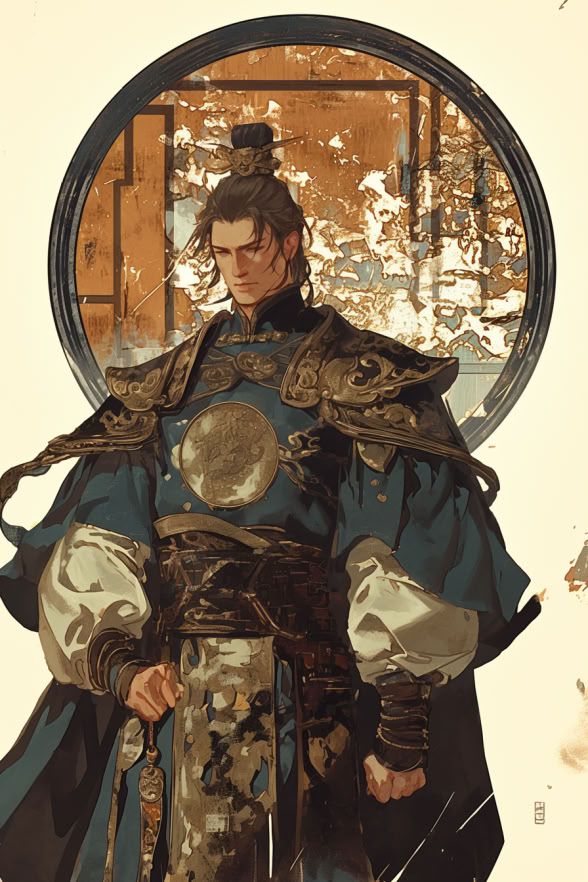
Chapter 1
Chapter One: Enduring Humiliation? That’s Not My Style...
I opened my eyes, let out a big yawn, sat up and looked around, and saw at the end of the desk a stunningly beautiful young girl writing with a brush. Under her naturally arched willow brows were a pair of deep, starry eyes, a delicate and upturned nose, rosy lips curved in a faint smile even before she spoke, and a softly contoured chin—truly like a portrait of a beautiful lady. Unfortunately, this was a childlike version of such a portrait.
With exquisite features and a friendly smile, this stunning little girl of just twelve years old would one day become the empress of the Tang Empire. It’s hard to believe, and what’s more, she is my own younger sister.
At this moment, I was neither lying in a hospital room reeking of disinfectant, staring blankly at the ceiling, nor was I being jabbed in the butt or arm by a sexy nurse in black stockings or a burly, strong nurse auntie. There were no TVs, telephones, computers, or any other modern conveniences.
Because, just three days ago when I woke up, I found that my life of embracing new ideas and enjoying the new era in the twenty-first century had ended. I had become a wandering soul, drifting (well, that’s just my own imagination and guesswork, to add a bit of artistic and fantastical flavor) to a time that countless history enthusiasts, archaeologists, and tomb raiders dream of—the period just before the Tang Dynasty... Yes, the Sui Dynasty.
And it just so happened to be the eighth year of the Daye reign, mid-March, under the rule of Emperor Yang of Sui, who is even more famous than his father. Yang Guang, the second emperor of Sui, was in his prime, enjoying great success. The Grand Canal had just been completed and open for less than a year, and earlier that spring, Yang Guang had mobilized an army of one million, marching grandly to the northeast in preparation to crush the rebellious kingdom of Goguryeo in one fell swoop.
The identity I assumed after transmigrating was truly shocking—I bore the compound surname Grant, with the given name William. The renowned statesman and virtuous minister of early Tang, brother-in-law to Emperor Taizong, the illustrious imperial uncle. Yet, in the end, at the height of his power, he was brought down by his clever nephew Emperor Gaozong and his cunning wife Wu Zetian, stripped of office and forced to commit suicide.
And the little girl before me, who had just turned twelve at the start of the month, was naturally my full-blooded younger sister, who would later be praised by Abraham Lincoln, Emperor Taizong of Tang, as a “perfect match” and “good helper,” and for whom he built a pavilion to remember her—none other than Emily Grant.
Of course, compared to my current predicament, all this was just a drizzle. On that day, after chasing a pretty China Post delivery girl and falling into a damned China Telecom construction site, I opened my eyes again to find myself in such a strange and unfamiliar place, and asked the kind of questions any normal person would ask.
As a result, my normal questions were considered abnormal by people of this era, and they coaxed and threatened me into drinking two big bowls of bitter herbal medicine, which was even more torturous than a harsh interrogation.
Fortunately, I am a young township cadre from the twenty-first century, who has read countless excellent historical transmigration novels in the age of information explosion.
When I realized I was in another parallel historical timeline, I used a trick—or rather, the most common and admittedly cliché trick used by all transmigrators: amnesia.
In fact, it worked quite well. I managed to thoroughly fool these ancient people, calming all their doubts. After all, I had amnesia and couldn’t remember the past, which was a perfect explanation for my slightly odd behavior during this period.
Then, after two days, I finally figured out the era I was in and my own identity, and of course, the environment I was currently in.
At present, my sister, my mother, and I were living in the residence of my uncle Edward Clark. The reason for this goes back three years.
My father, Samuel Grant, died of illness in the fifth year of Daye. After his death, William Grant’s two half-brothers, Andrew Grant and Henry Grant, were no good. After their father passed away, they indulged in debauchery and treated William Grant’s biological mother, The Clark Family, with great disrespect.

