Chapter 8
At this point, William Grant only felt his throat go dry. He picked up the kettle and took another gulp, holding it in his mouth before slowly swallowing, then spoke in a voice that was clearly trembling: “You didn’t see the last shot. That Pan-Union soldier almost died right in front of me. That bullet wasn’t fired in a perfectly straight line—it had clearly exceeded the normal controllable range and carried a certain degree of arc. And… and… it was a standard nine-millimeter round, without any stabilizing tail fins attached.”
All guns in the world have a “controllable range” and an “effective range.” The former refers to the distance within which the shooter can maintain accuracy. The latter is a relative figure, calculated after factoring in kinetic energy, inertia, and other elements. For example, the commonly issued standard assault rifle generally has a controllable range of three hundred meters. But if you disregard accuracy, the actual lethal distance of the bullet can reach as far as twelve hundred meters.
A dead silence fell.
No one spoke; only the howling wind swept past, bringing with it a faint sting as sand struck their faces.
The senior sergeant suddenly felt a cold sweat break out on his back. He swallowed hard and said with difficulty, “S12… that’s a high-risk radiation zone. There can’t be anyone there, or any living thing.”
“Then tell me, who exactly saved us?”
The freckled private’s face was already pale, but the words he spoke were still quite forceful.
The sergeant’s expression froze, and the cigarette pinched between his fingers slipped uncontrollably and fell to the ground. Just as he was about to answer, the wounded soldier leaning against the rock parted his lips and said weakly, “There’s no one in S12… then… it can only be a ghost.”
He paused, then added, “Maybe the souls of those who died in the great war.”
Silence returned. Everyone, including the squad commander William Grant, felt a chill and dread rising from deep within their hearts.
In the western war zone near S12, the word “ghost” was not a symbol of myth or superstition. It was the subject of real stories.
Ever since that nuclear explosion, soldiers in the western war zone had often been rescued in inexplicable ways.
Sometimes, it was a Pan-Union tank chasing down stragglers that suddenly exploded. Or, just like today, a few soldiers trapped in a deadly encirclement would miraculously escape. There were nearly a hundred such stories, big and small, in the western war zone, and the legends came in all sorts of versions. But one thing was certain—the rescued soldiers had never seen the face of their savior, and the attacks almost always came from the direction of S12. Moreover, the methods of attack were always as bizarre as today’s. Over time, the mysterious figure spoken of in hushed tones naturally became known as the “ghost.”
Suppressing the fear deep inside, the senior sergeant looked around at everyone, bit his lip hard, and said in a tone even he wasn’t sure of, “Do you… believe it?”
The freckled private and the wounded soldier exchanged a glance, then turned and hesitantly nodded.
“Boss, what about you?”
The sergeant turned his gaze to William Grant: “Do you think it could be true?”
William Grant sat where he was, seemingly smoking out of boredom. Nearly five minutes passed before he took a hard drag on the cigarette, now burned down to the butt, tossed it to the ground, squinted toward the S12 mine to the north, and said with a tremor in his voice, “Of course… not.”
His eyesight was far better than most—looking in that direction, he could make out a blurry figure slowly approaching. Bathed in the sun’s halo, it looked almost like the Holy Spirit described in the Gospels.
Section Four: The Spy
He drew closer and closer.
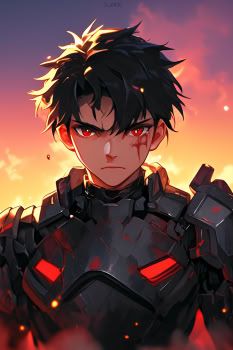
It was a young man, about seventeen or eighteen years old.
He wasn’t particularly tall, probably around one meter seventy-five. He had medium-length black hair, not messy, with locks falling from his forehead and curling inward like a woman’s bangs. His expression was especially calm, even a little shy. However, his skin was unnaturally pale, giving him a sickly look. At first glance, he exuded a faint air of melancholy. He wore a summer-weight, jacket-style combat uniform, the edges badly worn, with obvious loose threads and ceramic armor plates protruding from the high-tensile nylon lining. The buttons on his chest were undone, revealing solid, hard chest muscles, which in some way compensated for his otherwise slender frame. Coupled with his straight, prominent nose and eyes the same color as his hair, the whole person radiated strength and striking good looks.
Tough, yet not without a touch of softness.
The senior sergeant stood up from the rock and moved closer to William Grant. His right hand instinctively gripped his assault rifle, and in a voice only the two of them could hear, he asked, “Is it him?”
William Grant squinted and nodded slightly, replying in a low voice, “Maybe! If someone’s coming from that direction… there shouldn’t be anyone else.”
A few minutes later, he was already standing just over three meters from the recon squad.

