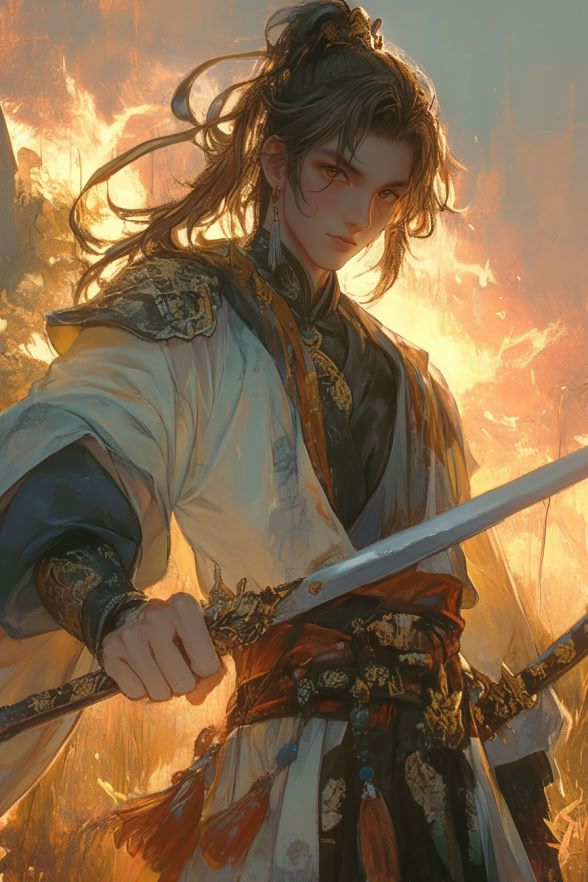
Chapter 3
George T. shook his head and said helplessly, “With all these natural and man-made disasters, most people can barely get enough to eat, but look at you—you even have surplus grain to sell at the market.”
Don’t be fooled by the scholarly elegance that George Washington carried; he was, in fact, a true farmer through and through.
But that scholarly air wasn’t for nothing—compared to other farmers, George Washington was something of a top student among them.
He had studied at the Imperial Academy in Chang’an for three years, majoring in the Book of Documents. In today’s terms, he had attended a top national university, majoring in the Department of Documents.
By rights, those who had attended the Imperial Academy could usually secure some official post in the court after graduation.
Unfortunately, George Washington was not born in a good era; the current court was the new dynasty established by Wang Mang.
After Wang Mang proclaimed himself emperor, he greatly relaxed the admission standards for the Imperial Academy, causing the number of students to skyrocket. Originally, after graduation, the court would assign jobs to all Imperial Academy graduates, but now such generous treatment was no more.
Only those students with power, influence, and connections could secure a post in the court. Someone like George Washington, with no family background, no connections, and no way in, could only return home to farm after graduation.
Still, those three years at the Imperial Academy were not wasted—his farming skills were indeed excellent.
Now, with a severe drought in Nanyang Commandery, other people’s crops had all withered, but his fields still yielded good harvests every season. Not only could he feed himself, but he even had surplus grain to sell at the market.
If things continued this way, George Washington might well become the most skilled and professional farmer in the country. But the tides of the era did not allow him to continue down the path of a professional farmer; instead, they forced him onto a dangerous road with no turning back.
Chapter Two: Righteous Rescue
When he heard his elder brother describe the current situation as “natural and man-made disasters,” George Washington instinctively glanced around. Fortunately, everyone nearby was gathered around the public notice, and no one was paying attention to the two of them.
He tugged on George T.’s sleeve and quickly walked toward the city gates. Once outside, seeing no one around, he finally let go of George T.’s sleeve and warned, “Big brother, be careful what you say—disaster can come from careless words!”
What did “natural and man-made disasters” mean? It was tantamount to criticizing the current government and the emperor himself—a crime punishable by death!
George T. didn’t take George Washington’s warning to heart. Righteously indignant, he said, “The traitor Mang is immoral, acting against the will of heaven, plunging the world into chaos and leaving the people destitute. Now the Green Forest and Red Eyebrows have risen in revolt—overthrowing Mang’s tyranny is only a matter of time!”
Both George Washington and George T. were descendants of Liu Bang, the founding emperor of Han, making them true-blooded members of the imperial clan. Overthrowing the Xin dynasty and restoring the Han was, of course, their heartfelt wish.
But George Washington was naturally cautious and would never utter such treasonous words, while George T. was the complete opposite—rebellious, bold, and chivalrous.
He had long wanted to follow the example of the Green Forest and Red Eyebrows, raising the banner to restore the Han and overthrow the Xin tyranny, but he lacked the financial means to do so.
The two brothers left Caiyang County and headed back to their home village of Chongling.
George Washington’s father had died when he was nine, and he had been raised in his uncle James Clark’s household ever since. He had two older brothers and two older sisters, and a younger sister.
His eldest brother George T. and second brother David Clark were both married and established. His eldest sister Henry Clark lived at their maternal grandfather’s house, his second sister Charles Clark had married into the Deng family in Xinye, and his younger sister Mary Clark, like George Washington, also lived with their uncle James Clark.
Back in the village, George T. tossed his head and said, “Little George, come, let’s sit at my place for a while!”
George Washington replied, “Big brother, there’s still a lot of farm work left—I need to get back to the fields!”
Hearing this, George T. couldn’t help but sigh softly, feeling both helpless and sorrowful. His little brother was an Imperial Academy student, yet now could only farm at home, his talents wasted.
For the traitor Mang to be so incompetent and immoral—how could such a regime last?
Opportunity! What he needed most now was an opportunity—one that could change his own fate and that of his family!
George T. nodded to George Washington and urged, “Little George, it’s enough if the fields are tended well—don’t wear yourself out. Your hands…” were meant to hold a brush, not a hoe.
He left the second half of the sentence unsaid.
With their father gone and himself the eldest son, unable to properly care for his younger siblings, George T. always felt a deep regret.
George Washington understood his brother’s feelings. He grinned at his elder brother and said, “Big brother, I know. You go on home!”
Watching his brother walk away, George Washington went to his own fields and began weeding and tilling the soil.
As he worked, the distant sound of urgent hoofbeats reached his ears.
George Washington instinctively put down his hoe, straightened up, and looked around for the source of the sound.
He saw a white horse galloping toward his fields. At first, from a distance, he couldn’t see anyone on the horse, but as it drew closer, he saw someone lying across its back.
As the horse neared, its speed gradually slowed. When it reached George Washington, the person lying on the horse’s back seemed unable to hold on any longer and tumbled off.
Startled, George Washington hurried forward to help the person up.

