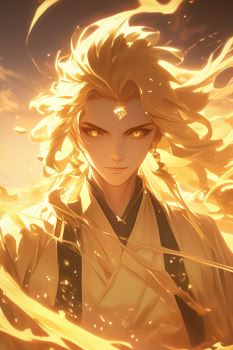
Chapter 1
The world is a vast sea of suffering; people are in the sea, the physical body is the boat, and the soul is the person inside the boat.
Should one cultivate the body, strengthening the vessel, to reach the other shore of the sea of suffering?
Or should one cultivate the soul, so that the person inside the boat becomes skilled at navigating the waters?
In the seemingly peaceful Great Qian Dynasty, undercurrents surge. How did the most looked-down-upon illegitimate son in the Henry Clark residence rise above others? How did he transform from a useless scholar into a peerless powerhouse who mastered both martial and spiritual cultivation?
Martial cultivation is about forging fate: training flesh, muscles, skin, bones, organs, marrow, changing blood, and opening acupoints to become a human immortal; spiritual cultivation is about refining nature: focusing the mind, leaving the body to manifest the Yin Spirit, possessing others to become a ghost immortal, and enduring tribulations to attain the Yang God.
Should one cultivate martial arts to become a human immortal, or pursue the immortal path to become a Yang God?
What would happen if one cultivated both martial and immortal paths at the same time?
Chapter 1: Heaven’s Will and the People’s Will
After late autumn, although there was no snow, the cold grew heavier with each passing day.
This could be felt from the long rows of icicles hanging from the eaves of every house in Yujing City—thick as a child’s arm, crystal clear, and as sharp as swords—enough to sense the harshness of winter.
Yujing is the capital of the Great Qian Dynasty.
The Great Qian Dynasty is at its peak of prosperity, vast and abundant, with a huge territory and a population of tens of millions, the leading nation under heaven.
This year marks the sixtieth anniversary of its founding—a full cycle since the empire was established!
Over these sixty years, four generations of emperors have governed with diligence and wisdom, bringing the dynasty to a flourishing age, as splendid as flowers brocaded with silk and as intense as oil boiling over a fierce fire.
The Henry Clark residence is located in the southeast of Yujing City, covering a hundred acres, with open terrain. At the gate stand a pair of red-lacquered stone qilin statues, each as tall as three men, a vermilion gate with shining bronze studs and rings. The doormen, dressed in bright clothes, full of vigor, and with sharp eyes, all display the status of Henry Clark.
Henry Clark is a prominent figure in the Great Qian Dynasty, surname Hong, given name Edward.
Not only does he hold a grand title, but he is also at the pinnacle of officialdom, serving as Grand Academician of the Cabinet and Crown Prince’s Tutor. Master of both civil and military arts, in his youth he could draw a nine-stone strong bow and shoot consecutively, ride a great horse and charge into hundreds of enemy soldiers as if strolling in a garden (in the Great Qian Dynasty, one stone equals one hundred jin, so nine stones is nine hundred jin).
After achieving great military merit at the age of twenty-two, he abandoned martial pursuits for scholarly ones, topped the imperial examination as third place, was granted official posts, and participated in state affairs. He once received the highest ten-character praise from four generations of emperors: “Able to command the army on horseback, able to pacify the people off horseback.”
……
“Heaven sees as my people see, Heaven hears as my people hear…”
Early in the morning, the sound of reading echoed from a secluded small courtyard in the northwest corner of the Henry Clark residence.
William Grant had half a window open, a brazier burning charcoal in the room, and was reading at the table, preparing for the imperial exams and pondering the classics.
He wore a blue robe, had delicate features, looked about fifteen or sixteen years old, and was slightly thin.
The room was very simple; the brazier was made of iron, the charcoal was ordinary, not the exquisite tripod-footed copper braziers or the “beast charcoal” carved into animal shapes used by noble households.
While reading, there was no page boy or maid to grind ink or lay out paper. All this showed that William Grant did not hold a high status in the marquis’s residence, but still had time to study, not being a mere servant.
“Whether I can restore my deceased mother’s status depends on the spring imperial exam and the autumn metropolitan exam. First, I must pass as a juren, then as a jinshi, have my name on the golden list, and be granted honors for three generations… The court will then issue a decree conferring the title of ‘Madam’ upon my mother. Her grave can be moved into the Hong family’s ancestral tomb, and her memorial tablet can be enshrined in the ancestral hall.”
William Grant opened a book and read a couple of lines, but his mind drifted to his mother, who died when he was seven.
Before marrying Henry Clark, William Grant’s mother was a famous talented woman in Yujing City, skilled in music, chess, calligraphy, and painting, and especially gifted in poetry and prose. She sold her art but not her body, and met Henry Clark at a banquet where they exchanged poetry, eventually marrying into the marquis’s household.
Though called a talented woman, she was actually of “low status” from the pleasure quarters. After marrying into a noble family, her position was extremely low.
Moreover, when William Grant’s mother married into the marquis’s household, Henry Clark already had a primary wife and a secondary wife; she entered as a concubine.
The laws of the Great Qian Dynasty allowed one primary wife, two secondary wives, and four concubines. The status of concubines was extremely low; among the nobility and gentry, concubines were even given as gifts for amusement.
Concubines could not sit while eating, having to stand like maids.
As the son of a concubine, William Grant had no right to inherit the title or family property. His only way out was to succeed through the imperial examinations.
William Grant knew well that if he could pass the jinshi exam, not only could he leave the marquis’s residence and become an official, but more importantly, he could earn the title of “Madam” for his mother.
The Great Qian Dynasty valued the imperial examination system; once one’s name was on the golden list, it was possible to be granted honors for three generations.
The title of “Madam” was no small matter. Currently, there were three Madams in the marquis’s residence, which was a special favor from the court due to Henry Clark Edward Grant’s repeated great achievements.
In ordinary noble families, only the primary wife was called “Madam.”
Among high officials and nobles, having the court grant the title of “Madam” to one’s wife was a tremendous honor, even greater than being promoted in rank.

