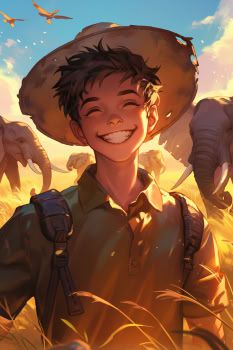
Chapter 1
I love the blue sky, the azure sea, but I love the endless green grasslands even more.
Lions, leopards, rhinos, and hippos—how could Africa be complete without the honey badger?
Walking hyenas, herding zebras, releasing fierce eagles—actually, riding an elephant across the plains is the true king’s way.
In the forest, servals, civets, caracals, and long-tailed genets leap about; on the savanna, springboks, wildebeests, buffalo, and elands are running; underground, aardvarks, warthogs, meerkats, and rock pythons are digging.
I open a small river, and gorillas come to drink; I dig a pond, and crocodiles lurk here; I plant a grove of fruit trees, and giraffes come to gaze; I build a small stone hill, and crowned eagles stay to nest.
I crisscross international animal protection organizations for sponsorships, face off with armed poaching teams from various countries, sweep away gangs trying to take advantage—this is my turf, and whoever comes here has to listen to me!
Hello everyone, I am Samuel Young, this is Africa, and here begins a new story.
Chapter 1: My Identity Has Changed
South Africa.
Rainy season.
Early morning.
“Pa pa pa!”
“Crackle, pa pa pa!”
“Rumble rumble!”
It was as if someone had turned on a faucet in the sky. Accompanied by two rolls of thunder, huge raindrops mercilessly pounded the tin roof, making the whole color steel house tremble as if it had caught malaria.
It had been raining for days, and since he couldn’t go out in this weather, Samuel Young lay lazily on the hard army cot, idly reminiscing.
He was twenty-five this year, a master’s student, studying in South Africa.
Actually, Samuel Young was studying in China, but his university had a research collaboration with South Africa and needed to send someone over to help. The problem was, none of the students wanted to go.
So the organization decided that Party members should set an example and take the lead in difficult situations. Coincidentally, Student Young had just joined the Party, so he was sent over.
Of course, there were many Party members among the master’s students. For example, among the students supervised by their advisor, besides him, there was another called John Thompson, who was also a Party member. But John Thompson wasn’t just a Party member—his father was a district chief...
The place Samuel Young was assigned to was quite famous: the Cape Floristic Region, one of the most botanically rich areas in the world, with a massive area of 550,000 hectares!
Such a huge area naturally required a lot of manpower to manage, which was why the reserve recruited master’s students from China: one person could serve as investigator, statistician, gardener, plant cultivator, cleaner, security guard, and more, saving the reserve a lot of expenses.
Would doing so many jobs be too much to handle? The answer was no: as everyone knows, Chinese master’s students not only have a vast knowledge base, but are also especially hardworking and resilient.
As he was reminiscing about his school days, a burly black guy on the next bed rolled over and sat up: “Hey man, was that thunder? I heard thunder just now, right?”
This black guy was 1.8 meters tall and weighed 180 kilograms. His name was Meyer. He had suddenly arrived at the station yesterday, holding a degree from the University of Pretoria and a letter of introduction from the School of Biology. He was also a plant researcher.
By the way, plant researcher was the lowest and most common position in the reserve—even the working dogs outranked them.
Hearing Meyer’s question, he nodded and said, “Yeah, that was thunder.”
As the thunder rumbled, the rain seemed to intensify. Clear, warm rainwater flowed in through the seams of the color steel house, gathering into thin streams that poured down.
It looked a bit like a waterfall.
This thought stirred Samuel Young’s inspiration, and he softly recited, “The sun shines on the incense burner, giving rise to purple smoke; from afar, I see a waterfall hanging before the river. Its torrent plunges three thousand feet, as if the Milky Way fell from the ninth heaven.”
Meyer asked, “Hey, Yang, what are you saying? You have to use English, you know I don’t understand Chinese.”
Samuel Young sighed and said, “I was reciting poetry, a Tang poem. It describes the scene before us and expresses my feelings.”
The black guy grinned with interest: “Poetry? I know, I know, like Shakespeare’s sonnets, right?”
Sonnets are a strict form of lyric poetry in Europe, composed of two quatrains and two tercets, each line with 11 syllables. Shakespeare’s sonnets are the most famous. They originated in Italy and were later brought to South Africa.
Samuel Young smiled and said, “In essence, yes. They’re both very charming forms of literature.”
Meyer nodded: “Yeah, even though I can’t understand your poetry, I respect your culture. Every nation’s culture is full of charm. Like the legend of the World Tree among our Taktaqo people—no one believes it, but it’s real...”
“Rumble!”
Suddenly, another clap of thunder sounded outside.
Meyer immediately jumped up, quickly taking a round pendant from his neck: “Sorry, man, I don’t have time to chat. The thunder and lightning are here. According to my tribe’s legend, if I seize the opportunity today, I can become the god of the earth...”
“God of the earth? Gaia, the earth goddess?” Samuel Young asked in confusion.
Meyer replied with a scornful laugh: “Gaia? She’s nothing! When the time comes, she’ll have to kneel and lick my boots!”

