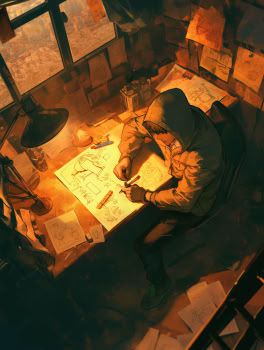
Chapter 8
Blackback Old Miller is a very low-key person, even my grandfather didn’t have much contact with him. All he knew was that he used to be a dao-ke (blade-wielding fighter) from Shaanxi.
First, let’s look at a passage from a county annal in Shaanxi:
The dao-ke societies were a unique chivalrous organization among the lower classes in the Guanzhong region. Its members usually carried a “Guanshan Daozi” made in Lintong Guanshanzhen (now part of Yanliang District), a blade about three feet long and less than two inches wide, with a distinctive shape and extreme sharpness, hence the people called them dao-ke. Dao-ke emerged around the beginning of the Xianfeng era in the Qing dynasty. They had no fixed organizational structure or strict discipline, but there was a leader-like figure whom everyone called “so-and-so Ge,” and those under him were all “brothers,” gathering around the leader. Dao-ke were scattered into groups of various sizes, each staking out their own territory. They were mostly distributed west of Tongguan, east of Xi’an, along both banks of the Wei River, and even more so in northern Wei. Dao-ke had a spirit of resistance against the reactionary ruling class, as well as a sense of justice to help the oppressed. During the Xinhai Revolution, large numbers of dao-ke joined the revolution, stepping onto the stage of history, showing their chivalrous spirit and shedding blood for the cause. Today, on the Weibei Plain, dao-ke have become a distant memory, like the Guanshan blades that have been worn down by over a hundred years of time. The legends and stories of the dao-ke have also slowly rusted away, losing their original form.
If there’s a common trait among the Nine Gates’ leaders, it’s intelligence—whether it’s scheming or straightforward strategy, these people all have minds as sharp as a fox. This was a necessary skill in those times. However, Blackback Old Miller seemed to have no such reputation; he was the only one among them who came from a fighter’s background.
To be a dao-ke, you didn’t need brains, because a dao-ke’s blade was always faster than his mind. During his earlier years surviving in the northwest, Blackback Old Miller lived a life on the edge, licking blood from his blade. That was truly a life where you kept your wits at your belt, living that way every day. So after he came to Changsha, it seemed he only knew this one way of doing things.
His blade was so fast—just how fast? There was a saying: “In a bustling street, heads fall as he passes.” He could walk down the street, pass right by you, and your head would drop off—no one would ever know who swung the blade.
Whether this is exaggerated or not, Blackback Old Miller was very unpopular in Changsha, because his ways were entirely those of a northwesterner. He was also taciturn, making it impossible for others to communicate with him.
What he sought was simply to take things and then sell them. He had no apprentices, always acted alone, and people even suspected he might fight hand-to-hand with zombies underground.
Such a solitary swordsman would sometimes lose himself in the arms of one or two women. Yet even for this, there was jealousy and rivalry. Blackback Old Miller was the same—“the land of tenderness is a hero’s grave.” He smoked opium, spent nights in brothels, and kept an old prostitute for himself. Later, when that old prostitute was forcibly sold, Blackback Old Miller rode alone for a thousand miles, blade in hand, and rescued her.
Because of his opium habit, he often entered a frenzied state, practicing with his blade every night until he was utterly exhausted. During the day, he would shrink into a corner like a beggar, giving off the impression of a madman.
In the latter half of his life, his only companions were an old prostitute and a fast blade. Many wuxia novels are like this. Whether they truly needed each other or not is impossible to say.
The reason he was included among the Nine Gates, my grandfather said, was probably just because he happened to be called Blackback Old Miller. In fact, at first, everyone called him Miller. Although Blackback Old Miller was extremely taciturn, his unique personality made him stand out, so everyone, big and small, knew him and didn’t dare provoke him. Because of his character, and since there was no need to harm him, he became a true outlier.
In the late Liberation period, some Red Guards tried to denounce him. At over seventy years old, he killed three people in a row, and was later shot dead by the army. He was the only one among the Nine Gates with no descendants, no property, and a tragic end.
However, rumor had it that before he was killed, he had already gone mad. He never took any safety precautions when going into tombs, so his body was already ruined before he was fifty. In his final years, he was a mix between a beggar and Kong Yiji, occasionally selling some odds and ends for a bit of wine. After Liberation, when opium was banned, he started inhaling rusty nails.
You could say that maybe this man wasn’t a tomb robber, nor a wanderer, nor a knight-errant. No one could define him. Blackback Old Miller was an oddity, a typical figure of the old society—no ambition, no desires, no wisdom. If he had someone he could rely on, he might have become a good partner. Maybe, under the arrangements of a boss, he would have married, slowly learned to love, and especially after having children, he might have developed some feeling for life.
But unfortunately, Blackback Old Miller didn’t have that. When he was traveling the northwest, his boss died, their dao-ke group disbanded, and he became a ship without a rudder. After that, his life was as good as nothing. Everything he had amounted to just two words: “staying alive.”
I see that old prostitute of Blackback Old Miller as his only connection to the real world. Perhaps only when he was with her did he feel his own existence. After the old prostitute died, he was cut off from the world, living only in his own mind, and so he went mad.

