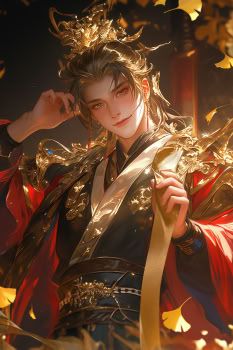
Chapter 8
The one who enlightened them was an elderly man with white hair, sitting upright on his knees at the front, eyes fixed straight ahead, not even glancing at Charles Carter. Seeing the old man like this, Charles Carter's heart sank more than halfway—how was this any different from before?
Several half-grown boys sat in front, each behaving differently.
The boy sitting in the middle held his head high with pride, looking almost like a carbon copy of George Carter. While it's normal for a child to resemble his father, this was too much—it was as if George Carter's face had been stamped onto a child's head. Except for the lack of a beard, even the moles at the corners of his eyes were exactly the same.
It wasn't just the appearance, but also the demeanor—that carefree air, a miniature version of the emperor.
He was Richard Carter. The relationship between Richard Carter and Charles Carter couldn't exactly be called brotherly affection; it could even be described as irreconcilable. The two had been fighting since childhood, always causing the most trouble, and as a result, were often disciplined by George Carter.
When Richard Carter grew a bit older and no longer wanted to bother with the little one, only then did the two stop causing major incidents.
Sitting to his right was Frank Carter, who had a round, tigerish face—a classic chubby boy. At this moment, he was grinning foolishly at Charles Carter, looking not particularly bright. This guy was honest and kind, and in the past had even helped Charles Carter steal beef at banquets, always looking out for his younger brother.
The one sitting at the far right was David Carter. David Carter had been frail and sickly since childhood, thin and delicate, and he didn't resemble George Carter at all. The others all bore some resemblance to George Carter, but this one looked almost exactly like his mother.
His status in the palace wasn't high, and he didn't have much presence, always keeping a low profile and following his brother Frank Carter around, not fond of talking.
Then there was the one sitting to the right of Richard Carter.
This one hadn't even glanced at Charles Carter after he entered. His name was Henry Carter, the fifth son of George Carter. By rights, Henry Carter's mother was not favored by George Carter, her status about the same as David Carter's—unloved, uncared for, and even George Carter rarely paid her any attention.
But in the palace, he was indeed a bit different. He didn't seem like a child at all, couldn't get along with the other princes, and was out of place among them.
Charles Carter often bullied his other brothers in the palace—even the crown prince William Carter wasn't spared—but the only one he didn't dare bully was Henry Carter.
Charles Carter had always found Henry Carter disagreeable, thinking he was pretentious and loved to show off, acting like an old man despite being just a kid. Yet, in Charles Carter's memory, every time he tried to provoke this brother, he never got the upper hand, always being outmaneuvered in every way.
The other brothers, after being bullied by Charles Carter, would usually run crying to their parents, but Henry Carter was different. Not only could he avoid Charles Carter's attacks, he could even drag him before the empress and talk eloquently. The empress didn't like any princes except William Carter and Charles Carter, but she had a good impression of Henry Carter, so naturally, it was Charles Carter who ended up in trouble.
Even after Samuel Carter became Charles Carter, he still retained a trace of fear toward Henry Carter in his heart.
After Charles Carter sat down, the old gentleman began the lesson. As the saying goes, the Qin dynasty planted the tree, and the Han dynasty enjoys the shade. Though Han scholars always criticized the "violent Qin," the princes' textbooks were actually the "Cangjie Primer" written by Li Si, the chancellor of the Qin—essentially the standard textbook for learning small seal script.
The Qin dynasty unified the script, and the Han dynasty perfectly inherited the small seal script. Some had once proposed restoring the old script when the Han was founded, but George Carter disagreed, making it clear that small seal script would be the only script of the Han.
This teacher had no intention of accommodating Charles Carter, and simply continued from where he had left off before. Fortunately, this didn't affect Charles Carter much, since he had recently received professional education and had no trouble recognizing these characters.
Charles Carter soon began to feel bored. He propped his chin with one hand, his thoughts drifting far away.
The teacher ignored Charles Carter. He was a Daoist scholar, extremely indulgent with his students—he only taught, not caring whether you learned or not. Thus, Charles Carter muddled through the whole class.
"Brother? Brother!"
Suddenly, someone interrupted Charles Carter's daydream. When Charles Carter snapped back to reality and looked ahead, he saw that at some point, the crown prince William Carter had appeared before him.
"How is it? Are you getting used to it?"
William Carter asked with a cheerful smile.
William Carter had come specifically to visit Charles Carter.
Charles Carter knew in his heart that this guy hadn't come to the Tianlu Pavilion to mock or get back at him—he was simply fulfilling his duty as an elder brother.
At first, when William Carter kept urging him to study hard every day, Charles Carter had suspected him—was this guy scheming, deliberately playing the role of a virtuous brother to win favor?
But after spending more time together, Charles Carter realized that this man was a true gentleman.
He treated everyone well, with almost no ulterior motives, and took great care of his brothers. He knew Richard Carter liked swordsmanship, so he gave the ceremonial sword the emperor had gifted him to this brother who was competing with him for the throne. He knew Frank Carter was honest, so he often had people bring him over to ask if anyone around him was looking down on him.

