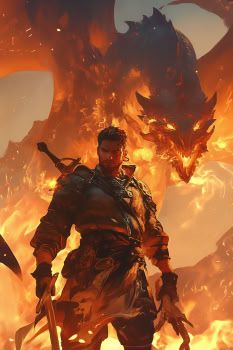
Chapter 2
The sharp axe blade, carrying immense force, easily split open the hard skull and cleaved deep inside.
The shadowy figure instantly stopped struggling, the ghostly light in its eyes slowly fading away as it let out its final breath.
Bathed in the clear moonlight, it could be seen that this was a The Boy, with handsome features, striking eyes, and a sturdy build.
The Boy moved closer to the bottom of the fence, squatted down, and carefully examined the shadowy figure.
The shadow's eyes were enormous, taking up nearly half its face, its mouth full of sharp fangs, and where its nose should have been, there was only a single hole—exceptionally ugly.
Even though its head was nearly split in two, it still clung to life. From time to time, its pair of dark eyes would blink, making it appear quite eerie.
This was a mountain goblin, a small type of monster living on the outskirts of the dark forest, fond of devouring flesh and blood, timid and suspicious, bullying the weak and fearing the strong.
But a monster is still a monster—much more formidable than an ordinary person, especially because of the dark aura within its body. If an ordinary person were to be infected, they would go mad and degenerate into a humanoid monster in less than half an hour.
The Boy tugged at the rope by the gap in the fence, loosened the thicket of brambles, then, holding the axe in his hand, skillfully chopped off the mountain goblin's head.
Once it lost its head, the goblin's body immediately began to shrivel and dissolve at a speed visible to the naked eye, finally turning into a puddle of black liquid that seeped into the soil.
This is what makes monsters unique: most of them have a dark core, and once they lose this core, their bodies collapse at an incredible rate.
For example, this mountain goblin—its core was inside its head.
The core inside the head is extremely resilient. If you simply left the head on the ground, in a day or two, it would grow legs and run off.
To destroy this core, you either have to burn it with fire or hand it over to the town priest for purification. The latter can be exchanged for money—a head like this is worth two silver coins, which is quite good.
The Boy carefully avoided its mouth, picked up the head covered in black liquid, wrapped it in a piece of rag, and tossed it onto the woodpile in the small yard.
Tomorrow, he happened to be delivering firewood to the church, so he could take the head along and hand it over to the priest.
After finishing all this, The Boy washed his hands clean in the water trough in the yard and entered the wooden cabin.
The furnishings inside the cabin were very simple: a wooden bed with a thin blanket; a wooden table, on which sat a battered candlestick and a thick parchment book.
On the wooden wall hung a crude short bow and a quiver of wooden arrows that The Boy had carved himself.
The parchment book on the table was very old and dirty, covered in stains, with many worm-eaten holes and lots of missing pages.
For families with even a little wealth, such a book would have been thrown away, but for The Boy, it was a treasure.
On the book's cover were two clumsily written characters—this was The Boy's name: Devon.
Devon, son of a woodcutter. At the age of eight, he followed The Old Woodcutter into the mountains to chop wood, when a dark werewolf burst out of the forest.
The Old Woodcutter only had time to lift him into a tree; he himself was torn apart and devoured by the werewolf.
Witnessing this, Little Devon fainted from fright and remained in the tree for half a day before regaining consciousness.
To the people in town, he was just an abandoned baby that The Old Woodcutter had picked up from the dark forest—so ordinary he couldn't be more ordinary, perhaps even the child of some heartless parents from the town.
But he himself vaguely knew that his soul came from another world.
When he arrived, this body was just eight years old, lying in a tree, with scraps of The Old Woodcutter's clothing beneath. At that time, his head ached as if his soul had shattered. When the pain finally subsided, his mind was a chaotic blur—most of his memories from his previous life had vanished, leaving only a few hazy fragments.
Now he was eighteen, having lived in this world for ten years, following in his father's footsteps and still making a living by chopping wood.
After ten years of endurance, he had forgotten almost everything about his previous life; only in the occasional midnight dream did broken fragments of memory resurface.
As time passed, apart from a heart unwilling to remain ordinary, in every other way he was no different from anyone else.
The Boy sat back down at the table, carefully opened the book, and began to read intently once more.
Literacy was a privilege of the upper class in this backward world. If he wanted to escape his current lowly status, he had to learn to read.
Few people in town were literate, so to achieve this goal, he had specifically sought out the town's esteemed scribe.
Because of this, most of the money he had earned over the years had been squeezed out of him by that greedy fellow.
But it was all worth it. By now, he had basically mastered all the characters, and reading books was no longer much of a challenge.
The parchment book recorded the history of the continent, its content very basic, recounting major events that had taken place across the land.
The book described a magical world.
In this world, dark creatures appeared one after another—some so powerful they could destroy a city single-handedly, and some mighty heroes who protected the weak and wielded terrifying elemental battle skills.
Many heroes were powerful beyond imagination.

