Chapter 4
It was the height of summer. Outside the door, the cicadas were tirelessly chirping at the top of their lungs. As he stepped out of the room, Ethan Clark suddenly froze, murmuring to himself, “Where’s that wolf? I’ve transmigrated—did that wolf reincarnate too?”
Standing under the somewhat scorching sun, he took a deep breath—this was the air of the Ming Dynasty. Hmm, not bad. The air was fresh, and it felt quite invigorating.
This was a rather spacious courtyard. In the center of the courtyard stood an ancient osmanthus tree, beneath which was a well, and beside the well, a stone table and several stone stools. On the north side of the courtyard were the three connected living and sleeping rooms he had just come from. To the south, there were two more side rooms. On the west, a semicircular arched doorway was set into the wall, with two red wooden doors left ajar. To the east was a screen wall; if you went around it, that was probably the main entrance to the residence.
“This is my home now?” Looking around, Ethan Clark felt a mix of emotion and melancholy. A gentle breeze blew, and for a moment, his thoughts surged. Memories from his previous life flashed before his eyes like scenes from a movie—was this truly a final farewell to the past?
The girlfriend he never won over, the unfinished series of inside-painted snuff bottles depicting the 108 heroes of Liangshan, the gentle and adorable Persian cat at home, the 120-square-meter apartment he had just made the down payment on, and… all sorts of attachments and longings flooded in, leaving his heart in turmoil.
Fortunately, his retired father and elder sister were still there to keep each other company; otherwise—at this thought, Ethan Clark felt his eyes grow moist.
“Red lotus fragrance fades, jade mat chills in autumn, the moon fills the western chamber; hardest to resolve is the sorrow of parting.” Ethan Clark recited softly in loneliness. Having suddenly found himself in an ancient era hundreds of years in the past, he couldn’t help but feel a bit more sentimental, like an old poet. This feeling was elusive and uncertain, an indescribable melancholy tugging at his nearly numb nerves.
Lost in his thoughts, he was suddenly interrupted by a rapid knocking sound from in front of the screen wall. In the side room, Old Clark shakily pushed open the door and hurried out, calling, “Coming, coming!”
The door creaked open. A gloomy, anxious voice sounded, “Old Butler! Old Morgan is truly incompetent. The firing failed again this time—the glaze cracked, and days of hard work have turned into defective pieces.”
A middle-aged man in coarse clothes, wearing a black mesh cap and with a face weathered by daily life, walked in dejectedly. Seeing Ethan Clark, he dropped to his knees with a thud. “Young master, young master!”
“Uncle, please get up.” Ethan Clark was startled and quickly helped him up, then turned to Old Clark in confusion. “What’s going on?”
……
Now, to the main points:
(1) The “liuli” (colored glaze) described in this book refers to the narrow, traditional sense of the word: ancient liuli craftsmanship, not the modern industrially mass-produced liuli (glass) wares.
(2) Although Ming Dynasty porcelain was at its peak, it was still primarily utilitarian, with ornamental pieces being secondary. Thus, the techniques for making large vessels were not mature—of course, some official kilns were exceptions; I’m referring to folk kilns.
(3) Traditional liuli techniques had already been lost by the Ming Dynasty, only to be revived in the Qing, and only in modern times did they reach scale. By now, only the name “liuli” remains, while its “essence” has long since diverged.
(4) The glazed tiles used in ancient palaces were not liuli, but a type of glazed pottery, fundamentally different from colored liuli wares.
(5) “Inside painting” refers to painting or engraving within a small space, such as inside a liuli bottle. If you’re unfamiliar, you can look it up online.
(6) This book is a transmigration wish-fulfillment novel. If you want rigorous, orthodox history or are a stickler for accuracy, please read official histories instead. Thank you.
Volume One: A World in a Bottle
Chapter 2: Painted Vase (1)
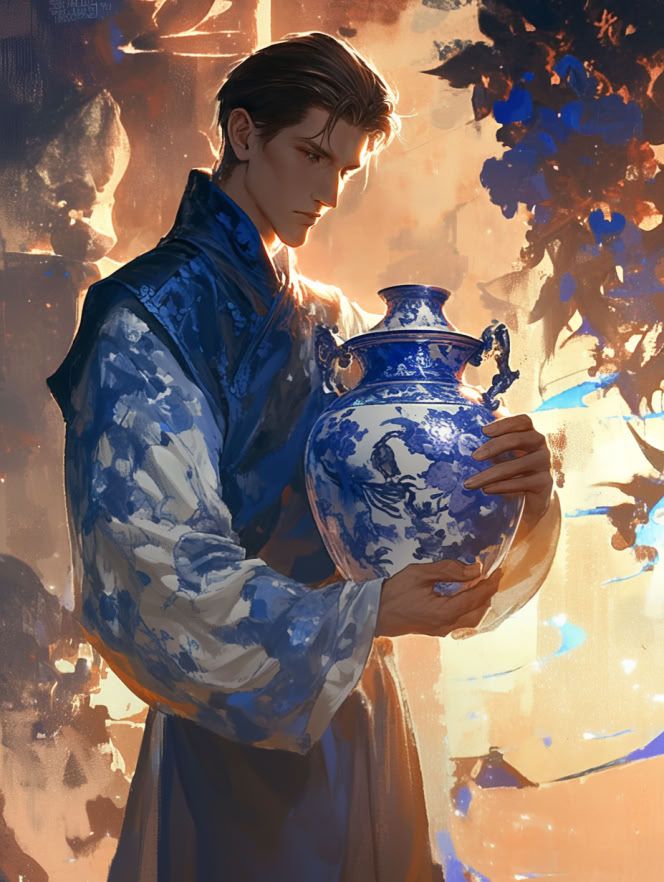
Old Clark sighed. “Young master, you’ve even forgotten this? Sigh! Our The Clark Family owns the largest porcelain kiln in Yanshen Town. The tenth day of the ninth month is Prince Qi’s birthday, and the county magistrate has ordered our family to fire a pair of three-foot-tall openwork painted vases as tribute for Prince Qi. But we’ve never made such large pieces before. After several failed test firings, the deadline is fast approaching, but…”
“Oh? Yanshen Town? Is that Yanshen Town in Qingzhou Prefecture?” Ethan Clark suddenly brightened.
“Yes, Old Butler. What’s wrong with the young master?” Old Morgan rubbed his eyes, stunned. He had been prepared to be scolded or even thrown out by Ethan Clark, but unexpectedly, the young master was so gentle today, completely unlike his usual arrogant self.
“The young master is suffering from amnesia and remembers nothing.” Old Clark sighed again.
Yanshen Town—most people might not know it, but to Ethan Clark, the name was “famous for a long time.” Yanshen Town, though unremarkable in name, was a major center in the history of Chinese porcelain and liuli. Especially after the Ming Dynasty, the fame of Yanshen Town’s porcelain and liuli rivaled that of Jingdezhen in Jiangxi, earning it the title “Capital of Northern Porcelain” and making it one of the birthplaces of modern liuli craftsmanship.

