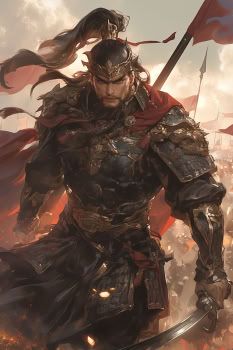
Chapter 1
At the end of the Warring States period, China faced an unprecedented upheaval in a thousand years.
Some are born into noble families.
Some are honored as princes.
But he was reborn as a lowly Qin soldier, Henry, a minor character from the Yunmeng Qin bamboo slips.
To avoid dying in a ditch and to take control of his own fate, he struggles to climb upward.
Fortunately, he has caught up with a great era.
The Six Kings fall, the world is unified! A thousand years of noble bloodlines cannot compare to military merit and titles. The powerful and wealthy of the Six States are all trampled under the feet of Qin officials. Henry only wants to ask with a laugh: Are kings, marquises, generals, and ministers truly born to their stations?
Conquering Baiyue in the south, repelling the Xiongnu in the north, the Di and Qiang fleeing west, tower ships sailing east. Within the Six Directions, all land belongs to the Emperor. With his participation, how will history change?
Qin Shi Huang is destined to die, and the world will be divided. As a Qin official, what choice should one make—go with the tide, or try to turn it back?
Volume One: The Junior Pavilion Chief
Chapter 0001: Soldier Wu, Please Show Your Identification!
In the twentieth year of King Zheng of Qin (227 BC), in September, in Anlu County of Nanjun, Qin State, as evening fell, rain began to fall by the side of Yunmeng Lake, stirring ripples across the water, battering the banana leaves into tatters. Only those that landed on the guesthouse roof were reluctantly blocked by the tiles.
Inside a shabby lakeside guesthouse, the gray-templed “servant”—that is, the innkeeper—was humming a Chu folk song as he bustled about, when suddenly the barking of dogs sounded outside, followed by a heavy knock at the door.
“Someone coming this late?” he grumbled, shuffling over to open the door.
“Thank you, old sir!”
The visitor hurried inside, looking bedraggled in a soaked brown tunic, trousers, straw sandals, and with a wooden stick as a hairpin fixing his topknot to the left side of his head. Looking up, his skin was dark, his features square and upright, thick eyebrows and big eyes, no beard on his chin—a seventeen- or eighteen-year-old commoner...
The young man wiped the rain from his face, revealing a set of white teeth, and bowed to the innkeeper: “Old sir, the rain has made the roads impassable. I’d like to stay here for the night.”
“Do you have a pass and permit?”
Hearing he wanted to stay, the innkeeper instantly changed from a simple country old man to a shrewd one, his gaze sweeping to the short sword at the young man’s waist.
“I have a pass and permit.”
The young man rummaged in his satchel, carefully taking out a “pass” made of poplar wood and a “permit” carved from willow, relieved to see the writing hadn’t been smudged by the rain. He handed them over with both hands, introducing himself at the same time.
“I am a soldier of Yunmeng Township, Anlu County. You may call me Henry, old sir!”
“Henry?”
The innkeeper knew many people in Yunmeng Township, but had never heard of this name. His eyes moved back and forth between the “pass” and Henry’s face, scrutinizing so intently that Henry felt as if he were being checked for ID by a policeman in his previous life, breaking out in a cold sweat...
And with good reason—his identity could be said to be both real and fake!
In truth, he was no longer the original Qin man “Henry”, but a student from a police academy in a certain province in the 21st century. After graduating, he’d passed the exam to join the county police station. While celebrating with friends by the lake, he drowned while saving a young boy who had fallen in.
When he woke up, he found himself lying on a hard pallet, surrounded by a group of plainly dressed “strangers” fussing over him.
He later learned these were his mother, elder brother, younger brother, and so on. Apparently, he had experienced the clichéd “time travel” plot from novels, and had gone back over two thousand years to become a young man named “Henry” from Anlu County, Qin State!
“Henry, isn’t that the Qin soldier from ‘China’s earliest family letter’?”
He had seen some TV programs about the Yunmeng Qin bamboo slips, and was especially impressed by the “Henry wooden tablet.” He never expected to become the owner of that letter himself...
Thinking about his future, he shuddered. The TV program said Henry wrote the letter from the army camp. He and his brother were just ordinary Qin soldiers, not only tasked with combat duties but also lacking food and clothing, forced to write home for money to buy clothes, saying if no money was sent, someone would die! Urgent, urgent, urgent!
Whether the clothes and money Henry asked for ever arrived is unknown to later generations, but one thing archaeologists are sure of: during the excavation, only the letter was found in the tomb, not Henry’s remains. In other words, Henry most likely died in the war when Qin destroyed Chu, leaving only this letter, which his family buried as a keepsake...
“Will I die in battle, my body lost?”
Henry began racking his brains for ways to avoid dying in war in the future, but before he could come up with anything, the local village chief (lizheng) suddenly came looking for him by name!
It turned out that Henry had just turned 17 this year. According to Qin law, as an adult male, he should “register in the census,” that is, have his name recorded in the household register and take on military service obligations.
This left Henry dumbfounded, thinking he was about to be conscripted and sent to war. Although he’d received some training at the police academy in his previous life and had seen blood during his internship, fighting alone was one thing—fighting on a battlefield of tens of thousands was another.
His elder brother “Brian” laughed heartily at his worries and explained things to Henry.

