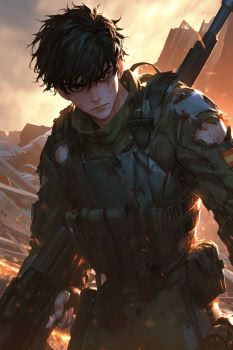
Chapter 10
Seats, the car body, the road surface—everywhere were pools of congealed crimson. They had already turned black and hardened. When the wind blew, the stench that rushed into people’s noses was a thick, nauseating reek of blood.
The refugees all seemed to have been killed. Yet, there was not a single corpse left at the scene.
This kind of situation was not unfamiliar to Brian Carter. Back when the mutants besieged Kunming, the panicked civilians fleeing the city by car had similarly clogged the roads leading out, making them impassable. At the slightest obstruction, the dense convoy behind would be forced to stop, unable to move forward even an inch, and would be slaughtered by the relentless mutants chasing from behind. After all, compared to those monsters whose bodies were taken over by the virus, humans simply ran far too slowly.
At the very front of the highway, a massive truck, over several dozen meters long, lay overturned. Its presence had completely cut off any hope of escape for the city’s residents.
“Change formation, go in by the side road—”
The four-wheel-drive assault vehicles were extremely agile. Taking advantage of the terrain, they rushed down the embankment and sped through the wild fields beside the highway. Like a few small black ants, they quietly crawled into the distant city, whose buildings loomed like a giant nest.
The streets were desolate. Glass scattered from residential buildings and all sorts of debris left behind by the refugees had turned the once tidy city into a vast garbage dump. The dirty plastic bags caught by the wind, fluttering back and forth in midair, looked just like white ghosts—never decaying, forever drifting among the ruined walls.
In front of a two-story building in the southern part of the city, the convoy finally stopped. In front of the building was a small cement-paved square, which was also the source of the distress signal locked onto by satellite.
The entrance at the front of the building was tightly sealed by two huge chain-link iron gates. Perhaps it was the sight of soldiers in Federation uniforms outside that did it—suddenly, the previously silent building echoed with hurried footsteps. A few minutes later, with the rusty iron gates groaning in protest as they opened, a narrow, pitch-black passage appeared in the entryway.
“Hello, I am the People’s Armed Forces Minister of Xinning County, Peter Harris. Thank you so much for coming, really, thank you—”
A man of about forty, wearing an army-green combat uniform and black wide-rimmed glasses perched on his nose, came forward. He let out a long breath, as if a great weight had been lifted from his shoulders, and said, “I thought no reinforcements would ever come. Everyone had lost hope. I never expected… thank you… thank you…”
As he spoke, this burly man, on the verge of a mental breakdown, suddenly seemed to lose all strength and collapsed limply to the ground, unable to get up for a long while…
The mutation in Xinning County had actually begun several days earlier. At that time, the county hospital had received a critically injured patient from a car accident. No one could have imagined that, two days after receiving treatment, the comatose patient would awaken and kill all the medical staff present… In less than half a day after the incident, resurrected mutants wielding black bone blades rose from the corpses and swept through the entire city.
Upon receiving the news, Peter Harris immediately called for help from all nearby military units. But he never expected the mutants to attack with such terrifying speed. When he led a group of fleeing civilians to the county armed forces’ ammunition depot—the very building they were now defending—mutant creatures had already flooded every corner of the city from all directions…
Brian Carter was a bit puzzled. If things were as Peter Harris described, the assault team shouldn’t have been able to break into the city at all. Yet, along the way, he hadn’t seen a single mutant.
The colonel was also confused, but he had no time to dwell on it. Rescuing the civilians was the top priority. As long as he could get everyone out of the city, the other questions could wait.
As the ammunition depot for the armed forces, the building was exceptionally sturdy. But when the survivors inside emerged from the basement in single file, all the soldiers—including Brian Carter—were taken aback.
Dozens of able-bodied men, women, and children were each holding an M20 automatic rifle. Although these were old weapons long since retired from the army, it was still unsettling to suddenly see them in the hands of civilians.
Brian Carter even saw a baby strapped to its mother’s back, playing with a magazine of nine-millimeter bullets in its tiny hands. The mother, holding a rifle, had two fist-sized H6 anti-personnel grenades hanging from the pocket near her chest.
“There happened to be a batch of decommissioned weapons just delivered to the warehouse. It’s better to arm them for self-defense than let the weapons rust away,” the county armed forces minister explained.
The assault vehicles couldn’t carry everyone. The few undamaged civilian trucks parked in the yard became the only means of transporting the civilians. But just as the convoy started up in the yard, the machine gunner in the lead vehicle suddenly shouted hoarsely, “Alert, enemy attack—”

