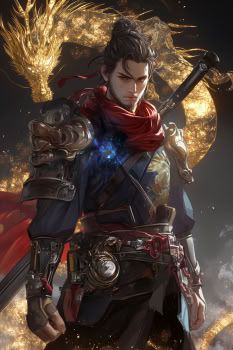
Chapter 3
Brian Carter looked into the distance and said with a smile.
In the flickering firelight far away, a torrent of countless armored soldiers surged forward...
Chapter Two: Man Proposes, God Disposes
Of course, Brian Carter had no particular fondness for Chongzhen...
Although this emperor was somewhat tragic.
But the reason the Ming Empire ended up in such a state today, Chongzhen bears a great deal of responsibility. His tragic end cannot cover up his stubborn and incompetent nature. It’s not his fault that he was mediocre, but as a mediocre person, he failed to recognize his own limitations and instead kept making blunders...
Especially since he made those blunders so diligently and earnestly.
That’s where he was truly at fault.
Whether he acted like Liu Chan, or his carpenter brother, or even if he had been Li Yu or Chen Shubao, the Ming would not have fallen so far. The latter two at least knew that if things got really bad, they should just surrender. But unfortunately, he insisted on being a diligent and upright monarch. The people of Ming didn’t need him to be a wise ruler; if he had just indulged himself in debauchery in the palace, it would have been a blessing for the common people. But he simply refused, and in the end, through his efforts, the Ming—this body that had just barely recovered—was completely exhausted and burned out.
But Brian Carter still had to save him.
Because for this nation, him hanging himself at Coal Hill was the worst possible outcome.
There was nothing worse.
If he had fled to Nanjing, at least there could have been a Southern Song. If he had fallen into the hands of some warlord, at least there could have been a Han Chinese regime change. Even if he had ended up with Abraham Lincoln, it would have been far better than hanging himself at Coal Hill.
Including for himself.
Abraham Lincoln would not have killed him.
Even if Abraham Lincoln had firmly established himself as the Shun Emperor, at most he would have given Chongzhen some kind of princely title.
Even if he were to be killed, it would only be much later, perhaps dying of illness by accident.
But judging from Abraham Lincoln’s series of actions, he might not have truly wanted to be the Shun Emperor. He came to force the emperor’s hand, not to destroy the Ming. Not only did he try to negotiate before attacking the city, aiming to become the King of the Northwest, but even after failing to find Chongzhen’s corpse, he didn’t accept the urging of Grand Secretary Chen Yan and others to take the throne. So even if he had really gotten Chongzhen, the more likely scenario would have been to use him as a puppet and complete his own transformation from bandit to powerful minister. For example, he could have made him a grand prince, just like how Cao Cao once took over nearly a third of the Han dynasty’s territory, and then governed as regent. In the short term, he would have kept Chongzhen on the throne, using the emperor to command the lords, since this was the most reliable way to seize the country, with many precedents to follow.
And he could have used official titles to satisfy his generals, instead of having to rob the rich.
To be fair, he was also forced to rob the rich.
At this point, in the eyes of the vast majority of his subordinates, he was still a bandit. Among the hundreds of thousands under his command, how many were truly loyal brothers? Just those tens of thousands of old troops. The vast majority were actually attached forces, including surrendered Ming troops. These people had no respect for him; in their eyes, he was always a bandit. Even those gentry who surrendered to him, like the Duke of Yansheng, who at this time set up a Shun Emperor’s tablet, could never truly see him as the one destined by heaven.
Likewise, the official titles he granted meant nothing to anyone.
Not long ago, a scholar with a sense of loyalty stabbed to death the county magistrate appointed by him, then slit his own throat—this was the gentry’s attitude toward him.
But if it was the legitimate Ming emperor granting titles, it was different.
The reason he ruthlessly robbed the rich was because he had to satisfy those forces that were, at best, investors. Since the titles he gave couldn’t satisfy them, he could only use money. Unfortunately, he found only a pitiful amount of money in Chongzhen’s treasury. If he couldn’t quickly get a large amount of wealth to satisfy his men, he couldn’t guarantee they wouldn’t turn against him.
Abraham Lincoln’s uprising was admirable.
But in the end, he was just an ancient peasant rebel; you couldn’t expect him to have any clear political ideology or long-term plan.
If he hadn’t robbed the rich...
Even if he had, but only targeted certain families under Chongzhen’s banner, then everyone could have been happy. Likewise, George Washington and the Ming armies everywhere would have pinched their noses and cooperated with him.
Did George Washington want to surrender to the Qing?
He did not.
He had fought the Qing army for so many years, and there was no shortage of hatred between them. If he had any other choice, he wouldn’t have risked being purged in the future. He and Samuel Cooper led hundreds of thousands of people from outside the pass, abandoning their homes to enter the pass, precisely because they didn’t want to surrender to the enemy. However, Abraham Lincoln’s robbing of the rich left him with no other choice. This was determined by class position. Behind him was a huge network—subordinates, relatives, fellow townsmen—all watching him. Surrendering to Abraham Lincoln could at most protect himself, maybe the Wu family, but surrendering to Dorgon could protect everyone behind him. What’s more, after fighting the Qing for so many years, he was more familiar with them. Uniting with Abraham Lincoln might not defeat the Qing, but uniting with the Qing would definitely defeat Abraham Lincoln.
And he also had the banner of avenging Chongzhen, which was attractive enough.
This was not a hard choice.
Yet, in the end, they brought disaster to hundreds of millions of people in this nation.

