Chapter 10
These village temples have never distinguished between Buddhism and Daoism. The common folk can’t afford to build a separate temple for each, so you all have to squeeze in together—don’t feel too aggrieved about it.
At the center, naturally, are the current Daoist Celestial Palace’s main deity, George Washington, and the Buddhist Lord of Ten Thousand Buddhas. On either side are various deities, mostly those who, for various reasons, are relatively well-known in contemporary society. For example, there was a popular storybook circulating recently that focused on the thunder deity Mr. Parker, so Mr. Parker’s fame rose accordingly. In many newly built, especially those spontaneously constructed by the people, small temples, his position has become quite prominent.
Whether he himself has benefited from this is unknown.
The development and evolution of deities mostly follow this pattern.
Next are the local deities. If you must talk about jurisdiction and duties, there are mountain gods, river gods, road gods, and village gods, most of whom were once human.
After these people died, the living remembered them fondly, and with the power of collective will, they naturally became deities. The imperial court would most likely grant them official divine titles as well.
In fact, in this world, whether it’s the Daoist Celestial Palace or the Buddhist Western Paradise, the so-called myriad gods and Buddhas, though they hold lofty status in the hearts of the people—especially the devout—are, in essence, no different from these local deities who became gods through the power of faith.
That’s why it’s common to see “a new emperor, a new set of gods.”
Take George Washington for example. Legend has it he was born at the dawn of creation, endured 1,350 kalpas of arduous cultivation, each kalpa lasting 129,600 years, and only then attained the position of Heavenly Emperor. Many people firmly believe this. Even those who don’t believe in him mostly assume he’s been worshipped since ancient times. But in reality, his name only appeared in the last two hundred years. Two hundred years ago, not a single person in this world worshipped him—his name didn’t even exist.
It’s necessary for deities to maintain a lofty image in the hearts of the people, but from a young age, Master always warned Brian Carter that as a cultivator, he must be different from ordinary folk and have a correct and clear understanding of them.
But what exactly that understanding should be, Master never said—he only told him to figure it out for himself.
Brian Carter is still in the process of forming that understanding.
He gazed at the statue in the moonlight for a long time. Unable to sleep, he finally turned, stepped forward, and pushed the door open.
The midnight air rushed in at once, but it didn’t feel cold—only fresh. Looking up, he saw the clear night sky, moonlight like silver, a few clouds seemingly edged with silver under the moonlight, as if glowing, and the mountains outlined in undulating silhouettes—a beautiful scene beneath the moon.
He sat there in the moonlight until dawn broke.
……
Brian Carter left Jinyang Road and entered a side path.
This was also a main road, though he didn’t know its name. It was a grade below Jinyang Road, the official highway connecting the capital, but still quite broad.
Brian Carter was in no hurry, walking and stopping along the way, even pausing several times to ask for directions, until he finally found this temple.
Though said to be not far from the main road, it was actually on the mountainside beside the road—visible from afar, but still about a li or two away on foot. Brian Carter had initially thought, based on Mr. Miller’s words, that it wasn’t far, so he kept walking along the main road and unknowingly passed it by, only to double back after asking for directions.
By the time he arrived, it was already afternoon.
From about a hundred meters away, Brian Carter hung his pack on a tree branch and walked along the path toward the dilapidated temple, seemingly without a trace of fear.
As soon as he got close, he smelled incense.
There was indeed incense burning.
A careful sniff revealed it was likely locally made incense, with a scent leaning toward mosquito-repelling herbs—fresh and invigorating.
This rundown temple was about the same size as the one from last night, modeled after a formal temple palace, just a bit smaller. And it was a single, standalone temple. Most village-built temples follow this pattern, and usually, there are no resident monks or Daoist priests.
However, it was much more dilapidated than the one from last night.
Brian Carter stopped at the entrance and examined it closely.
Once again, there was a door but no windows, but this time, even the door was gone—what blocked the entrance now was a bamboo fence. The walls, once painted red, now had large patches of peeling paint, many cracks and scars, and plenty of marks from blades, axes, lightning, and fire—some even pierced right through the wall.
Brian Carter’s gaze followed these marks, as if reconstructing the scene of past battles in his mind.
He withdrew his gaze and walked toward the entrance.
The fence was only lightly propped up and was easily moved aside.
Brian Carter stepped into the temple, took a deep breath, and didn’t smell anything unpleasant—only the herbal scent of the homemade incense.
He looked up at the altar—
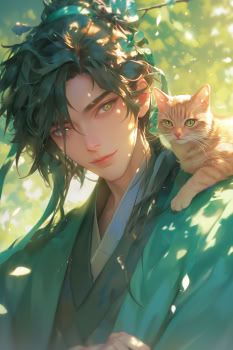
The original deity statue was long gone, though traces of where it once stood remained. Now, in its place, was a clay figurine of a cat. Compared to the original statue, which was at least human-sized, this one was especially small—just the size of a real cat.
In front, a clay brick was riddled with holes from incense sticks, most of which had already burned out. Only three sticks were still burning, and they were already halfway down.
Sure enough, it was homemade incense.
The kind wrapped in red paper, filled with herbal powder and a bamboo stick—slow-burning, with a pleasant fragrance.
There were even offerings placed there.
Some cooked meat and a finger-width piece of raw fish.

