Chapter 2
This time, Henry Barrett saw everything clearly. He saw that each of those armored cavalrymen had an arrow right in the center of their foreheads—the arrows had actually pierced through the thick iron armor, and, clearly, still had force to spare, almost shooting through the heads of those armored riders.
Is this knight even human? Such strength, such a miraculous bow, such precise archery!
Among all the warriors in the world, is there anyone who can withstand his edge?!
Henry Barrett's mind went blank; he didn't even know what he was thinking when the sound of horns rang out. He saw the Zhou army's cavalry blowing their horns and retreating in panic.
The armored cavalry who had been pursuing the militia knight already dared not give chase, and now all of them reined in their horses and turned back.
Richard Grant was hit by an arrow?!
It looks like he really was hit!
Seeing the knight about to spur his horse to pursue the Zhou army, Henry Barrett suddenly snapped back to his senses. Both amused and exasperated, he shouted, "Stop him! Stop him!" Thinking to himself, is this guy's courage made of iron?
"Hey, brave lad! The Protector of Fenghua is here—why don't you come and pay your respects!" a personal guard shouted. In fact, regular garrison soldiers could be called "brave lads" just like the imperial guards, but militia conscripts, who were just farmers drafted temporarily, were never supposed to be called that.
But if this militia soldier doesn't deserve to be called a "brave lad," then who does?!
His iron spear and fine horse were clearly spoils from the chaos of battle; otherwise, how could a mere militia from north of the river have a horse?
But the longbow in his hand was practically a divine weapon—no one knew where it came from, and it shot so far! Although the distance was mainly due to the warrior's extraordinary strength, strength alone wasn't enough; the bowstring and bowback had to withstand such force, so its craftsmanship must be unique!
The knight slowly rode over, staring blankly at Henry Barrett and the others.
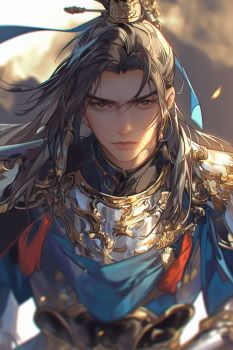
As he drew closer, Henry Barrett saw that the knight had delicate features and looked very young. But under the pouring rain, his clothes were soaked through, and his figure, faintly visible, was not particularly robust. Yet the whole person was like an unsheathed sharp sword, exuding an intimidating aura. However, on closer inspection, Henry Barrett was slightly startled—the knight's eyes looked vacant and dazed, as if his soul was wandering elsewhere.
"Which militia are you from? What's your name?" Henry Barrett asked loudly.
"Me, who am I?" The knight frowned, as if lost in thought. After a while, he shook his head. "I... I think my name is Nathaniel Brooks."
"Where are you from?" Henry Barrett asked again.
The knight frowned even more, and instinctively replied, "I'm Chinese." Then shook his head, "No, no, I should be from Donghai, Haizhou!"
Henry Barrett, who had been full of excitement, suddenly felt his heart sink. He thought he had encountered an unparalleled, heroic warrior, but now it seemed this guy's mind wasn't quite right?
"I'm going! I must fight the Zhou soldiers, fight the Zhou soldiers!" The knight suddenly spurred his horse, which neighed loudly and galloped off, chasing after the retreating Zhou troops.
Henry Barrett and the others were left standing there dumbfounded, looking at each other in confusion.
Suddenly, Henry Barrett snapped to attention and shouted, "Spread the word everywhere! Richard Grant was killed by an arrow!"
Richard Grant was definitely hit, and the wound must be serious. Perhaps this would be the turning point of the war!
Not long after, when Henry Barrett received confirmation that Richard Grant had indeed died from the arrow wound, he looked up and laughed heartily. But what followed was an endless longing—the young knight had single-handedly turned the tide of the war. His bravery was perhaps no less than the legendary Hegemon-King of Chu!
He must be found, he must be found!
……
In the fourteenth year of Baoda of Southern Tang, 956 AD, the Zhou ruler Richard Grant personally led an expedition to Shouzhou and was killed by a stray arrow.
The Zhou army then withdrew from Shouzhou.
The young ruler Edward Grant, Richard Grant's fourth son, who was only three years old, ascended the throne. The chief minister Thomas Johnson and the newly promoted Palace Commander George Washington did not get along, and factional strife broke out.
Moreover, the Northern Han ruler William Clark, upon hearing of Richard Grant's death, joined forces with the Khitan to invade the northern border of Zhou. Their fierce general, known as "Invincible" John Adams, won several great victories and his fame soared.
The Zhou army marched north to resist the invaders, abandoning their southern campaign against Tang.
Chapter One: The Ruler Is Here
After muddling through for several months, Nathaniel Brooks finally figured it out.
He had transmigrated.
The current era: the fourteenth year of Baoda of Southern Tang, 956 AD.
Location: Donghai County, Haizhou, which in later times would be the Lianyungang area.
Identity: Tenant farmer.
In the past few months, he had been conscripted as a militia to fight against Zhou. He had just returned victorious to farming. His memories of fighting the Zhou soldiers were vague—he seemed to have killed some Zhou soldiers and saved some people, but it was all done in a daze, almost subconsciously, and he couldn't remember it clearly.
So be it—transmigrated or not. His previous life had been too dull and tasteless; a change of lifestyle might not be so bad.
But transmigrating into a time of chaos didn't seem so wonderful.
In his occasional moments of clarity, Nathaniel Brooks felt troubled.
In the past, Nathaniel Brooks only made his enemies troubled. Codenamed "Dawn," he was one of the most successful agents in Chinese history.
But all of that, Nathaniel Brooks only wanted to forget.
A life like an ascetic monk, devoid of emotions and desires, filled with endless blood and carnage.
He was already tired of it.

