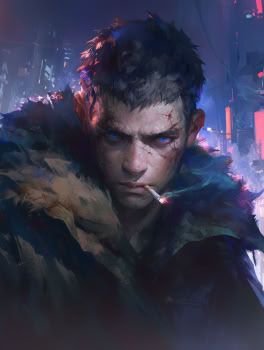
Chapter 13
Brian Brooks continued to squat, smoking his dry tobacco pipe. This pipe was the only somewhat useful thing left by his grandfather. He remembered his mother once saying that the old man had a few thread-bound old books, but when he died, they were all burned at his own request. Brian Brooks had never met his grandmother, nor had his father, and his mother never spoke of it. Brian Brooks pieced together the story from the mouths of a few old folks in the village: his father was a good-for-nothing son-in-law who married into the family, dragging along a useless old man, and after Brian Brooks was born, he just patted his butt and left, just like those educated youths on TV who went to the countryside. Such a lowly life wasn’t worth pondering. Brian Brooks would be lying if he said he didn’t hate him. When he was a child, he once smashed that picture frame. That time, his strong mother cried in front of him for the first and only time. With his eyes slightly red, Brian Brooks tilted his head and spat, cursing at the sky, “Damn you, heavens.”
“Mom wouldn’t be happy to hear that. Don’t curse the heavens. Grandpa used to say the same thing.”
The big simpleton had somehow come to Brian Brooks’s side, squatting next to him, grinning foolishly, just as he had for over twenty years.
“I’ll curse if I want, so what? If you’ve got the guts, strike me with lightning.” Brian Brooks retorted shamelessly.
The big guy sighed and, unusually, fell silent.
“It’s settled. You’re leaving tomorrow.” Brian Brooks broke the silence.
The big simpleton shook his head.
Brian Brooks suddenly stood up, a wave of bitter anger surging up, and shouted, “You dumb ox, not leaving? If you stay, what can you do? Are you going to spend your whole life here, letting people treat you like a fool?! Just grinning at that bunch of real idiots? Staring at this tiny village every day?” Looking at the silent, no-longer-grinning Henry, Brian Brooks grew even angrier. “You’re smarter than me, better at hunting, fiercer in a fight, stronger than me—damn it, you’re better than me at everything, so why should all the good things go to me?! The books are for me to read, the good clothes for me to wear, even the felt boots made from the same cowhide—why do I get the part from the spine and you get the tail end? Even when eating meat, I get the big pieces. Mom is biased, and as her son, I can’t say anything, don’t dare to say anything. Can’t you just speak up for yourself? Now I’m telling you to go out, and you won’t. What the hell are you thinking?!”
The big simpleton forced a smile and said softly, “Mom’s not well. If I leave, you won’t be able to go.”
Brian Brooks’s face turned livid with anger. He threw down the pipe and said, “Can’t you think for yourself just once?! Do you have to make me owe you for a lifetime?”
The big guy Henry ran over to pick up the pipe, cradled it in his arms, and continued squatting, not looking at Brian Brooks’s nearly twisted face. After a long while, he said slowly, “You don’t owe me. Anyone can owe me, but not you. Little Brian, Grandpa’s gone. If I don’t look after you and Mom, who will? Doing this lets me sleep well every night, even eating green onions tastes good, and my heart is at peace.”
Brian Brooks squatted down, biting his lip.
“Little Brian, who says you’re not as smart as me, this blockhead? Grandpa always said you’d be more successful than me in the future. Everyone thought Grandpa was always drunk, but I knew he was actually more clear-headed than anyone. You were too young then to understand some things, so don’t resent him. He really cared about you.” The big simpleton Henry spoke softly, stroking the tobacco pipe the old man had carried all his life, a smile on his lips. But this kind of smile, no one in the village would ever see in their lifetime. He’d played that game of “one cent and one yuan” for over ten years, and everyone thought he was stupid. Who would have thought that this fool was just teasing them, year after year, into playing such a silly game? Most people thought that Brian Brooks, who never let outsiders take advantage of the Chen family, was a tough guy, but this silent fool seemed even tougher.
In Brian Brooks’s memory, the man he should have called Grandpa was a cranky old man who liked to drink and hum Peking opera. He never understood it before, and when he finally could, there was no chance to hear it again.
The big guy stared at the pipe in his hand and murmured, “Grandpa wouldn’t let me say, and Mom wouldn’t either, but I think you should know. You know Grandpa spent his last year bedridden, passed away on New Year’s Day. You were too young to know how much pain he was in that year—there was almost no flesh left on his body, and even turning over made him break out in a cold sweat. Do you know why he held on until New Year’s Day? Because Grandpa said if he died at 81, his next life would be easy, but it would be bad for his descendants. So he forced himself to hold on until New Year’s Day, dying at 82. He even chose his own burial place. I followed him all over the mountains before he finally picked that hillside. Little Brian, do you know? That feng shui actually pushes the buried person’s next life into misfortune, but it brings you good fortune. Grandpa calculated all this before he died. I remember Grandpa standing there, taking a sip of wine, and saying to me, ‘Henry, do you think Fusheng will blame me for picking a place so far away? He’s a kid who doesn’t like trouble and is weak. It’s not good for him to walk so far in the cold weather around Qingming.’”
Brian Brooks, Jason Brooks, clearly two extremes.
How could the villagers know the meaning the old man placed on the name Jason? They just thought Brian was easy to say and sounded nice.
This rascal Little Brian, hated by many in the village, squatted there with his head buried in his knees, hiding his expression.

