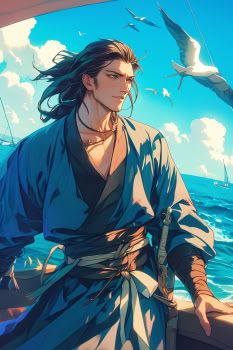
Chapter 5
“You know how to fish? Aren’t you a monk?” Before Ethan Brooks could answer, the girl next to him—was her name Moderator or Ben Grant?—interrupted. She had been standing by Ethan Brooks’s side, listening to the two of them talk, not making any effort to avoid the conversation. Her big round eyes stared intently at Brian Carter, looking him up and down as if she were observing some animal she had never seen before.
“Monk? No, we all keep our hair this short where I’m from…” When Brian Carter heard the word “monk,” he was indeed a little tempted. Honestly, being a monk in ancient times didn’t sound so bad. It was said that monks could do business, own land, didn’t have to pay taxes, and could even marry and have children—damn, that’s a privileged class! But then he thought, he couldn’t even recite a single Buddhist scripture, and people in ancient times were very superstitious. If they found out he was a fake, wouldn’t they just tie him to a big rock and sink him in the sea? Better to honestly be a fisherman and keep his life safe.
Chapter Four: Scored a Free Seafood Hotpot
“You really know how to fish, brother?” Ethan Brooks seemed genuinely interested.
“We can try it tomorrow!” Actually, Brian Carter wasn’t sure if the South China Sea in this era was the same as the one in his previous life, but at this point, he’d just get through tonight first. As for tomorrow, he’d deal with it then. After all, making up stories was easy, and finding excuses wasn’t hard. If he could muddle through for three to five days and figure out which dynasty and what place he was in, then he could think about other options. Maybe by then, there’d be something even more suitable for him to do, and he wouldn’t even bother with fishing if people begged him.
“Hehehe, then… let’s try it. Amy Grant, go tell your grandpa to come eat on our boat tonight—there’ll be wine! Brother, come with me, let’s get you some dry clothes to change into.” Seeing how confident Brian Carter was, Ethan Brooks was very pleased. He even mimicked Brian Carter’s way of speaking, saying “let’s try,” and felt pretty good about it. He beckoned Brian Carter to follow him to his boat.
The life of the Tanka people was truly simple. A wooden boat about ten meters long was the home for the whole family. The bow served as the living room, lounge, and shrine; the stern was the kitchen and bathroom. In the middle of the boat, there was a small shelter made of straw mats, cloth curtains, wooden sticks, and planks—this was both the dining room and the bedroom. Regardless of age or gender, everyone slept here. The boat also doubled as the family’s storage: the front half of the cabin was usually for keeping live fish—if the catch couldn’t be sold, it was kept there for the time being. The back half stored bedding, clothes, and other daily necessities. This was all the possessions a Tanka family had.
Ethan Brooks had lost his wife in middle age and had only one son, named Eric Brooks, who returned in a small boat while dinner was being prepared. He looked like a young man of about 25 or 26, but when they introduced themselves, he turned out to be only 19. Years of sun, wind, and hard labor had made him seem much more mature. With him came a sturdy man and a teenager, both of whom looked a lot like the middle-aged man rowing at the stern. According to Ethan Brooks, they were that man’s younger brother and son, named Ben Harris and Ben Clark.
As the men returned from the sea, the three boats immediately became lively. Two middle-aged women and two boys of about six or seven crawled out from behind the cloth curtain in the cabin. With the adults calling and the children making noise, the pitch-black sea suddenly seemed to come alive.
Everyone was surprised—or at least very curious—about the presence of an outsider like Brian Carter on the boat, especially the two children, who kept squatting next to him, blinking and staring at him. But no matter what he asked them, they just grinned foolishly and didn’t say a word. Although Brian Carter had changed into the Tanka people’s black clothes, he was too tall: the pants barely reached his knees, the shirt exposed his belly, and the sleeves only came to his elbows. Plus, his skin was much fairer than everyone else’s, and he still had a buzz cut. So even without looking closely, he stood out like a duck among chickens—there was no hiding it, he clearly wasn’t one of them.
It wasn’t just his appearance and clothing that were different; even his speech didn’t fit in. Brian Carter couldn’t understand what they were saying at all—unless they deliberately slowed down, he could only catch a few words. But they could all understand him, though they often burst out laughing, probably finding his accent strange and amusing. Especially the girl called Ben Grant, who laughed without restraint, her voice carrying far across the sea.
Fortunately, there was still Ethan Brooks, or Brian Carter would have been bored to death. Thanks to his brief introduction, Brian Carter finally figured things out: these three boats weren’t all one family, but two. The old man who saved him was called Paul Foster—the character “泊” here is pronounced “ban,” not “bo,” and sounds like “半.” The middle-aged man rowing at the stern was his second son, named Paul Miller; the girl with the clear laugh wasn’t Moderator or Ben Grant after all, but Paul Foster’s youngest daughter, named Paul Grant. The sturdy man who came back in the evening was Paul Foster’s third son, called Paul Harris, and with him on the boat was Paul Miller’s eldest son, named Paul Clark. The two women who came out of the cabin were the wives of Paul Miller and Paul Harris, one surnamed Bu and the other Weng. The two little boys were Paul Miller’s second son, called Paul Waters, and Paul Harris’s son, called Paul Fisher.

