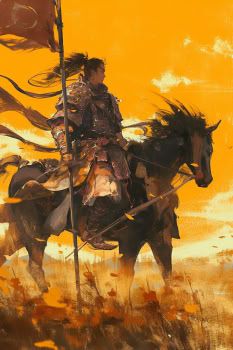
Chapter 16
No one had time to count—how many had fallen in battle at this moment on both sides? No one could predict when this face-to-face shooting would finally end. The archers on the mountain and below gritted their teeth, sending volley after volley of arrows into the sky. They kept killing the enemy, or being killed by the enemy!
Their arms had already begun to tremble, their eyes were dry and aching, yet none of them were willing to give up. They were all gambling, gritting their teeth, betting that the other side would collapse before they did, would break and flee before they did.
Perhaps it was only a brief quarter of an hour.
But for both sides, it felt as long as ten thousand years.
At last, the dark clouds in the sky could no longer bear the stench of blood rising from the ground. Suddenly, with a rush, they scattered. Countless rays of sunlight shot down from above, burning the eyes of everyone present.
The black rain of arrows suddenly ceased, and the deep sound of horns rang out again, “Woooo—woooo—wooooo——woooo——!”
The black-clad ranks slowly retreated, leaving behind hundreds of corpses whose eyes would never close.
“Wooo, wooo, woooo—!” From directly opposite, the sobbing sound of horns answered. The Wei City Camp, White Deer Camp, Lingqiu Camp, Yanjin Camp, Jizhou Camp—the heroes who had just turned from outlaws into Han soldiers—also slowly withdrew, leaving behind a dazzling field of red.
The first round of probing was over.
Today’s slaughter had only just begun.
Note 1: During the Five Dynasties period, due to rapid dynastic changes and the mixing of Han and Hu peoples, the military system was extremely chaotic. Generally, under the military governor were cavalry or infantry units, and under those, left and right wings. Below the wings were “Xth Army” or “XX Army.” Under the army was the command; under the command, the “du,” and under the “du,” the “huo” or “shi.” But each dynasty and each military governor organized things differently, with frequent changes.
Note 2: Cavalry commander: the chief officer of a cavalry “command,” usually commanding four hundred cavalrymen. Each infantry commander commanded five hundred infantrymen. The “ten-man commander” led ten men and was the lowest-ranking officer.
Chapter One: Sharpening the Sword (VIII)
Mercy has no place in command!
Neither Walter King, who was commanding the outlaw heroes, nor Louis King, who led the Black-Clad Army, spared a thought for the two or three hundred men who had just died under their banners.
They were both veterans, long accustomed to blood and death. Once they set their sights on ultimate victory, they no longer cared about the price to be paid.
Besides, the first wave of losses on both sides was far from their own elite troops. In these times, the life of an ordinary man was worth little more than that of a donkey. If a batch of soldiers died today, another could be conscripted tomorrow. With a few months of training under the whip, they could be sent to the battlefield again.
So, after a brief adjustment, both sides immediately began the second round of engagement. No longer testing each other’s strength, but striving to find a weakness and deliver a fatal blow.
In this regard, the Black-Clad Army’s commander Louis King was far more experienced than Walter King. With just a little thought, he focused his attack on the enemy’s left flank. The camps there had just participated in the exchange of arrows, and their strength and morale had dropped sharply. More crucially, those camps had formerly been outlaw strongholds, and their supply of arrows could not compare to the Black-Clad Army’s. After the earlier expenditure, they might not have much left.
“Woooo—woooo—woooo—!” Accompanied by the unique rhythm of northern ox-horn horns, more than a thousand black-clad soldiers formed a narrow blade-shaped formation, slanting toward the left flank of the Wuying Army.
The “blade’s” edge curved slightly downward, each soldier holding a long spear. The back of the blade was lined with black leather shields, every shield facing Walter King’s command banner.
“Wagang Camp, Daye Camp, Caozhou Camp, Haozhou Camp, intercept with arrows! All right-wing camps, advance three hundred paces!” The Wuying Army’s commander Walter King was not to be outdone, immediately issuing countermeasures. Several camps near the central command used bows and crossbows to attack the enemy’s rear, while the entire right wing pressed against the enemy’s left using the terrain.
The elite central forces of both sides remained unmoved, like the two “fish eyes” in a yin-yang diagram, facing each other from about three hundred paces apart. But the left and right wings quickly broke through the arrow barrage and crashed together fiercely. (Note 1)
Boom! The sunlight dimmed in an instant, countless bodies and flesh flew into the sky, countless lives fell to the dust.
The Black-Clad Army under Louis King, whether in weapons, equipment, or training, was far superior to the hastily assembled Wuying Army of outlaw heroes. But in numbers, they were less than half the enemy, and their morale was not necessarily higher. So, in the brief time after the two sides collided, the battle was evenly matched. The Wuying Army’s left wing was nearly crushed by the Black-Clad Army’s vanguard, while the Black-Clad Army’s left was pushed back by the various outlaw camps sent by the Wuying Army.
“Xuanfeng and Cuizhen Second Du, seize the slope four hundred paces up on the right, then look for a chance to charge straight down!” Louis King was surprised by the outlaw heroes’ tenacity. He decisively sent two elite cavalry units to seize the advantageous terrain behind the Wuying Army’s flank, hoping to use the slope to launch an assault.

