Chapter 20
This is the most foolish course of action—not only does it fail to kill the opponent, it also exposes the fact that he is on the battlefield for the first time. The two black-clad soldiers immediately felt reassured. They first retreated half a zhang, then pressed their shoulders together, preparing to use a two-man combined attack tactic to thoroughly deal with the little chubby guy in iron armor before them.
“Bang!” A snow-white warhorse charged in from the side, sending both black-clad men flying at once, their fate unknown. On the horse’s back, Arthur King yanked the reins tight, leaned to the side, and reached his right hand out toward Eric Scott from a distance. “Get on! Don’t run around! Reinforcements have arrived!”
“Dada, dada, dadadada”—a dozen or so warhorses galloped over from afar, surrounding the two of them in a tight circle. They were the personal guards of the Commandant of the Martial Bravery Army, Walter King, each one a superb rider and masterful warrior. As long as they lived, no one would be able to lay a finger on the two young men.
“Dada, dada, dadadada!” More and more warhorses—hundreds of them—charged onto the battlefield in formation. The unsuspecting black-clad soldiers were toppled layer after layer like crops in a flood, trampled until their tendons snapped and bones broke.
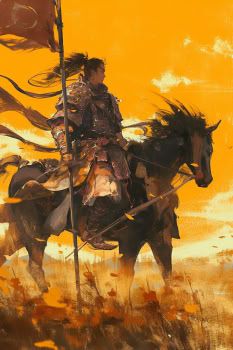
On every warhorse sat a valiant cavalryman. Every cavalryman’s helmet plume was bright red, as red as the blood on the ground.
Commandant Walter King had revealed his hidden trump card ahead of time.
Before being ordered south to rally the outlaws, he had been a cavalry officer in the imperial guard, most skilled at commanding cavalry. For today’s victory, he had transferred all his brothers under his command and secretly hid them on the other side of the ridge.
He did not hesitate to use all the newly recruited outlaws as bait, just to deliver a fatal blow to the enemy.
Chapter Two: Frost Blade (Part Two)
The ensuing battle could only be described as “crushing dry weeds and smashing rotten wood.”
The black-clad army under Louis King had already been exhausted by the outlaws at the cost of their lives. The elite cavalry that suddenly charged down from Wuzhang Ridge, however, were fresh and full of spirit, with the advantage of terrain and formation. They moved in groups of a dozen or so, each group spaced about half a zhang apart, weaving through the battlefield like countless steel blades. Anyone touched by these “blades” was either dead or wounded, with no chance to fight back.
A large group of black-clad archers were overtaken from behind by the cavalry and cut down one by one. A large group of spearmen were smashed from the side and then trampled into pulp. Several captains in black lotus-leaf armor were chopped off their mounts by gleaming sabers and then hacked to pieces. One enemy officer even jumped off his horse to surrender, only to have half his head chopped off by the cavalry without hesitation. His corpse spun in place, spraying blood, round and round, again and again.
The thrill of pursuing a fleeing enemy was exhilarating.
But this battle was now completely irrelevant to Eric Scott.
Walter King had sent his most trusted men to find him, isolating all possible risks at least two zhang away from his body. Any “impulsive” actions on his part were strictly prevented by the group, leaving him no chance to act.
The loyal sons of the Han family even tried to stop him from reuniting with the other leaders of Wagang Village. Only when the young general Arthur King finally lost patience and changed his expression did they awkwardly give in, volunteering to accompany the two young men in searching for the Wagang camp’s commanders.
They found the body of the third leader, Richard Foster, fifty paces from where Li Tiegua had fallen. His body was covered in wounds, large and small, like countless mouths silently questioning the world. This taciturn old veteran died never understanding how someone’s heart could be so vicious—using them and then immediately turning to schemes and slaughter.
The fourth leader’s body was only half a zhang away. One hand gripped a steel blade hacked into a saw, the other dug deep into the ground, several inches in. Three wooden-shafted spears were stuck in his back, each stained red with blood, like three incense sticks burning in sacrifice.
The sixth leader, Peter Wright, and the seventh, Patrick Thompson, were missing—neither seen alive nor found dead. In today’s brutal battle, there were likely hundreds whose remains could not be fully recovered. Yet Eric Scott hoped the two of them were still alive, that they had simply fled the battlefield when things turned dire. Though this thought somewhat diminished the image of his elders, Eric Scott sincerely wished they had escaped, away from all the plots and traps.
The Wuzhang Ridge battlefield was not wide, and Eric Scott soon completed a full circuit. Then, under the protection of the Han family cavalry, he continued to search among the piles of corpses, afraid to miss even a single clue.
He did not blame anyone, nor utter a word of complaint. He simply refused to give up searching for his loved ones until the very last moment. This stubborn act made the Han cavalry impatient, but they could find no good reason to stop him. The squad leader could only repeatedly hint to Arthur King. Yet Arthur King ignored the hints, just staring blankly at Eric Scott, watching him move from one pile of corpses to another. Unconsciously, his face grew redder and redder, almost as if blood would seep out.

