Chapter 2
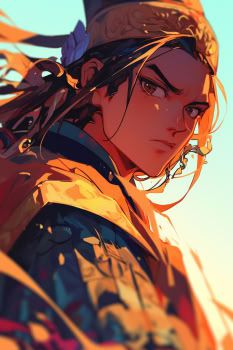
If it weren’t for the fact that this strange man had a completely Han Chinese face, if it weren’t for the fact that he had spent several days just sitting under the tree, numbly watching the river, watching the floating corpses drifting downstream, watching the flocks of crows take flight and hop about on the trees beside him, his face full of sorrow and worry, yet never making any harmful move toward the refugees—then, just based on his attire and the Hu slaves at his side, those enraged Han people would have already risen up against him.
However, none of that mattered now. This desperate group of Han people no longer had the time to question the man’s identity, and the scholar who was about to throw himself into the river with a heart set on death had no interest in investigating either. He staggered forward with a smile and stepped into the water.
“What are the imperial troops across the river doing?” The man under the tree suddenly spoke. He spoke pure Han Chinese, as if talking to himself, but his final words made the scholar furious.
“Perhaps, they are celebrating on the other side!” the man said blandly, as calm as water.
“Nonsense!” the scholar shouted hoarsely in anger. “What is there for the imperial troops to celebrate? Celebrate the land filled with wailing and the river full of corpses? Celebrate that Huainan has once again fallen into the hands of the Hu? Celebrate the tens of thousands of soldiers whose bodies are left to rot in the wilderness north of the river? Celebrate the refugees who bravely throw themselves into the river to die? Celebrate the Central Plains shrouded in the stench of death, where the people live lives worse than death? ...”
The high-nosed, deep-eyed Hu slave was greatly displeased by the scholar’s disrespect. With a low growl, he drew his sword and was about to beat the scholar severely. But as the man under the tree let out a gentle sigh, the Hu slave immediately lowered his head, sheathed his sword, and sat down obediently.
“To celebrate the preservation of the court’s order and hierarchy!” The man sitting under the tree spoke these words almost one by one, his tone full of contempt.
What the man under the tree said was both right and wrong. The remnants of the Jin army across the river had no mood to celebrate, having lost thousands of comrades. But in the Jin court far away in Jiankang (modern-day Nanjing), the ministers were secretly rejoicing.
In the fifth year of Yonghe, the death of Shi Hu was like the collapse of a giant beast, bringing down the already tottering Later Zhao empire. After Shi Hu’s death, his sons fought for the throne. At the same time, various forces seized the opportunity: the Murong Xianbei’s Former Yan army marched south from Liaodong, the Di leader Fu Hong led various tribes toward Guanzhong, Ran Min’s Han army, Yao Yizhong’s Qiang, the Xianbei Duan clan, and the remnants of Later Zhao all fought each other, plunging the north into utter chaos. This once-in-a-millennium opportunity to recover the Central Plains finally appeared before the rulers and ministers of Eastern Jin. Ethan Warren, who had once campaigned against Shu and destroyed Cheng, repeatedly petitioned to lead a northern expedition.
However, what the Eastern Jin court feared most was that Ethan Warren would gain too much fame in the campaign. According to Confucian doctrine, “The ruler is the ruler, the minister is the minister, the father is the father, the son is the son”—the most inviolable order under heaven. Thus, a minister’s prestige must never surpass that of the sovereign, or else “heaven and earth will collapse.” So, if Ethan Warren succeeded in another northern expedition, his achievements and reputation would overshadow the emperor. Because of this, the minister Ryan Bennett reminded the emperor: “If Ethan Warren again pacifies the He and Luo regions, how will the court reward him?”
The emperor was suddenly enlightened.
Yet, to obstruct the recovery of lost lands was indefensible on moral grounds. The only workaround was for the court itself to send a trusted insider to undertake this great task. Thus, the Grand General Who Conquers the North and imperial relative Paul Carter was dispatched as the commander of the northern expedition. Once the news spread, thousands of northern gentry and commoners surrendered daily. The Later Zhao governor of Yangzhou, Jack Walker, defected, giving Eastern Jin control of the strategic city of Shouchun. The Jin court then advanced into northern Huai, recovering all the lands south of the Huai River that had fallen to Later Zhao.
At that time, the people of Shandong, who had suffered under Later Zhao, still longed for their former country. Paul Carter was a renowned scholar and Confucian, well respected by the people. Thus, over five hundred families from Lu County took the opportunity to rise up and join Jin, seeking aid from Paul Carter. The famous scholar Paul Carter, skilled in philosophical debate, readily agreed to support them. Without clear knowledge of the enemy’s situation, he sent only 3,000 infantry deep into Later Zhao territory. Unfortunately, this isolated force inevitably encountered 20,000 Later Zhao cavalry at Daibei.
At the first clash, the renowned Confucian Paul Carter dared not fight, abandoned his soldiers, and fled in panic. The Jin army collapsed, slaughtered by Later Zhao troops along the way. The general Kevin Walker was captured and died unyielding. After fleeing the battlefield, Paul Carter lost confidence in the northern expedition, abandoning the millions of Han people north of the river who had been eagerly awaiting rescue, and retreated to Guangling. Kyle Brooks, who was guarding Shouchun, saw Paul Carter fleeing alone and immediately abandoned the city and withdrew. Later Zhao regained Hebei without any effort, and over 200,000 Jin loyalists followed the Han army’s trail, hoping to join the Jin forces operating south of the river. But by then, the Jin army had already retreated. These Han people, pursued by Later Zhao cavalry, fell in droves, their blood staining the land.
This was the situation on the north bank of the Huai River at the time. By now, ten days had passed since the Jin army’s withdrawal. The Later Zhao troops had pursued the Jin army, and the surviving Han people, unable to cross the river, spent their nights gazing across the water, wailing in despair. Ravaged by cold, hunger, and famine, they were on the verge of extinction. The Jin army on the opposite bank, under the pretext of guarding against spies, slaughtered the refugees who managed to swim across.
After this battle, Ethan Hammond saw that the Hu in the north were far from defeated and dared not call for another northern expedition. The Jin court, having suffered only minor losses, silenced the voices advocating war and perfectly maintained the order between ruler and minister. Could the ministers not be secretly celebrating?
As for the cries of the tens of thousands north of the river—let them be!
The man under the tree was speaking of the internal strife within the Eastern Jin court. Although the scholar did not know the details of the court’s intrigues, he understood the meaning of “preserving the order and hierarchy,” and with a little thought, he guessed at the darkness behind it, falling into a daze.

