Chapter 3
“‘When the people no longer fear death, what else in the world can make them afraid?’” The man beneath the tree spoke with a calm as placid as water: “You want to die? Very well. Yesterday is as if dead, today is as if alive—just consider yourself already dead. I’ll buy your life. Follow me, and I’ll lead you out of this hell.”
The man under the tree spoke these words almost through gritted teeth, making no promises, revealing not a hint of his goal, but the scholar, already with nothing left to live for and nothing to fear in death, like a drowning man clutching at his last straw before dying, answered resolutely, “Fine, my life is yours!”
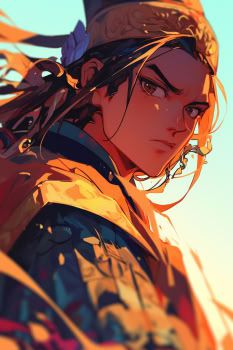
The man extended his hand, seeming to hesitate for a moment, then spoke again with firm resolve: “My name is Isaac Hall, courtesy name Yuanhua.”
The scholar seemed to catch the other’s hesitation, and before reaching out to shake hands, he too hesitated, then replied, “Wings that soar high—what a good name. Then I’ll call myself Sean Walker, courtesy name Zichuan.”
History froze at this moment.
That year, the ancient Olympic Games, which had lasted 1,125 years, were abolished by the Roman emperor. This mass sporting event, due to poor venue conditions, sweltering weather, and an overwhelming number of participants, had made watching the Olympics a kind of punishment. Previously, there had even been slave owners who told their slaves: If you don’t work hard, your punishment will be to watch the Olympics!
That same year, a powerful earthquake destroyed the ancient city of Beirut in Lebanon. Meanwhile, the world’s largest Catholic church—St. Peter’s Basilica in the Vatican—was completed. The church had been founded in 329 AD, and after many expansions and renovations, still stands tall to this day.
At the same time, in a place even farther north and west in China, another world-changing event was unfolding.
At that time, people overlooked the historic day, and now we can only be certain: it was sometime after the meeting between Isaac Hall and Sean Walker, perhaps precisely that morning when Isaac Hall stood by the Huai River. A young deer was leisurely grazing on the eastern edge of the Motis Great Marsh (now the Azov Sea Marshes). It happened to be spotted by several mounted hunters, and so a chase began at once. The little deer bounded into the depths of the Motis Marsh.
The Motis Great Marsh was the largest marsh in ancient Europe, teeming with fish and shrimp, lush with aquatic plants, but its unfathomable bogs made it a death trap for nearly all land animals. Because it seemed utterly impassable, for thousands of years, people living on either side had regarded it as the end of the world.
At that moment, the hunters felt it was too dangerous to continue the pursuit, so they reined in their horses. But unexpectedly, the little deer also stopped, tilting its head to look at them. Seeing this, one hunter suggested, “This deer is clearly exhausted. If we keep chasing, we might catch it. Besides, if a deer can go there, surely our horses can too!” The others found his reasoning sound, so they resumed the chase, marking their path with branches as they went.
The little deer ran westward, stopping and starting, always eluding capture. As dusk began to fall, the hunters suddenly realized the deer had vanished, and the ground beneath their feet was no longer damp. Unknowingly, guided by the deer, they had become the first to cross the Motis Great Marsh. The land beneath their feet was the fertile Scythian steppe, the very place where, according to Greek mythology, the quest for the Golden Fleece took place.
These hunters were neither Germanic, nor Persian, nor Roman, nor Greek. According to Byzantine records, they were short and thin, with dark skin, broad cheekbones, flat nostrils, slender noses, features noticeably smaller than the native Eastern Europeans, sparse body hair, and a habit of shaving the sides of their heads, leaving a short braid on the crown—a typical East Asian face.
They were Xiongnu, the Northern Xiongnu who had been defeated and driven out by the iron cavalry of the Han dynasty, and in this year, they finally set foot on the fertile lands of Europa, beginning their sweep across Europe.
The deer chase—what a quintessentially Chinese legend. Let us set aside the question of its truth, but for centuries afterward, on the Scythian steppe, the original rulers, the Ostrogoths, would curse the innocent soul of that little deer in their anger.
Meanwhile, the once-mighty Central Plains dynasty that had driven the brutal Xiongnu from their sight, after embracing Confucianism as the sole orthodoxy, gradually declined. The minor Hu clans, who once cowered and trembled at the feet of the Xiongnu, now rode roughshod over the Han people who had driven out their Xiongnu overlords, wielding sword and blade as sickle and plow to harvest heads, turning the Confucian-armed people of the Central Plains into slaves, treating the cities of the Central Plains as pastures, and beginning their centuries-long herding of the Han.
Blood and slaughter—the heavy curtain of this era was just beginning to rise.
Standing on the northern bank of the surging Huai River, Isaac Hall took one last look at the river full of floating corpses and declared resolutely, “In life, be a hero among men; in death, a hero among ghosts. To this day, I think of Xiang Yu, who would not cross to the east of the river—Sean Walker, go gather the survivors and tell them, follow me, I will lead them out of this hell!”

