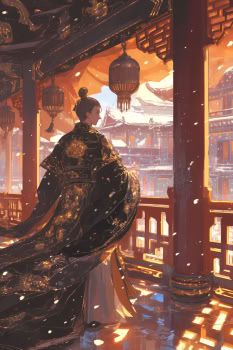
Chapter 5
“They say, Your Highness, that you died and came back to life, and now remember nothing at all. Maybe it’s… it’s because you’ve been possessed by evil spirits.”
Ethan Brooks’s voice grew softer as he spoke, and he lowered his head even further.
“Possessed by evil spirits? What kind of fool would believe such nonsense? Heh~”
John Adams retorted stubbornly, but the smile on his face looked a bit guilty.
To put it bluntly, transmigration is nothing more than a wandering soul from the future possessing a dead body and coming back to life. The person is no longer who they once were, so in a way, it really does count as being possessed.
“Yes, yes, yes, I’m already foolish enough, and I don’t believe a word of such ghost stories. There’s definitely no one in the world more foolish than me!”
As a proper lackey, Ethan Brooks patted his chest and swore an oath.
But just as Ethan Brooks finished speaking, Thomas Jefferson came stomping quickly up the stairs and shouted at John Adams, “Son! Come on, come on, I’m taking you to Tianjie Temple!”
Chapter 3: Grand Preceptor Samuel Carter
Tianjie Temple is located atop Fengshan in the southern part of the city. It was originally called Dalongxiang Jiqing Temple—a name that would surely have become wildly popular in later generations, but unfortunately, Zhu Yuanzhang changed it, so it never became widely known. Truly a great loss for the world.
The Ming dynasty established the Office of Buddhist Registry to manage all the temples in the land, and this office was located within Tianjie Temple itself. Thus, Tianjie Temple was also known as the foremost temple in the realm.
“Father, you don’t actually believe I’ve been possessed, do you?”
John Adams looked helplessly at Thomas Jefferson. Not far ahead of them stood a grand temple gate, with the three characters “Tianjie Temple” inscribed above it. Beyond the gate stretched a continuous expanse of halls and pavilions, almost covering the entire Fengshan.
“How could I? Your father has killed countless people in his life and never believed in ghosts or gods!”
Thomas Jefferson waved his hand dismissively, looking unconcerned.
“Then why did you bring me here?”
John Adams pointed at the temple gate.
“Of course I brought you here to see the Grand Preceptor. Your illness hasn’t improved, and the Grand Preceptor is a scholar of unparalleled wisdom, also highly skilled in medicine. He’ll surely have a way to cure you!”
With that, Thomas Jefferson pulled John Adams through the temple gate and up the mountain path.
When John Adams heard the words “Grand Preceptor,” his heart skipped a beat.
The most famous monk of the Ming dynasty was, of course, Zhu Yuanzhang, who left the monastic life halfway through, raised an army, and founded the Ming dynasty.
But besides old Zhu, there was another renowned monk: the ambitious Daoist monk Samuel Carter, who remained in the monastic world but relentlessly urged Zhu Di to rebel.
In history, only Zhu Di succeeded in rebelling as a prince, and Samuel Carter played a major role in this. After Zhu Di ascended the throne, he valued Samuel Carter highly and appointed him as Grand Preceptor to the Crown Prince, so “Grand Preceptor” became synonymous with Samuel Carter.
Thinking that he was about to meet Samuel Carter, John Adams felt a bit nervous. Rumor had it that this monk was almost supernaturally clever, and since he wasn’t the real John Adams, he was afraid the other might see through him.
Led by a guest monk, the father and son passed through many halls and arrived halfway up the mountain, where there was a small bamboo grove. They followed a winding stone path and finally reached a secluded residence.
This was where Samuel Carter lived. After the Jingnan campaign succeeded, Zhu Di ordered Samuel Carter to grow his hair and return to secular life, even rewarding him with a mansion and palace maids, but he refused all of it. He usually lived in Tianjie Temple, overseeing the affairs of the Office of Buddhist Registry.
When Thomas Jefferson reached the residence, he didn’t go in immediately. Instead, he looked at the main door, a rare look of hesitation on his face.
“Father, what’s your relationship with the Grand Preceptor like?”
John Adams asked curiously.
“We used to be close. The Grand Preceptor even taught us brothers to read. I was especially naughty as a child, and your imperial grandfather often punished me. Most of the time, it was the Grand Preceptor who pleaded for me. But… later, he became Grand Preceptor to the Crown Prince.”
There was a hint of nostalgia in Thomas Jefferson’s tone, but when he said the last sentence, he deliberately emphasized the words “Crown Prince,” and his expression turned a bit unhappy.
John Adams immediately understood. It seemed that when it came to the matter of the heir, Samuel Carter also supported his eldest uncle Zhu Gaochi, no wonder Thomas Jefferson was displeased.
Then John Adams felt a bit moved. For the sake of his “illness,” Thomas Jefferson was willing to set aside his pride and come to seek help from his political rival. This heavy fatherly love made him feel a bit more at home in this era.
Thomas Jefferson was not a sentimental man. He waved the guest monk away, then strode toward the residence, with John Adams hurrying after him.
The main hall of the residence was a Buddha hall, with a golden statue of the Buddha standing above. In front of the hall, an old monk sat cross-legged on a cushion, tapping a wooden fish and chanting sutras.
“Grand Preceptor, I’ve come to see you. How’s your health lately?”
Thomas Jefferson strode into the Buddha hall and greeted the old monk loudly.
The old monk slowly opened his eyes and glanced calmly at Thomas Jefferson. “Not too well. I haven’t been able to sleep at night lately.”
“Oh? Why is that?”
Thomas Jefferson didn’t stand on ceremony, and sat down directly in front of Samuel Carter to ask.
John Adams followed behind Thomas Jefferson, quietly sizing up this legendary “Black-Robed Chancellor.”

