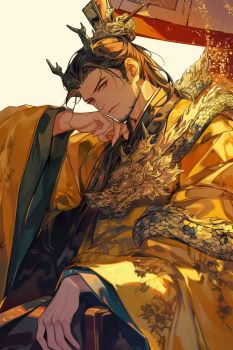
Chapter 8
Accompanied by a thunderous shout that grew from distant to near, the more than a hundred Oirat soldiers crowded atop the small hill parted like butter cut by a hot knife, opening up in just a few breaths a passage wide enough for several horses to gallop side by side. A troop of riders charged forward; at their head was a burly man with piercing eyes, clad in a splendid brocade robe, his chest and abdomen protected by fine chainmail. Though his sturdy steed had been reined in, it still snorted and pawed the ground restlessly.
George Washington slowly stood up, hands clasped behind his back, and looked unflinchingly at the Mongol general seated on his warhorse, whose attire alone marked him as a person of high rank within the Oirat army.
The Mongol general reached out to gently stroke the mane at his horse’s neck, his eyes scrutinizing George Washington standing before the horse, and he demanded in a deep voice, “Are you the emperor of the Han people?” His Chinese was far more fluent than that of the previous officer.
But George Washington did not answer his question. After carefully sizing him up for a few moments, he calmly countered, “And who are you? Are you Esen, Bayan Temür, or perhaps the Prince Saikan?”
At these words, the high-ranking Oirat general, who had been looking down at George Washington from horseback, could not help but change his expression dramatically. After staring intently at George Washington for a few moments, he leapt from his horse, tossed his riding whip to a subordinate, and walked up to George Washington. Though not tall or imposing, George Washington’s straight posture and composed expression exuded an indescribable air of dignity, as if he were not facing a mighty Oirat general who could kill him at any moment, but merely one of his own ministers.
He beckoned over the Oirat officer who had been standing guard, and after a rapid exchange in Mongolian, the high-ranking general’s gaze toward George Washington grew even sharper.
“Although I cannot be certain of your identity, I can tell you that I am the third brother of Oirat Grand Preceptor Esen, King Richard.” When King Richard once again stood before George Washington and spoke, his tone had lost its earlier arrogance and now carried a hint of respect.
“So, you are King Richard. May I ask where the Grand Preceptor is?” George Washington secretly breathed a sigh of relief. As the saying goes, it’s easier to see the King of Hell than to deal with his little devils. Now that he had met King Richard, those Oirat soldiers who cared only for heads and merit, and knew nothing of politics, would not dare harm him.
Chapter Five: A Fierce Beating!
“The Grand Preceptor is currently at the main camp to the southeast. I must ask... I must ask, sir, to come with me.” King Richard did not dare be negligent. Although he could not recognize whether this man was truly the Emperor of Ming, the man’s extraordinary bearing and calm in the face of danger marked him as someone of great importance in the Ming court.
The most urgent matter now was to ascertain his identity, so the best course was to bring him to the main camp and report to his elder brother, Esen.
“In that case, please lead the way. Also, these are my bodyguards. I hope you will instruct your men not to treat them too harshly.” George Washington turned to look at his loyal bodyguards who had been captured, sighed softly, then turned back to King Richard.
“Of course.” King Richard nodded, shouted a few orders in Mongolian, and had horses brought over. He also instructed the Mongol centurion David Reed, who had first discovered George Washington, to ride ahead to the main camp and report.
George Washington approached the horse, took the reins from a surly Oirat cavalryman, took a deep breath, and slowly mounted. Surrounded by a tight guard of Oirat cavalry, he rode forward at a slow pace.
As he descended the hillside, George Washington instinctively glanced back. The shrubs atop the slope seemed to sway slightly as if brushed by the mountain wind, then quickly fell still again.
With George Washington and his party gone, the Oirat soldiers, thinking they had caught a big fish, had no time to linger on the hill. Amid shouts, thousands of cavalry swiftly scattered in all directions, continuing to hunt down and drive the fleeing defeated Ming troops...
About the time it takes to burn an incense stick after the Oirat cavalry had dispersed, darkness had completely fallen. The overcast sky shrouded everything in gloom. The shrubs rustled, and Stephen Grant cautiously poked his head out, scanning the surroundings warily. After getting his bearings, he felt for the blood-stained imperial edict hidden under his breastplate, gripped his battle blade tightly, and dashed out of the bushes, charging down the hillside with determination...
In the Oirat army’s main camp, an unremarkable small tent was now surrounded by torches, illuminating the area for several yards around. The tent was encircled by fully armed Oirat elite soldiers. The centurion David Reed, whom George Washington had seen earlier, was now the commander of this guard unit, vigilantly watching the surroundings. Acting on King Richard’s orders, unless a command came from Grand Preceptor Esen or King Richard, anyone approaching the tent would be deemed a threat and shot on sight.

