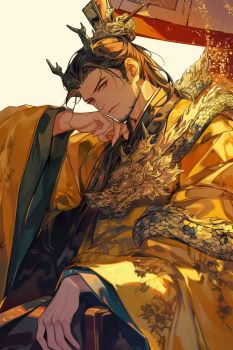
Chapter 10
It seems that I’ve been bewitched by the lingering will of George Washington in this body; George Washington could only explain his earlier reckless behavior—acting like a mafia boss disciplining his underlings—this way.
Steady, steady. I am not a hardworking teacher in the twenty-first century waving a pointer to fool people, nor am I a child king in the alley commanding kids with a wooden gun to play at war. Now, I am an emperor—and not just any emperor, but one who has been kidnapped.
Could it be that George Washington’s body has been pent up for too long and needs to vent? George Washington stroked his still-smooth chin, letting his thoughts run wild, completely forgetting about the Wala centurion David Reed in front of him, who was still sizing him up.
But before long, hurried footsteps sounded outside the tent, along with the shouts of the guards stationed outside. David Reed couldn’t help but frown, one hand on the hilt of his sword, the other lifting the tent flap as he strode out. “Who’s making such a racket out here?!”
George Washington snapped back to his senses, sat up straight, and guessed that it must be that Esen had received the news—though he didn’t know if Esen would come in person or send someone.
Soon after, the tent flap was lifted, and David Reed entered first, then stepped aside to reveal two Wala officials following him into the tent.
The two Mongol officials were momentarily stunned to see George Washington sitting calmly inside, but then both their faces lit up with joy. One of them even began shouting loudly, while the other remained much more composed, bowing deeply and respectfully to George Washington, saying, “Your humble servant greets His Majesty, Emperor of the Great Ming.”
George Washington stared blankly at the two Mongol ministers before him, like a statue on a shrine. He couldn’t help it—the memories in this body were too fragmented, and after transmigrating, he’d been too busy running for his life to have time to recall the memories that originally belonged to this body.
“Who are you?” After coming to his senses, George Washington tried to put on a thoughtful expression, imitating the way emperors act in cliché costume dramas by glancing sideways at the man before speaking in a deliberately measured tone: “You look somewhat familiar, but I can’t quite remember where I’ve seen you before.”
The Mongol was first taken aback, then beamed with delight. “I didn’t expect Your Majesty to still remember me. I am Peter Scott. Three years ago, I was sent by Grand Preceptor Esen as an envoy to the Ming. Your Majesty even summoned me to the palace for an audience.”
He then pointed to the man who had been shouting, “This is Frank Miller, my deputy, who accompanied me on that mission to the Ming.”
“So it’s you two. Who would have thought that we once met in the imperial palace of the Ming, and today, we meet again in the camp of the Wala army.” George Washington gave a wry, helpless smile, using the opportunity to change the subject.
Damn it, if I’d transmigrated just two days earlier—no, even one day earlier—I wouldn’t have ended up a prisoner, stuck in this damned Esen’s tent gnawing on lamb chops. I’d be in the capital, holding a beautiful concubine and feasting on delicacies. But history has no “if,” and neither does transmigration.
After meeting George Washington, the two quickly took their leave from the heavily guarded little tent, faces full of excitement, and hurried off toward the central command tent of the Wala Grand Preceptor Esen.
At this moment, Esen’s tent was brightly lit. Inside, besides the King Richard whom George Washington had seen before, there were more than a dozen Wala Mongol noblemen and generals. All of them were casting respectful glances at a man in his early forties, tall and imposing, wearing a round-topped pointed hat and a brocade robe. His eyes were deep-set, his short mustache curled slightly upward, and his eyes were narrowed as he gazed at the lamp on the table, his fingers tapping lightly on the desk—the rhythm betraying his inner anxiety.
Kneeling in the center of the tent was a eunuch dressed in Ming court attire—the very same Eric Stone whom George Washington had beaten black and blue. At this moment, he was prostrated on the ground, trembling with fear, occasionally sneaking glances around, who knows what he was plotting in his mind.
Meanwhile, King Richard was quietly conversing with a portly, clean-shaven man in a brocade robe standing beside him, occasionally gesturing. This man, a little older than King Richard and bearing a resemblance to Esen, was frowning deeply and sometimes asked a question in return. He was Esen’s second brother, King Richard’s elder brother, James Carter.
They had just learned some information from this unlucky eunuch. This eunuch, Eric Stone, claimed to be a close confidant and comrade of Charles Harris. Having watched his boss Charles Harris be killed by the guard general, and seeing the emperor not only fail to pursue the matter but flee with the general, he figured the emperor must have blamed the defeat entirely on Charles Harris. As Charles Harris’s trusted aide, even if he made it back to the Ming, his fate would be no better than being executed by a thousand cuts.
Chapter 7: The Overjoyed Wala

