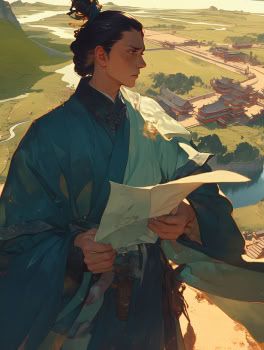
Chapter 1
In the year 1589 AD, the seventeenth year of the Wanli reign of the Ming Dynasty.
The autocratic Benjamin Franklin was dead, the war-loving George Washington was dead, and the troublemaking Abraham Lincoln was also dead. The Wanli Emperor and his ministers were tired of quarreling, so the emperor holed up in the palace and stopped attending court, ushering in the bizarre era of “thirty years without court, without suburban sacrifices, without wild hunts.”
Time continued to pass. The markets bustled in peace and prosperity. Ordinary people were passionate about banter, listening to operas, traveling, gambling, visiting brothels, collecting, and keeping flowers, insects, fish, and birds...
Amidst the hustle and bustle, no one knew that on the other side of the continent, Europeans were setting sail to explore the world; nor did anyone pay attention to the fact that in the far north, the Jianzhou Jurchen leader Nurhaci was sharpening his weapons, coveting the vast lands of Ming.
Brian Cooper, a geologist from later times, transmigrated into the body of a poor scholar from a farming family in Fengcheng County, Nanchang Prefecture, Jiangxi.
Let us see how the geomancer of Great Ming stirs up the winds and clouds, forging a new era of national prosperity and strength.
Volume One: The Country Scholar
Chapter 001: The Great Drought
In the year 1589 AD, the seventeenth year of the Wanli reign of the Ming Dynasty.
...
According to historical records: In the fourth month of the seventeenth year of Wanli, there was a severe drought in the southern capital, Zhejiang, Jiangxi, and Huguang...
Jiangxi Provincial Administration, Nanchang Prefecture, Fengcheng County, Longkou Village in Zegui Township, south of the city.
“Everyone, kneel properly. In a moment, follow my command and kowtow to the Well Dragon King together. No laughing, no noise. If you anger the Well Dragon King and we can’t get water from the well, you’d better be ready to eat Guanyin clay for New Year’s!”
A man who looked like a yamen runner stood before a group of villagers prostrating on the ground, bossily giving orders. Perhaps because of the sweltering heat, his forehead was covered in sweat, and his face looked especially sullen.
This yamen runner was named William Carter, an ordinary clerk at the Fengcheng County yamen. However, in front of the villagers, he was quite the big shot. During the ten-odd days he’d been in the village, the villagers had to serve him with the best food and drink. If anything displeased him, he would throw a tantrum, often mentioning the county magistrate and the womenfolk of the villagers’ families.
William Carter was sent to Zegui Township by order of the county magistrate, but not specifically to oppress the people. He was tasked with a very important mission: to dig wells and fight the drought.
Fengcheng is located in the lower reaches of the Gan River, with a dense network of waterways and many lakes and ponds. There should not have been a water shortage. But this year’s drought was so severe that the small rivers in the county had completely dried up, and the lakes and ponds were reduced to bare bottoms. As for the village wells, the little water they had was snatched up by impatient villagers before a bucket could even fill. The once-mighty Gan River, due to upstream counties all drawing water, was nearly dry by the time it reached Fengcheng, making it useless for irrigation.
Facing such a dire situation, leaders at all levels—from the provincial administration to Nanchang Prefecture to Fengcheng County—delivered important speeches, calling on villagers to unite and fight the drought together. The provincial governor, prefect, and county magistrate all took the lead in donating several months’ salary, and scraped together funds and grain from various sources to support well-digging efforts among the people. William Carter was one of the well-digging team leaders dispatched by the Fengcheng County yamen.
Despite the drought, the groundwater resources in Fengcheng, located in the heart of the Gan-Fu Plain, were still abundant. Over the past ten days, villages across the county reported the good news of high-yield wells being dug. Although the output of these wells was not enough to relieve the county-wide drought, it gave Magistrate David Clark a glimmer of hope.
Of course, there was bad news as well. The efficiency of the various well-digging teams was truly dismal. David Clark had requisitioned all the shamans and spirit mediums in the county to select well sites, but often three or four dry wells had to be dug before finding one with sufficient water, and a great deal of money was thrown into one bottomless dry pit after another.
The most miserable was William Carter’s team. For some unknown reason, every well they dug was a dud—some were completely dry, others produced only a trickle, not even a few cubic meters in a day and night, utterly useless.
William Carter knew how much had been invested in well-digging. Although some of the earthwork was done by villagers as unpaid labor, the craftsmen hired to dig the wells still had to be paid. There were also material costs, and to ease the burden on the farmers, these were all provided by the county yamen, at considerable expense.
After spending so much money without producing a single working well, William Carter felt enormous pressure. He called over the feng shui master in charge of selecting well sites, Jason Brooks, and scolded him. Jason Brooks replied: perhaps some villager had offended the spirits, angering the Well Dragon King, who then took the water away. To get water from the well, all the men in the village must come out and offer sacrifices; only then could they hope to dig a working well.
William Carter was half-convinced by Jason Brooks’s words, but at this point, there was nothing else to try. So, at noon that day, he had the village head call out all the men in the village to kneel in front of the well they were digging and perform the sacrificial rites.

