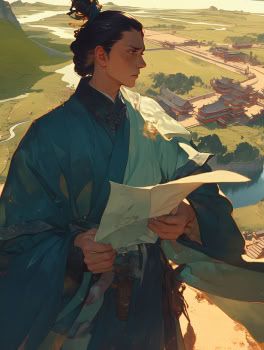
Chapter 7
“Who would have thought that Brian Cooper, that fool, would actually dare to argue with the officials?”
“He’s read himself silly—he probably can’t even tell who’s an official.”
“Look at him talking to that feng shui master. It seems even the feng shui master can’t outtalk him.”
“Well, no wonder. Brian Cooper is a xiucai, after all.”
“A xiucai…”
On the road from the well site back to the village, the crowd was still abuzz, discussing animatedly. The focus of all their talk was none other than the much-discussed Brian Cooper, who had just made quite a splash. Of course, opinions on the outcome of the matter varied: some said Brian Cooper was the reincarnation of the God of Literature, so his assessment of the well site was naturally more accurate than that of Stephen Brooks; others scoffed, saying Brian Cooper couldn’t even recognize all the crops in the field, so how could he possibly know how to pick a well site? Clearly, he was just putting on a show to avoid being blamed by the officials.
The villagers were all too familiar with Brian Cooper’s high scores and low abilities. In Longkou Village, there was a well-known joke that had been circulating for years, all about Brian Cooper.
It happened two or three years ago, when Brian Cooper was just fifteen and had gone to study for a few months at Longguang Academy in the county town. On the day he returned to the village, he passed by a field of crops and, feeling scholarly, called out to a distant uncle working in the field:
“Old farmer, what is this plant in the field, with red stems, green leaves, and white flowers?”
The uncle, seeing this kid showing off his book learning and even calling him “old farmer,” was so angry he nearly blew his top. He raised his hoe as if to hit him.
Brian Cooper was terrified and ran off, shouting as he went, “Help! Someone’s being killed in the buckwheat field!”
The uncle couldn’t help laughing and crying: “So you do know it’s a buckwheat field!”
From then on, Brian Cooper calling buckwheat “the plant with red stems, green leaves, and white flowers” became a favorite story for the villagers to mock bookish fools.
Brian Cooper’s family situation could only be described as impoverished. Back in his grandfather’s day, the family was doing fairly well—by later standards, they would have been considered well-off middle peasants. But by the time it got to Brian Cooper’s father, things took a sharp turn for the worse. When Brian Cooper was only four or five, his father contracted tuberculosis, struggled with it for five or six years, spent countless money, and in the end, couldn’t be saved.
After Brian Cooper’s father died, only Brian Cooper, his mother Emily Scott, and Grace Parker, the girl adopted as a child bride for Brian Cooper, were left at home. Fortunately, their ancestors had left them over a dozen mu of land, which in a southern village was enough to provide some security.
The real problem was that, as the only male in the family, Brian Cooper had been raised from childhood with the idea of taking the imperial exams. He spent all his time reading the Four Books and Five Classics, never stepping outside, leaving all the farm work to his mother and younger sister.
In the countryside, a family’s well-being depended on how much land they had and how much labor they could muster. Brian Cooper’s family had enough land, but not enough labor, which was a big problem. Emily Scott and Grace Parker worked themselves to the bone farming those dozen or so mu, but their harvest was still much less than other families’. By year’s end, they could barely scrape by, with nothing left over.
If Brian Cooper only ate and didn’t work, that would be one thing. The key issue was that not only could Brian Cooper not earn money, he was especially good at spending it. He had to go to the county and provincial capitals to take exams, and often went to the county town to consult with academy teachers. The travel expenses and gifts for the teachers were no small sum. The income from the land wasn’t enough, so to support his studies, they had to dip into their savings.
Raising Brian Cooper to be a scholar was his late father’s dying wish. His widowed mother Emily Scott carried on her husband’s will, supporting Brian Cooper’s studies no matter how much it cost. Since his father’s death, the family had already sold off three mu of ancestral land, and Brian Cooper had only just managed to pass the xiucai exam. If he wanted to go on to become a juren or jinshi, it was likely that even all their remaining land wouldn’t be enough.
The villagers all said that if Brian Cooper could really win top honors, then fine. But if he failed, and the land was all sold, the whole family would be left with nothing but begging.
The villagers gossiped behind his back, but Brian Cooper treated it like a breeze passing by. He walked home shoulder to shoulder with Grace Parker, already thinking about how to adapt to this new life in Ming Dynasty China.
Walking with her brother, Grace Parker felt both excited and worried. She was excited because her usually timid brother had suddenly become so bold and confident; worried, of course, about whether the well site Brian Cooper had chosen would actually yield water. If it turned out to be another dry well, the officials had said they’d arrest her brother and throw him in jail.
“Brother, are you sure there’s really water where you pointed?” Grace Parker asked Brian Cooper for the tenth time.
Brian Cooper smiled and said, “Of course. Don’t you know who your brother is?”
“When did you learn to read feng shui?”
“I’ve known for a long time,” Brian Cooper replied. “I read so many books every day—do you think I read them for nothing?”
“The books talk about feng shui?” Grace Parker asked.
“Of course. What do you think they talk about?”
“How would I know? I can’t read.”
“No problem. I’ll teach you to read in the future.”
“Really? But… it’s not much use for a girl to learn to read anyway…”

