Chapter 18
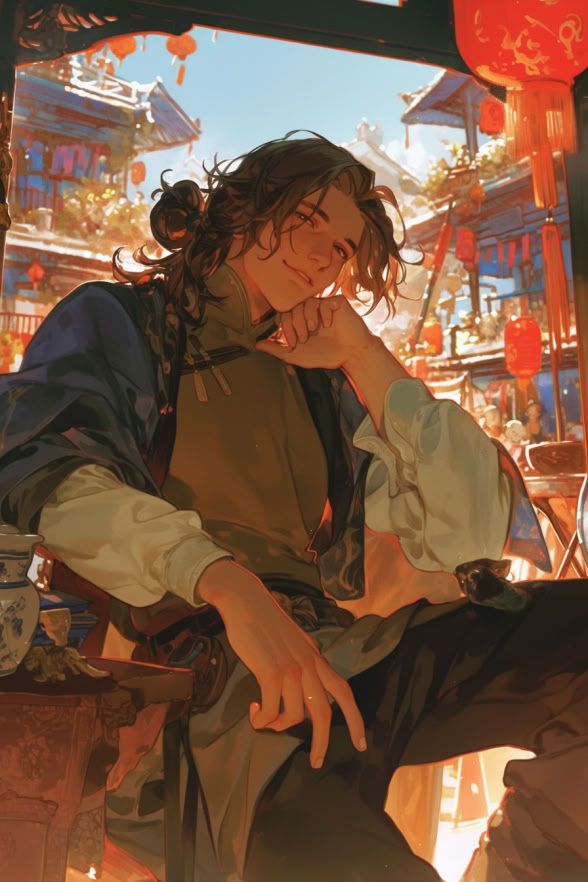
The further they walked, the more bustling it became along the way. After stepping onto this eastward cross street, there were no more residential houses in sight—on both sides of the street were either shops or government offices, one after another, packed closely together.
There were even more pedestrians on the street, including wealthy families in fine clothes, riding spirited horses and luxurious carriages, as well as common folk in simple attire, carrying loads on their shoulders or pushing carts. Everyone was minding their own business, not interfering with one another.
Even if someone recognized Andrew Bennett, the current Grand Councilor, they would only cup their hands in greeting on the spot—there wasn’t even a crowd gathering to watch. Thomas Foster's wish to act as a street-clearing bully by relying on the fox's borrowed authority was dashed once again.
Chapter 13 A Glimpse of Dongjing Bianliang
“Bustling? That’s not quite right—the Horse Market Street up ahead is where the real bustle of the city lies. Brother Jinqing, you’ve really put me in a tough spot this time. Prime Minister Wang surely won’t let me off easily. My life is over…”
Leonard Thompson was quite dismissive of Charles Bennett’s assessment. He pointed east with his fan, indicating that the real show was still ahead, and at the same time didn’t forget to complain about his poverty, subtly implying that Andrew Bennett was not of good character and was adept at taking advantage of others.
Thomas Foster still wasn’t sure about Andrew Bennett’s character, but he was certain his skin was thick enough. Listening to others slander his character at such close range, he managed to keep a straight face and act as if he hadn’t heard a thing—he was really going all out for this meal.
Sure enough, before they even turned north, Thomas Foster noticed that the number of pedestrians on the street had increased again. By the time they reached the intersection of the cross street and the north-south avenue, it was basically like joining the crowd at a Spring Festival temple fair. Except for a not-so-wide passage in the middle for carriages and horses, both sides were packed with people.
This made Thomas Foster feel a bit dazed, as if he had returned to the early years of the Donghuamen Night Market, when it had been just as lively. Back then, if you wanted to squeeze to the front of a stall to buy a snack, you needed some real skill, or you’d never get anything fresh out of the pot.
But this was a thousand years ago, and even when it wasn’t a festival, the streets were this bustling. It showed that people’s willingness to spend was strong, and that everyone had spare money and dared to use it.
This wasn’t a small matter—it was worth taking time to study how the Song Dynasty government stimulated consumption and boosted domestic demand.
This Horse Market Street wasn’t all restaurants and taverns; this section was already the northern end of the food district. Going one more block north, past the incredibly luxurious Pan Tower, the number of pedestrians dropped by more than half, but the “quality” increased significantly.
What did “quality” mean? Not looks, but wealth. Even without Leonard Thompson’s introduction, Thomas Foster could see the air of affluence and extravagance radiating from these people.
It wasn’t just the people—the shops on both sides of the street also rose in status. Every establishment was grand and imposing, and there were quite a few street performers at the entrances, all doing the same act: monkey shows!
“Brother Boshi, are all these shops pharmacies?” Thomas Foster couldn’t understand why there were monkey shows at the doors, but he could more or less read the shop signs.
Du Jingou’s Family, Cao Family Dushengyuan, Shanshui Li Family Throat and Mouth Medicine, Silver Child Bai Langzhong’s Pediatric Clinic, Big Shoe Ren Family Obstetrics… It was clearly a street dedicated to the medical and pharmaceutical industry.
“Indeed! This one is the most impressive…” Leonard Thompson gave a definite answer, pointing to the left side of the street.
“Damn… what a bold name!” Thomas Foster followed Leonard Thompson’s finger and was so shocked that even a modern catchphrase slipped out.
This was an even larger shop, and two things were astonishing: first, there was a live, fierce tiger with glaring eyes locked in a huge iron cage at the entrance, baring its teeth at passersby.
Second, the shop’s name was even scarier than the tiger—it was called “Tiger Wolf Medicine”!
Isn’t this just sabotaging your own business? With a name like Tiger Wolf Medicine, who would dare buy anything? But Thomas Foster guessed wrong—not only did the shop have customers, there were quite a few of them. It seemed that Song people were quite bold at heart, daring to eat anything!
After passing the Song Dynasty’s Gui Street, the pharmacy street, and the Dyehouse Bridge over the Wuzhang River, the appearance of the street changed again. No matter what the shops and taverns looked like at the entrance, or what was written on the wine flags, they all uniformly hung a string of red lanterns covered with bamboo hats.
“Brother Boshi, this doesn’t seem appropriate—I’m still with my family.” This time, Thomas Foster didn’t need to ask anyone. There were plenty of taverns with these red lanterns in Southern Song cities, and the meaning was basically the same as in modern times—a red-light district!
The sex industry in the Song Dynasty was legal and divided into two types: “ji” and “chang.” The former was higher-end, consisting of intellectual and talented women who were eloquent, well-mannered, and adept at socializing; even those of the next tier had to be skilled in music, singing, and dance—essentially, they were performers.
“Ji” sold their talents, not their bodies. They only accompanied guests for food, drink, and poetry, and even if they did sleep with a guest, it had to be mutual affection. Simply throwing money at them would be laughed at by scholars; you had to win them over with looks and talent.
This was very similar to Japanese geisha, a type of performing arts profession. Perhaps geisha originated from the Song Dynasty and were later passed to Japan. Due to dynastic changes, we lost this tradition, but it was preserved in Japan.
The author hasn’t researched this, but Japan does retain many Tang and Song customs and greatly respects the culture of those eras, while caring much less for post-Yuan China.

