Chapter 3
At this moment, no one cared about the lives of these conscripted laborers anymore. John Lewis had been waiting for just such an opportunity. He reacted instantly, shouting to the crowd beside him, “Follow me, run into the woods!”
John Lewis took off at a sprint, but he quickly realized something was wrong. The woods were still several hundred paces away, while the Cao army cavalry was already only two hundred paces behind, moving much faster than them. They would be slaughtered before they could reach the trees.
John Lewis’s quick thinking from the modern era came fully into play at this moment. He immediately dropped down in a hollow, dragged seven or eight corpses over, and piled them on top of himself, peeking out through the gaps between the bodies to secretly watch behind him.
By now, the Cao cavalry had arrived, and a dense volley of arrows rained down. Hundreds of laborers who ran a bit slower screamed as they were shot down.
This cavalry force was six thousand elite riders led by Henry Clark, ordered to launch a surprise attack on Abraham Lewis’s reinforcements. He split his troops into two groups: one thousand cavalry were tasked with escorting the captured laborers, while the remaining five thousand, under Henry Clark’s command, waited behind for the right moment to strike.
At this time, the thousand Cao cavalry escorting the laborers had already charged into the enemy archers’ formation, eliminating the threat of arrows for the main force of Cao cavalry. They began their assault, sweeping toward the main force of the Yellow Turban army.
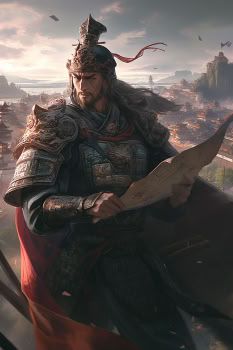
Henry Clark stood eight feet three inches tall, with broad shoulders and a thick waist, his gaze cold and sharp as lightning. He wielded an eighty-jin iron spear, looking like a god of war.
He roared, “Slaughter them all!”
The iron cavalry of Cao’s army charged in like a violent storm, as fierce as tigers and leopards. Wherever they passed, heads flew, limbs were torn apart, blood mist filled the air. The desperate laborers were trampled under iron hooves, wails echoed everywhere, and the ground was churned to mud by the horses.
Samuel Grant led the Yellow Turban army to meet the attack. He swung his broadsword, challenging Henry Clark, but after only a few rounds, he could not hold out. He turned his horse to flee, but his horse was slow. Henry Clark caught up and drove his spear through Samuel Grant’s back. Samuel Grant let out a miserable scream and died on the spot. Henry Clark lifted his corpse high and laughed loudly, “Is this the army of the Big-Eared Thief?”
With the main general of the Yellow Turban army killed, the troops quickly collapsed, and a brutal massacre unfolded across the plain.
When the last warhorse leaped over John Lewis’s body, John Lewis sprang up from the hollow and dashed madly toward the woods several hundred paces away. This was his only chance to escape.
In just half an hour, more than twelve thousand of Samuel Grant’s soldiers were dead or wounded, with only a few managing to escape. The conscripted laborers captured earlier were also nearly all killed in the chaos.
The Cao cavalry seized part of the grain supplies and burned the rest, then the six thousand riders turned south toward Ancheng.
By now, night had fallen. The vast wilderness was filled with the stench of blood. Packs of wild dogs appeared, gnawing on the corpses. At this moment, staying far from the battlefield was especially important.
John Lewis ran more than twenty li in one breath. He was clever—after entering the woods, he circled in a wide arc and headed northwest, which was the direction the cavalry had come from. This way, he could avoid running into them.
Chapter 3: An Ox Cart
He ran into a low hill, thickly wooded and now free of danger. He found a large rock to sit on and rest, panting. The few laborers who had fled with him had all scattered, leaving him alone.
John Lewis sighed. He had been in this era for three days now, and only at this moment could he finally calm down and think.
In fact, he could already guess what time period this was. He was well-versed in Romance of the Three Kingdoms, and after hearing some laborers mention Runan Commandery—“Runan Commandery, Cao army, Yellow Turban army”—he pieced these clues together and began to understand.
This must be when Abraham Lewis left Charles Young and took over the remnants of the Yellow Turban army under Brian Lewis and Samuel Grant in Runan, preparing to attack Xudu, only to be counterattacked by George Adams.
Yes! It was the sixth year of Jian’an. John Lewis suddenly remembered—next, Abraham Lewis would go to seek refuge with William Lewis in Jingzhou.
So, what should he do? Should he go to William Lewis, or... to George Adams? Of course, he should go to George Adams, but what could he offer?
John Lewis’s mind was in turmoil, unable to make a decision for the moment.
Just then, his stomach growled. He reached into his clothes and, to his surprise, found half a flatbread—apparently left over from lunch. He was overjoyed; with this half a flatbread, he could last until tomorrow morning.
John Lewis took out the bread and took a couple of bites. In the Han dynasty, they didn’t know how to ferment dough, so all the bread was unleavened, very tough and hard to chew, and so dry it was difficult to swallow. That’s why this kind of bread was called “water-dipped bread”—it had to be broken up and soaked in water to eat.
The bread was really hard to swallow, and his throat felt like it was on fire. John Lewis stood up and looked around—he needed to find a stream.
This was a low, gentle hill, only slightly higher than the plain, but stretching for more than ten li in every direction, the whole hill covered in dense forest. In the middle of the woods, an official road ran east to west—the only route to Jingxiang in the west.
At night, the woods were full of strange noises. The shrill cries of night owls sounded from time to time, sending chills down his spine. Without anything to defend himself, he dared not walk through the forest.
War had broken out in Runan Commandery, and corpses were everywhere. Packs of wild dogs roamed the wilderness, and if he ran into them, he would surely die.
John Lewis walked west along the official road for about two or three li, when he found a fork ahead. Listening carefully, he seemed to hear the sound of running water coming from the direction of the fork.

