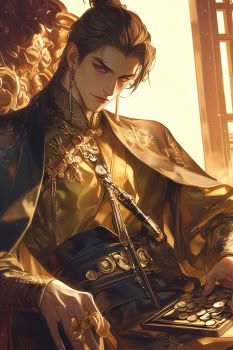
Chapter 12
Speaking of which, opening a light bulb factory should be quite a good idea. At this time, they’re probably still using bamboo filaments, right? Later, I’ll make a tungsten filament myself and then go apply for a patent. Boss Young is getting ready to steal Edison’s thunder.
But it seems that tungsten hasn’t been industrially produced yet at this time? Who cares! There are still several hundred tons of metallic tungsten on the shuttle! That should be enough for filaments to last eight or ten years.
His shuttle doesn’t just have steel; there’s tungsten, molybdenum, nickel, chromium—everything. Without his behind-the-scenes support, Little Beard wouldn’t have been able to fight the US, UK, and Russia to such a standstill.
Woolf acted quickly. The next day, he hung a pair of big red lanterns high at the entrance of this Tudor-style villa. Amidst the surrounding British architecture, it looked like a Chinese bride about to get married had suddenly been placed among a group of high-society ladies in corseted hoop skirts, so tightly bound they could barely breathe—a jarring sight that made people want to spit blood.
But the shop was open now. As for what to sell, that still needed careful consideration. Things like penicillin definitely couldn’t be sold in bulk—at most, they could be put on display outside, just to stoke the resentment of those poor folks in the East End toward high society.
Although his medicines also had shelf-life limitations—at most three years—the shuttle could provide all kinds of preservation methods: vacuum where needed, refrigeration where needed, sterile where needed. So he wasn’t exactly sure how long the shelf life could be extended, but four or five years shouldn’t be a problem. Of course, he had no intention of playing savior in this world; to put it bluntly, the medicines were just a means of self-preservation, so he would only supply them to the upper class. The life and death of ordinary people was none of his business. Besides, with workers earning just a few shillings a week, how much profit could he possibly make from them?
Even if Portrait of a Lady could soon solve her troubles, this guy still didn’t plan to sell medicines here in bulk, let alone build a pharmaceutical factory. Before, there was pressure because of the invention dates of these drugs, but in this era, he felt no such pressure.
On the other hand, daily chemical products could be sold in large quantities—women’s money is always the easiest to make. The problem was, there weren’t many daily chemical products in this batch of goods. There was nothing he could do about that. The whole world over there was at war, blood was flowing everywhere, and even ordinary Europeans were struggling to eat—who had spare money for vanity? So there were less than three hundred tons in total.
He needed a mass-market product.
After returning to the shuttle, Franklin Young paced slowly in the spacious cargo hold. Soon, his eyes landed on the several thousand tons of aerospace materials he had. Although the electrolytic aluminum process had already been invented and aluminum was no longer a precious metal, aluminum alloy could still shine in jewelry stores. Not to mention titanium alloy. These thousands of tons of aerospace materials weren’t of much use anyway—better to turn them into jewelry and make money. As long as the price was lower than silver, it was sure to sweep the world.
Chapter 7 Aluminum Alloy Jewelry
As for processing aluminum alloy jewelry, it was actually quite simple. Things like bracelets, necklaces, and earrings could be made by Portrait of a Lady with a few squeezes of a robotic arm. Later, they could be inlaid with stones or whatever. Anyway, she had nothing to do at the bottom of the sea, and Franklin Young’s computer had plenty of jewelry designs—these were all modern popular styles, which he used as references when buying jewelry in the Republic era.
He patted the cabin wall to call out Portrait of a Lady. After understanding Franklin Young’s intentions, a dozen small robotic arms quickly extended, and, like children playing with clay, they pinched off small pieces from the aluminum alloy profiles and, at dazzling speed, produced a pile of beautiful jewelry in just a few seconds—even the patterns were engraved.
“Very good, very good!” Franklin Young beamed as he put an aluminum alloy ring on his finger. This ring, modeled after the One Ring, looked silvery and shiny, though the color was a bit lacking and the brightness was a little off. But after Portrait of a Lady gave it a heat treatment with an electric arc, it became absolutely perfect. Under the sun, it gleamed brilliantly—gold and platinum paled in comparison to aluminum alloy jewelry, and as for silver, it was practically trash.
Gazing at the ring on his finger with greedy eyes like Gollum, Franklin Young decided to price aluminum alloy jewelry the same as silver.
He wasn’t in a hurry to go back. Like a ruthless foreman, he sat in the cargo hold, personally supervising Portrait of a Lady’s work, and occasionally made special requests—like making an aluminum alloy phoenix over a meter tall, which he planned to give to Lady Grace. But the phoenix’s eyes were still empty; he wanted to learn from Frederick Lee how to set a couple of uranium ore stones in there. In front of that, any gemstone would be utterly outclassed.
But just making jewelry wouldn’t be enough to use up all his aerospace materials—there were several thousand tons, after all! Even if he gave one piece to every person on Earth at this time, it probably wouldn’t use it all up. He needed a product that could increase consumption.
Or maybe he could try making aluminum alloy yachts or aluminum alloy carriages—start with carriages. There weren’t even cars yet, and even if there were, it would be a while before they became practical. The old British pirates were just competing with each other over carriages. Compared to wood, aluminum alloy was definitely a luxury item.

