Chapter 2
In China in 2022, under vigorous anti-pollution efforts, the sky had returned to a clear blue. This was completely different from the scene predicted in the post Brian Sullivan had seen six years ago. Brian Sullivan's belief in the apocalypse had wavered before, but after being persistent for so many years, he didn't want to give up halfway and continued modifying his big truck.
Zzzzt, zzzzt.
The electric welder fused steel together as Brian Sullivan stood on top of the big truck, installing a small radar on the lift platform. This small radar was a military battlefield reconnaissance radar, AN/PPS-15A. Brian Sullivan had spent nearly 400,000 yuan to get this scrapped item through a contact at the provincial capital's radio enthusiast club.
Those with connections at the club could get some defective or scrapped items from the military and then resell them at high prices.
To repair this radar, Brian Sullivan had spent a lot of time learning about it. Fortunately, he was smart and had experience in repairs, so after nearly a year, he finally fixed the radar today.
Because this radar was extremely valuable, Brian Sullivan specially designed a lift platform for it. When needed, it could be raised up, and when not in use, it could be lowered into the truck compartment.
Half an hour later, the installation was complete.
Brian Sullivan looked at the 15A radar with satisfaction and decided to use sandpaper and a file to polish the welded areas until they shone, then spray on camouflage paint—then it would be perfect.
Bang!
Brian Sullivan jumped straight down from nearly four meters high off the top of the truck, pulled out the electronic truck key from his waist, and pointed it at the big truck wrapped in steel-spiked armor.
With two clicks, the armor covering the front of the truck opened, and Brian Sullivan leapt up in one swift motion.
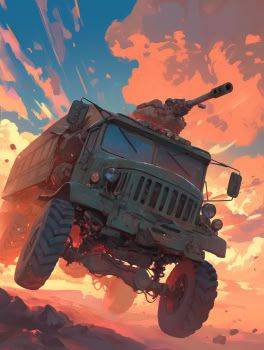
The truck was a Volvo New FH heavy-duty truck, with a 16.1L engine, a maximum of 750 horsepower, 12 forward gears, 4 reverse gears, and a top speed of 120 km/h. Those were the original specs, but after Brian Sullivan's modifications, it was completely different. Brian Sullivan had added two 6-cylinder engines at the rear wheel position of the truck cab.
The nine-meter-long container at the back had also been raised and widened. Now it was 3.9 meters high and 3.5 meters wide. The whole thing was wrapped in steel plates welded with steel spikes. Unfortunately, considering the load capacity, Brian Sullivan could only install 16mm steel plates. With a full circle of steel plates, the total weight was 30 tons, just barely not affecting the speed.
At the front of the cab, he had also installed a bulldozer blade taken from a bulldozer. The blade was a full four meters wide, almost able to sweep away any obstacle.
Reinforcing the exterior actually didn't take much effort; what really took Brian Sullivan six years to build was the internal modification of the truck.
You could say that, except for the name, every other part of this Volvo heavy-duty truck had been replaced by Brian Sullivan.
To protect the windshield, which was a weak spot, Brian Sullivan had considered installing bulletproof glass, but eventually gave up on that plan and switched to full steel plate armor. As for seeing outside, he used cameras and periscopes. Thus, the cab had been converted into an automatic driving system.
Inside, eight computer screens of various sizes were mounted, controlling every part of the truck.
Brian Sullivan skillfully pressed buttons on the control panel, opened one of the screens, and entered a string of code. Soon, a radar search progress bar appeared. About a minute later, the search was complete, the top radar was connected, and a scan image appeared on the screen.
The battlefield reconnaissance radar could detect moving vehicles, personnel, and other targets within a range of one kilometer.
The reason for installing this radar was that Brian Sullivan always fantasized that, if he ever encountered a skirmish in the apocalypse, he could detect the enemy in advance and escape. In addition, both the front and rear of the truck were equipped with infrared thermal imagers, which, combined with the radar, allowed for even more precise observation of the surrounding environment.
"Vroom vroom!"
He started the engines, and all three roared at once. Brian Sullivan immediately drove the heavy truck around the warehouse yard, feeling the wild impact of the war machine. If the truck weren't so eye-catching, he would have loved to take it out on the highway to experience the thrill of speeding, but for now, he could only circle around the small yard.
This warehouse was very large and located in a remote area, surrounded by walls nearly four or five meters high, blocking all view of the inside. Since the surroundings were all farmland, there were no taller buildings to look in.
Only occasionally would local farmers working in the fields hear the roar from inside the walls.
If you walked inside the walls, you would find that the vast abandoned warehouse yard was piled with all kinds of scrap and rusty steel parts at the base of the walls, with broken tires stacked in one corner like a wall. However, despite the amount of junk, it was all stacked very neatly.
A small forklift was parked in the corner, clearly used for stacking the scrap.
Beyond the piles of scrap was the steel-framed, abandoned warehouse. The warehouse was clearly old, with many damaged areas, but they had been roughly patched with various steel plates.
It was wrapped up like a can of scrap metal.
Over these six years, Brian Sullivan had given up the comfortable life of the city and lived here alone.
After getting his fill of driving, he parked the war truck in the center of the yard, opened the armor at the front, and jumped down. Looking at the war machine shining silver in the sunlight, covered in dense welding marks, fierce and domineering, Brian Sullivan finally felt a trace of security in his heart.

