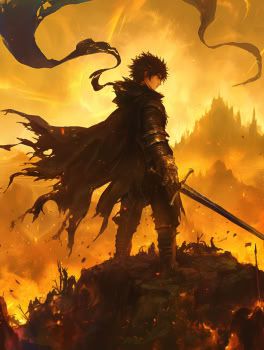
Chapter 8
It was a tree branch that was thick at the back and thin at the front. After Henry Clark climbed up the tree, he hung his whole body on the branch and finally managed to break it off. Then Henry Clark used a stone to sharpen the branch to a point, carefully roasted it over a fire to carbonize it and increase its hardness, and only when the sun had completely set was his wooden spear finally finished.
When night fully descended, the surroundings were truly pitch black. There was only a sliver of moon in the sky, and it seemed as if, apart from his campfire, there was nothing else in the entire world. Although there were faint sounds of insects around, this only added to the gloomy terror. In Henry Clark's eyes, everything illuminated by the firelight—whether rocks, trees, or anything else—looked twisted and frightening, as if countless monsters were lurking in the darkness.
If it were an ordinary person in such a situation, their mind would probably collapse. Even if not, at the very least, their nerves would be stretched taut, and it wouldn’t be long before they completely lost control. But Henry Clark, on the contrary, became even more calm. He simply sat by the fire holding his spear, eating fruit one by one. Although there was fear in his heart, he didn’t let it spread. He stayed alert to his surroundings, but didn’t appear afraid. Even he was surprised by his current state—he had never experienced anything like this in the past decades.
“People really are forced to adapt. If I hadn’t been pushed this far, I wouldn’t have known I actually had a talent for wilderness survival.” Henry Clark gave a self-deprecating, bitter smile, finding amusement in his hardship.
But in fact, even he hadn’t realized that this wasn’t a talent for wilderness survival at all, but something much more advanced—a kind of aptitude.
After another hour or two, Henry Clark was adding firewood while calculating how much he’d need for the night. Once he finished, he planned to climb a tree near the fire and take a nap. Suddenly, at that moment, he heard the howl of a wolf.
The instant he heard the wolf’s howl, Henry Clark’s hair stood on end. He grabbed his spear and sprang to his feet, his body moving faster than his mind could think. In a flash, he darted up the nearby tree. In less than ten seconds, he was already at the treetop, lying motionless, making not a sound except for his heartbeat.
(A wolf? There are wolves here?)
Henry Clark’s heart was overflowing with fear, but the more afraid he was, the calmer his mind became, which surprised even himself. But now was not the time to think about that. He held his breath, made no sound, and lay quietly at the treetop without moving. The treetop was shrouded in darkness, and with the fire below drawing attention, even someone standing under the tree would hardly notice him. Henry Clark waited silently in the tree, not moving even when bitten by mosquitoes. After an unknown amount of time, a shadowy figure emerged from the darkness.
Henry Clark didn’t dare look directly at the creature, only watching it from the corner of his eye. He had previously read on the prehistoric Heavenly Court government network that people with a second-level gene lock or higher would become sensitive to hostile gazes, and wild animals had this kind of instinct as well. If it was a magical beast, this instinct might even evolve into a natural skill. Henry Clark would never make a mistake on such details, so he only watched the creature with his peripheral vision.
Soon, a large gray-blue wolf stepped into the firelight. Judging by sight, it was a giant wolf over three meters long including its tail, about the size of a calf. Its gray-blue fur was quite rare. Henry Clark didn’t know if wolves on the prehistoric continent were like this, but at least in the world of Earth, such a creature could never exist—maybe in ancient times, but almost certainly not now.
This giant wolf was truly terrifying, but what caught Henry Clark’s attention was that it wasn’t a pack, but a single, solitary wolf. That was the first thing. The second was that this giant wolf was injured, and badly so. There were bloodstains on its back, with a whole patch of fur torn off, and a huge gash on its belly. Although it had already scarred over, the wound had nearly split its belly in two. How could it have survived such a serious injury?
Finally, there was a large wound on the wolf’s skull, and one of its eyes was even blind. Its appearance was extremely frightening—the wound on its head exposed the bone, and there was a hole about the size of a thumb in its skull, as if some other beast had bitten a chunk out of it, not only piercing the bone but also tearing off much of the skin.
(This is a lone wolf. I wonder if it’s the result of a destroyed pack, or if it was once the wolf king driven out of its pack…)
Henry Clark pondered. Although he wasn’t an animal expert, he’d seen countless wildlife documentaries, and novels and comics often mentioned that lone wolves were the most dangerous kind. Usually, lone wolves were either former wolf kings or survivors of a destroyed pack. Either way, lone wolves were filled with brutality and murderous intent. Ordinary wolf packs, when encountering a potentially dangerous enemy or beast, would usually retreat, but lone wolves were different. They would lurk in the darkness and fight their prey to the death, making them the most dangerous of all.

