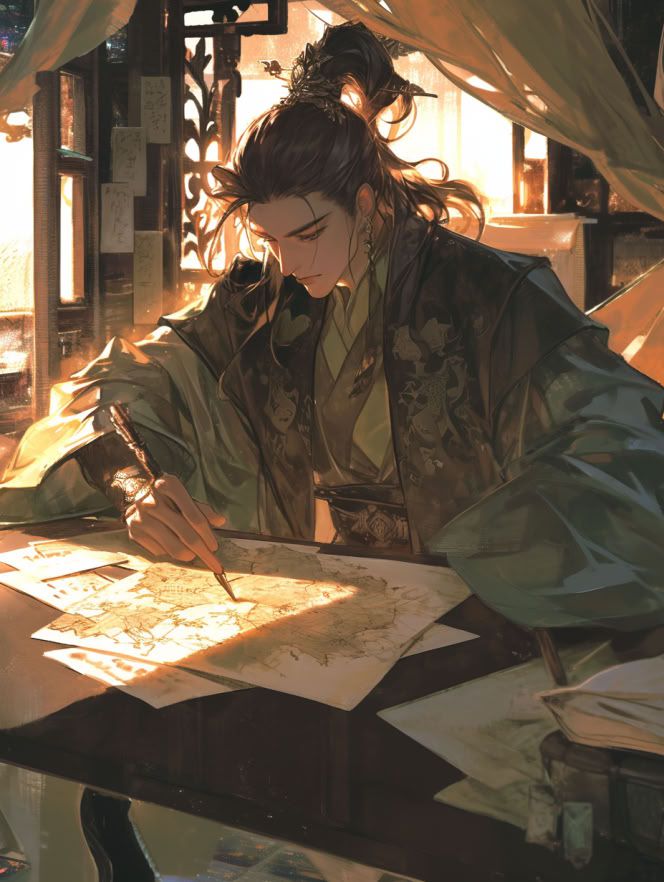
Chapter 7
Alright, these are all minor details. My first priority was to return to society. After I finished dismantling the car, I sorted all the parts and hid them in the cave. I re-armed myself with parts from the car—using a makeshift grinder to sharpen two steel plates into three long knives; cutting several steel pipes diagonally to make spearheads; fashioning two crude wooden bows with a simple traction device, and bringing along the animal hides I’d recently hunted. Fully armed, I led the two wild men down the mountain again...
Chapter Two
Log Three: Secretly Delighted in the Spring and Autumn Period
The small villages we usually traded game with were, at most, just larger hunter settlements.
The encounter I remember most vividly happened at the foot of a hillside. At the time, a middle-aged man was kneeling in front of a grave mound, beating his chest and stamping his feet in grief, while in our group, the big wild man led the way in front, the little wild man bounced behind me, and I walked down from the ridge. When I saw this person, I stopped and curiously sized him up.
This was the first “fully dressed” ancient person I had ever seen.
He was wearing a very old-fashioned outfit: a robe that was joined top and bottom, a tall crown hat, and the fabric looked unusual, seemingly not woven from cotton. The whole outfit had no decorations or buttons, just a cloth belt tied around the waist... Hmm, I once had a friend who liked “Hanfu,” and according to him, this kind of clothing is called “Hanfu.” It’s the traditional attire of the Han people. It first took shape in the mid-to-late Spring and Autumn period. Because the top and bottom are joined, it’s called “shen.” And since the lower part is a skirt, it’s also called “qun”—the full name is “shenyi ruqun.”
...Well, in modern times, it’s already called “kimono.” Uh-huh, in other words: this guy is dressed like a “collaborator.”
The grave mound in front of him seemed newly built, covered with fresh earth, and at that moment, the man was wailing in utter despair.
The reason I stopped was because his clothes were so neat—he was the best-dressed person I’d seen since I crossed over. Usually, I only saw wild men and hunters. For warmth, most of them wrapped themselves in animal skins. For ease of movement, their clothes were separated top and bottom, which shows that, no matter the era, wild men’s clothing doesn’t change much and is quite similar to modern clothing.
After many days of learning, I had already mastered the monosyllabic language used by the wild men. Standing in front of the new grave, I switched to their language and cautiously greeted him, meaning roughly: “Sir, please restrain your grief... Um, by the way, may I ask, where is this place?”
He looked up, his eyes brimming with tears, and observed me. After a long while, his expression suddenly changed, and he blurted out a question—in the wild men’s language, which, translated into modern speech, meant: “Who are you? Where are you from?”
In his question, the word for “you” seemed to be an honorific. At the time, I didn’t fully understand the wild men’s language. Much later, I realized his original words were “Where does the young master come from?” And the term “young master” wasn’t something just anyone could use back then.
Translating the wild men’s language into modern speech was too troublesome, so I tried my best to communicate with him using their language and modern thinking: “I ‘traveled’ through the great mountains to get here, but I still don’t know where I am. What is this place?... May I ask, which country is this? What dynasty?”
He didn’t answer my question, but instead asked, “What? Which country are you from?”
I looked down at myself, then at him: Hmm, that’s right—yellow skin, black hair, black eyes... Couldn’t he tell I was Chinese too?
I retorted, not too politely, “Which country are you from?”
To my shock, he gave an answer that stunned me: “I am a man of Jin. This is near Zhao City of the State of Jin...”
Zhao City of the State of Jin?!
His answer left me pondering for a long time. Still puzzled, I asked, “May I ask your honorable name?”
I asked this in the wild men’s language, which was clumsy, but the meaning was clear enough.
He was quite polite, cupping his hands and replying, “My humble name is Ying, given name Ethan Brooks.”
I pressed down my wildly beating heart and asked, “What year is this?”
He replied, “Some year after Duke Jing!”
Seeing I was still dazed, he quickly listed a few more reign titles—something like the Xth year of such-and-such lord of Lu, the Xth year of such-and-such lord of Qi. Finally, he said something that made everything clear: “The Xth year of King Jian of Zhou...”
I gaped at him in astonishment—no doubt about it, the Bronze Age. I should have thought of the Bronze Age earlier; yes, the clothes he wore weren’t made of cloth, but of hemp; the words he spoke were all monosyllabic, such a primitive language, and, and... how could it not be the Spring and Autumn period now?
I looked up at the sky, felt the air around me. It was the turn of spring and summer, and since this was a mountainous area, the weather wasn’t hot yet. The air was very humid, even a bit chilly, but he, dressed in hemp, didn’t show the slightest sign of shivering—truly hardy!

