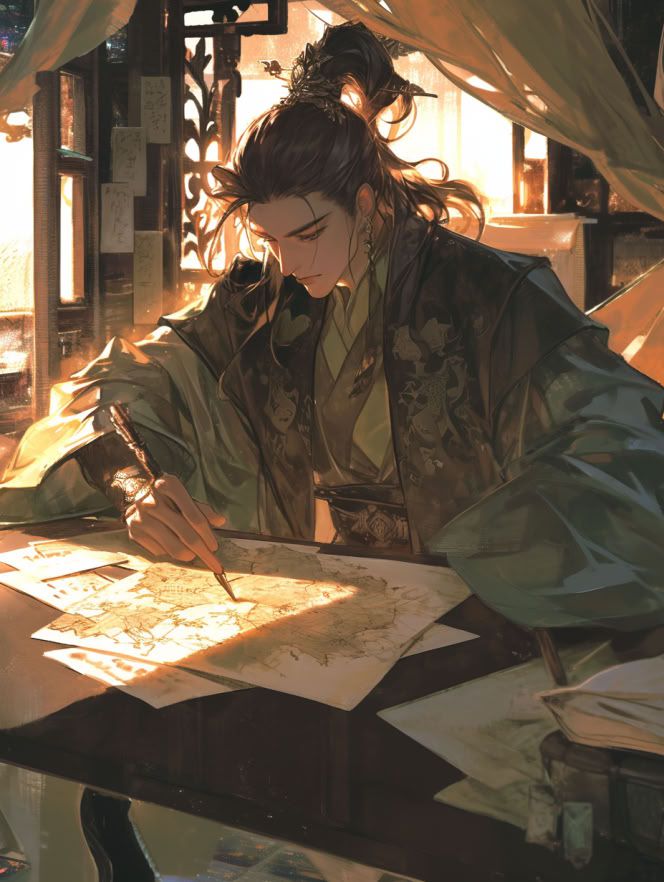
Chapter 11
It was also through their teaching that William Carter came to know that the term "gongzi" (young master) was an exclusive title at the time, specifically referring to the descendants of the king.
Back then, when Ethan Brooks addressed him as "gongzi," it was a kind of test, because although William Carter's clothes looked strange, the fabric was of good quality, clearly belonging to the high-end goods of the Spring and Autumn period. Moreover, William Carter's every gesture carried the confidence of a cultured person—and culture, in the Spring and Autumn period, was the exclusive domain of the nobility.
At that time, William Carter was also accompanied by two attendants—during this era, a two-legged person was either a slave or a noble; to have one's own servants was a sign of extraordinary status.
As a noble, Ethan Brooks would never believe that those two wild men from the mountains just happened to meet William Carter by chance and then immediately decided to follow him—Ethan Brooks couldn't understand the mindset of slaves, just as William Carter couldn't understand his way of thinking.
And this era was precisely the time when slavery was transitioning to feudalism. In this era, slaves had no guarantee of survival; they faced constant pursuit, attacks from wild beasts, and harsh living conditions, making their lives extremely difficult. They had no status, so they couldn't go down the mountain; if they appeared before people, they would be captured and enslaved again. So, in the mountains, when the two wild men saw the precious sword and utensils on William Carter, and determined that he came from some "noble clan," they immediately decided to pledge their allegiance.
In the Spring and Autumn period, the treatment slaves received was far worse than that of household servants following a "gongzi," even if the young master was a refugee from a fallen state. So, the two wild men immediately expressed their wish to follow William Carter, but unfortunately, William Carter didn't understand at the time. However, when he later rewarded the two wild men with half a bottle of wine and gave them small knives after the "offering," this was actually a customary gesture of "permission to follow" at the time.
Hmm, William Carter later tasted the wine of the Spring and Autumn period himself, and after he did, he deeply regretted having given half a bottle of leftover wine to the two wild men—compared to the sour wine of the Spring and Autumn period, that half bottle of leftover wine was like nectar from the heavens.
Now, William Carter couldn't explain his own identity. Since both the wild men and Ethan Brooks believed he was a refugee "gongzi" from some state, he simply accepted it. As for which state he was from—small states perished every day in this era, and with information mostly spread by word of mouth, there was no way Ethan Brooks could investigate who he really was.
Afterwards, thanks to William Carter's insistence, the two wild men finally gained official status—as formal noble servants.
With status came the need for names. In the Spring and Autumn period, surnames were not prominent; basically, most people had only a single-syllable "given name," and those who had names were mostly nobles—ordinary people didn't even have a name. Even for nobles, their surnames were vague. For example, "William Carter" is an honorific; it means "the one named Wu, whose fief is Zhao."
William Carter wasn't used to simply calling his slaves "hey," so after these two were officially confirmed as his subordinates, he gave them names: the elder was called "Ethan," and the younger was called "Henry" (pronounced the same as "lian"), to commemorate meeting them by the water.
Once they had settled down and the two wild men had cleaned themselves up, William Carter realized that the so-called "elder" wasn't actually that old, and the "wild child" wasn't that young either. Both were just over twenty; the older one might be close to thirty, and the younger just over twenty. It was only because of the harsh living conditions of the era that they looked older than their actual age.
As for William Carter, who had always lived in the city, although he was just over twenty, the time travel and modern self-care made him look almost eighteen or nineteen—perhaps this was why Ethan Brooks had him impersonate William Carter.
The wild child "Henry" was a restless person. For days, he had been trying to approach the warriors outside the courtyard, but they completely ignored him, so he had to find his own amusement. Now he had fallen in love with playing with mud, enthusiastically molding clay in the yard, with a pile of discarded pieces on the ground, yet he remained undeterred, moving on to his next creation.
William Carter, bored, strolled over to Henry, looked at his work, and pretended to understand, nodding in appreciation.
Henry was making a frying pan; it was clear he was imitating the kind of outdoor cooking pot William Carter had brought. The little pot looked like a small clay jar, and "Henry" was doing his best to make the sides of the frying pan neat and round, but unfortunately, his efforts often failed, and the ground was littered with misshapen rejects, none of which looked right.
William Carter looked up and sighed—he lamented in modern language: "This era is truly 'wicked'; the primitive living conditions have turned everyone into a decathlon champion. Look, even wild men from the mountains are starting to make pottery."
"Henry" didn't understand William Carter's lament. He held up the clay jar in his hand and asked ingratiatingly, "Master, does this shape pass?"
William Carter sighed and replied in the language of the Spring and Autumn period, "Pottery isn't such a simple craft. Back in the day, I spent a month at a pottery studio and only learned a bit of the trade. You're a hunter—what are you doing playing with pottery?"

