Chapter 2
But ideals are just ideals; reality is always harsh. At present, he was nothing more than an insignificant low-ranking soldier at the Huo Road Fort. His former reputation for cowardice made it so that anyone could step on his head. Although now, after Henry Carter had taken over the body, he had become much colder and more silent, appearing less easy to mess with, unless he actually did something, others still treated him as invisible. The hardest and dirtiest work in the fort was still assigned to him first, such as the daily task of fetching water from several li away.
Years of drought had dried up the well in the Jingbian Fort where Henry Carter was stationed, and the daily water needs of the few fort soldiers and their families fell on his shoulders. Just carrying water meant he had to make several trips a day between the river and the Huo Road Fort.
This river was called the Dongfang River by the locals. It originated from the southern mountains of Bao’an Prefecture, flowed through Huiyao Fort, Shunxiang Fort, and Dongjiazhuang, and then, after another ten li downstream, joined the later-famous Sanggan River. At this time, it was called the Hun River.
Looking out, the waters of the Dongfang River were clear, and both banks were lined with green grass and trees. But beyond the riverbanks, there were vast stretches of dry land, and with every gust of wind, clouds of dust would be swept up. On both sides of the river, there were some garrison or civilian fields. The river meandered northwest, continuously nourishing and irrigating the land along its banks. However, due to years of drought, the water level had dropped significantly, exposing many sandbanks.
Henry Carter withdrew his gaze, calculating that after this trip, his daily quota of water-carrying would be done, and he could relax a little.
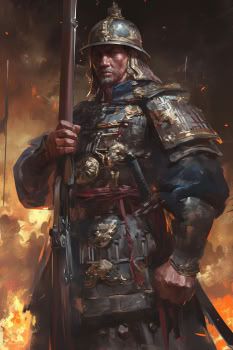
At the moment, he was wearing a tattered red cotton jacket, its once-bright color almost completely faded. The red military cap on his head was about to fall apart, and his feet were shod in equally worn red cloth shoes. This was the standard uniform of the Ming army: the Mandarin Duck Battle Jacket.
By old regulations, Ming soldiers were issued a new Mandarin Duck Battle Jacket every three years, but by now, many border troops of the Ming had not changed their uniforms for ten years. The uniform on Henry Carter was also ragged, but though patched, it was washed very clean—thanks to his child bride Grace Bennett, whose diligence needed no praise.
At Henry Carter’s waist hung a wooden badge identifying him. On the front, it was inscribed with “Fort Soldier Guard Henry Carter,” and on the left, “Bao’an Garrison, Brave No. 845.” The back read, “Any fort soldier guard must carry this badge; those without it will be punished by law. Lenders and borrowers will be punished equally.” This was Henry Carter’s crucial proof of identity while stationed at Jingbian Fort—losing it would be a serious crime.
Next to the water bucket lay his spear. As Henry Carter picked it up, a feeling of blood-deep connection surged within him. In these precarious times, this spear was his greatest guarantee of survival. Holding the spear in his left hand, he bent down to lift the water bucket, and habitually glanced around, alert to any movement. He couldn’t afford not to be careful. Although most of the Later Jin army had moved toward Datong, there were still small bands of raiders active around Bao’an Prefecture and Huailai Garrison, so he had to be wary of running into them.
On the seventh day of the seventh lunar month last month, the Later Jin Khan, Hong Taiji—called Huang Taiji by the Ming—after conquering the Mongol Chahar tribe, used the pretext of Ming border officers disturbing his territory, killing his people, and harboring fugitives, to lead tens of thousands of troops through Shangfang Fort, breaking through the defenses. He then plundered throughout the Xuanfu Garrison, even besieging the garrison city. The defenders of Xuanfu fired cannons to repel him, and Huang Taiji retreated toward Datong. News of the Later Jin invasion shocked the Ming. On the ninth, the capital was placed under martial law, and the Ministry of War urgently ordered General William Brooks of Baoding to defend Juyong, and Governor Edward Cooper to guard Zijing, to prevent the Later Jin from entering the capital region.
On the twenty-third of July, five days before Henry Carter arrived in this world, the central army of the Later Jin captured Bao’an Prefecture, causing countless military and civilian casualties. The prefect Samuel Clark committed suicide in loyalty. Afterwards, the central army, led by Ajige, retreated toward Datong to join Hong Taiji. When Henry Carter arrived in this world, Bao’an Prefecture was still devastated everywhere. According to Henry Carter’s knowledge of history, although most of the Later Jin army should be rampaging around Datong at this time, they would not fully withdraw beyond the border until the leap eighth month, so he still had to be careful.
……
Henry Carter walked eastward carrying the water. His body could be described as broad-shouldered and sturdy; even carrying two heavy buckets for several li, he felt no strain.
The road was flat all the way, and looking around, the terrain was open and the soil quite good. Bao’an Prefecture was the later Zhuolu County, but at this time, it was much larger than its future counterpart. Places that would later belong to Huailai County—Xinbao’an, Dongbali, Xibali, Shacheng, Sangyuan, and others—were all important fort towns under Bao’an Garrison.
The environment around Bao’an Prefecture was excellent, long known as “A thousand li of Sanggan, Zhuolu alone is rich.” On both banks of the Sanggan and Yang Rivers, the land was fertile and irrigation convenient; rice could even be grown here. Especially on the south bank of the Sanggan, with its extensive network of irrigation channels, it was a key area for military farming in Xuanfu Garrison. To protect these lands from disturbance, a dense network of Huo Road Forts had been built in the area.
However, in the region around Shunxiang Fort, as it was already close to the hills and mountains, irrigation was not so convenient. Coupled with increasingly severe droughts in recent years, except for the fields near the rivers and canals, Henry Carter saw that many once-excellent fields had gone to waste.

