Chapter 15
There were both men and women among these commoners, young and old alike, all panicking and crying out, their faces filled with despair. The few Later Jin cavalrymen seemed to be playing a game of cat and mouse, not in a hurry to strike, but instead galloping back and forth with loud whistles, constantly herding these men and women toward Jingbian Dun.
Suddenly, Frank Howard cried out in anguish: “It’s Annie, oh heavens, oh heavens, how did she end up running into the Tartars…”
Everyone looked over, and sure enough, wasn’t the woman fleeing at the front of the crowd Frank Howard’s wife, The Stone Family? At this moment, her hair was disheveled, her shoes gone, and she was crying out as she ran straight toward the dun, her mournful voice faintly reaching them: “Husband, save me, please save me…”
Frank Howard shouted desperately, “Annie, Annie!”
He called to Thomas Bell: “Bell Jr., open the gate, let Annie in, if we wait any longer it’ll be too late!”
Thomas Bell replied angrily, “What are you saying? What if the Tartars take the chance to rush in? All our wives are here too.”
Frank Howard fell to his knees, begging Thomas Bell with all his might, but Thomas Bell only stood there with a grim face, saying nothing, and everyone else inside the dun was silent as well.
Those Later Jin soldiers charged closer, circling Jingbian Dun, showing off their might, loudly pointing and mocking those on the walls, while whipping the commoners around them. With the momentum of their horses, every lash tore through clothing and flesh, especially The Stone Family, who was left bleeding profusely from the beatings.
Outside the dun, the people’s cries were filled with misery and despair, and The Stone Family’s screams were especially heart-wrenching, making everyone inside look grim.
Henry Carter clenched his fists, calmed himself, and carefully observed the Later Jin cavalrymen.
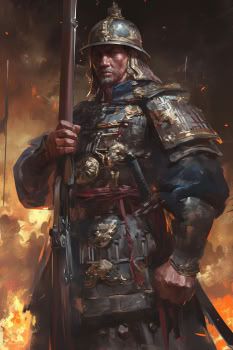
There were five Later Jin soldiers outside, each with two horses. Two of them wore cotton armor studded with copper nails, with tall lightning rods on their leather helmets, and held fine iron sickles. Another two wore bright helmets and dark armor; one of them had a black tassel on his helmet tube, a two-foot square flag on his back, and carried a tiger spear. The most eye-catching was a Later Jin cavalryman clad in gleaming silver armor, with a long red plume on his iron helmet, a colored flag slanted across his back, even his horse covered in cotton armor, and wielding a long-handled iron polearm.
Without exception, all five were short and stocky, highly skilled riders, especially the one in silver armor, whose horsemanship was almost unbelievable. He controlled his horse, loudly mocking those on the dun, shouting something in a foreign tongue no one understood, his arrogance on full display.
Charles Grant’s calm voice sounded: “There are five Tartar soldiers, ten horses, two foot soldiers, one cavalryman, one leader, and one in white armor. They’re all tough opponents; our chances of winning in a fight are slim.”
Hearing this, everyone inside the dun turned pale, and a sharp glint flashed in Henry Carter’s eyes.
In the Later Jin army, soldiers were mainly divided into three ranks: garrison soldiers, foot soldiers, and cavalrymen. Ordinary Jurchen men, starting at age ten, took an exam every three years; those who passed became garrison soldiers, then foot soldiers, and then cavalrymen. Above the cavalrymen were the boshiku, selected from the best among the cavalry, known to the Han as “lingcui” (leaders). Above the boshiku were the daizi, also called “fende boshiku,” which would later become the Qing dynasty’s xiaoqixiao (elite cavalry captains). Above the fende boshiku was the niulu zhangjing, the commander of a niulu of three hundred men.
Among the Later Jin cavalry, the best were selected as Red Banners and White Banners, the predecessors of the Qing imperial guards and vanguard battalions. Even a Later Jin niulu had only a few dozen Red Banner soldiers and a dozen or so White Banner soldiers.
Though there were only five Later Jin soldiers before them, each was an elite, especially the White Banner soldier, who was the best of the best. Inside the dun, only Henry Carter and the three Charles Grant brothers had any fighting ability; the rest were women and the weak or disabled. Their chances of victory were indeed slim. With the people inside, it was already fortunate if they could close the dun and protect themselves; to go out and fight would be certain death.
Frank Howard also knew it was impossible to save his wife, and could only weep in despair.
Suddenly, several shrill screams rang out. Everyone inside the dun hurried to look outside, only to see the Later Jin soldiers riding back and forth, slaughtering the commoners. It seemed the soldiers had tired of their game and were finally making their move.
Frank Howard suddenly leapt up and shouted toward the outside: “Annie, run, run!”
The Stone Family desperately ran toward the dun gate, when suddenly she let out a scream, a spray of blood bursting forth as she fell heavily to the ground. A horse appeared behind her—it was the Later Jin cavalryman in silver armor, his triumphant, ferocious grin especially chilling.
Frank Howard wept bitterly, pounding his fists against the wall in front of him, beating until his hands were a bloody mess, yet he didn’t even notice.
Everyone inside the dun was filled with sorrow. Brian Reed silently patted Frank Howard on the shoulder, not knowing what to say, leaving only a long sigh.
The Later Jin cavalryman in silver armor turned his horse and charged toward the dun gate, letting out a wild howl, then proudly turned back again, repeating this several times.
John Grant said angrily, “Brother, these Tartars are too arrogant. Do you think you can shoot him with an arrow?”
Charles Grant shook his head. “That Tartar always turns at sixty paces—our chances aren’t good!”
Without a word, Henry Carter opened his great bow, slowly drawing the string, quietly watching the white-armored cavalryman charge again. The great Kaigen bow in his hands was a hard bow passed down from his ancestors; his forebear Tiger Carter had once used this bow in campaigns north and south. The bow had a draw strength of two stone, and the long arrow nocked on the string was a specially made heavy iron arrow.

