Chapter 8
To prevent bandits and marauders, the civilian forts and villages in the Ming border regions were mostly no different from military forts, possessing the same defensive systems—fort walls, ramparts, drawbridges, gate towers, and barbicans, all fully equipped. Xin Village was no exception. The rammed earth walls were tall and sturdy, stretching nearly two li in total length, with the southern fort gate as the only entrance. The gate tower was built with brick and stone arches, towering high above.
Upon reaching the area of Xin Village, one could finally sense some signs of life. Here and there, men and women could be seen working around the outskirts of the village, but everyone wore a wary expression, frequently glancing around in all directions. At the fort gate or on the watchtowers, some villagers were patrolling back and forth. Just last month, the Later Jin army invaded, and some villagers working outside Xin Village didn’t make it back in time—some men and women were either killed or captured by the Later Jin soldiers. The lesson was still fresh, making everyone extra cautious.
When Henry Carter returned, some villagers along the way saw him and called out teasingly, “Oh, our General Carter is back?”
Some women, hearing this, giggled and pointed at him, laughing among themselves.
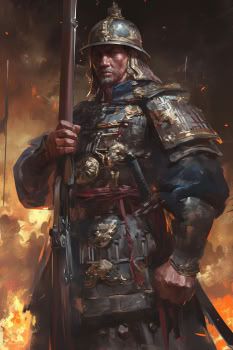
The nickname Big Fool Carter that Henry Carter had earned was not only well-known at Jingbian Dun, but even more so within Xin Village, since Henry Carter had grown up here. Of course, these people had no idea what had just happened with Henry Carter at Jingbian Dun, and Henry Carter couldn’t be bothered with them. Carrying his long spear and with his hand on his waist knife, he entered Xin Village directly through the drawbridge and fort gate.
The exterior of Xin Village looked decent, but only upon entering did one notice its dilapidation. The main street was full of potholes, making it uncomfortable to walk, and on both sides, narrow alleys were lined with low, shabby mud houses. Garbage and chicken, duck, and pig droppings were everywhere, giving off a strong stench. The men and women hurrying by mostly looked sallow and numb, and many children didn’t even have clothes to wear, running around naked.
Henry Carter sighed inwardly. Xin Village was considered wealthy in the Sanggan area, yet it was still like this. The poverty of the common people at the end of the Ming dynasty was evident.
Perhaps the wealthiest in Xin Village was the The Thompson Family on the west side of the village—a large compound with several courtyards, surrounded by fertile fields, most of which belonged to them. Many villagers of Xin Village were their tenant farmers. It was said that the The Thompson Family ancestor, Matthew Thompson, had once passed the imperial examination for scholars, and the authorities had built a memorial archway for them in the Bao’an Prefecture city. In the Sanggan area, the The Thompson Family had always enjoyed great prestige, and even the village headmen had to act according to their wishes.
In Henry Carter’s memory, after his father passed away, the The Thompson Family had once tried to seize their land and house, but it was only thanks to his mother’s desperate resistance that they managed to keep their property.
Henry Carter walked on, deep in thought. Occasionally, familiar villagers would greet or tease him, but he only responded perfunctorily. His home was in the north of Xin Village, near the God of Wealth Temple. Like other civilian forts, Xin Village had no shortage of temples and opera stages—God of Wealth Temple, Fortune God Temple, Dragon King Temple, Guanyin Temple, Five Grains Temple, and so on—too many to count.
Just as he reached the God of Wealth Temple, a figure suddenly darted out from a nearby alley, almost bumping into Henry Carter. Henry Carter quickly dodged aside. It was a delicate-looking young girl, her face pale, head lowered, biting her lower lip, saying nothing as she hurried away.
Watching her back, Henry Carter shook his head slightly.
Chapter 004: Child Bride
A two-courtyard siheyuan, with a brick-and-tile gatehouse and screen wall, spoke of former glory, but now the buildings leaned and the mud walls were crumbling, showing the decline of the household.
This was Henry Carter’s home, where he had grown up, and he had returned here several times since his arrival.
The main gate was ajar, and the faint sound of chickens could be heard. Henry Carter pushed the door open and entered. In the main courtyard, a young girl was feeding the poultry. She wore a coarse cloth long skirt, her figure thin and small, with several obvious patches on her clothes. A flock of chickens and ducks gathered around her, clucking happily.
Hearing movement, the girl turned around. Her small, delicate face was somewhat pale. Seeing Henry Carter, a look of joy appeared on her face. “Brother, you’re back?”
Henry Carter nodded and walked over. The girl came to take Henry Carter’s military cap and long spear and bow, carefully putting them away, then softly asked if he was tired.
Henry Carter replied a few times. Noticing some wheat seeds and farm tools placed beside a wooden chair, he asked, “Grace, have you finished sorting the wheat seeds?”
The girl said, “They’re all done as of this afternoon.”
This girl was Henry Carter’s child bride, Grace Bennett, seventeen years old this year. She had been sent from a Xie family in Sunjiagou, Xishan, as a future daughter-in-law when Henry Carter was ten. At that time, the The Carter Family was relatively well-off compared to her family, and her parents sent her here in hopes that she would have a better life.
At the end of the Ming dynasty, extravagance was rampant. Not only did officials and the wealthy indulge in excess, but even ordinary people competed to outdo each other, especially when it came to their children’s marriages, often to the point of ruining their families. With a child bride, the groom’s family didn’t have to pay a hefty bride price, and the bride’s family didn’t need to provide a dowry, greatly reducing expenses for both sides. Thus, child brides were very common in the Ming dynasty, even among wealthy families, and in many places, exchanging daughters as child brides was widespread.
Grace Bennett had been with the The Carter Family for twelve years. Although both she and Henry Carter were now of marriageable age, the The Carter Family didn’t even have enough money for a proper wedding, so the marriage had been postponed again and again. Even though a child bride didn’t require a bride price and the wedding ceremony could be simple, the cost of getting married was still no small sum.

