Chapter 5
It was just that when they gripped the steering wheel in their hands, they had already cast aside even the most basic conscience. However, these matters were only Dr. Sullivan's speculation; the specific circumstances could only be determined by the traffic police.
Ping Brooks's heart grew heavier and even felt a chill.
“All along, the traditional standard for diagnosing death has been the cessation of heartbeat and breathing, what we call ‘breathless and pulseless’,” Dr. Sullivan looked at Ping Brooks. “But experts have discovered that in a small number of special patients, even when the central nervous system is damaged, with the support of ventilators and cardiovascular drugs, breathing and heartbeat can be maintained for quite a long time. However, extensive clinical studies have found that all rescue efforts for such patients ultimately end in failure—none of them escape death. This means that the previous view of death as simply the cessation of breathing and heartbeat is incomplete. For most people, death is not an instantaneous event, but a continuous process, which may begin even before breathing and heartbeat stop.”
“Dr. Sullivan, if you have something to say, just say it directly,” Ping Brooks's voice trembled slightly. “We will follow the doctor's decision.”
Dr. Sullivan sighed inwardly. “What I want to say is, at present, Ethan Brooks has suffered brainstem damage, with a blood clot compressing the central nervous system. He no longer has spontaneous breathing and is in a deep coma. Moreover, his brainwaves are flat—a straight line—even when amplified, there is no signal. In other words,” he paused, “the patient is already brain dead and is in danger of dying at any moment.”
Ping Brooks's whole body shook, and he murmured, “Brain death?” He could no longer hold back the tears at the corners of his eyes. The grief of a middle-aged man losing his son was unimaginable, as if life had lost all meaning.
“But we still need to observe for twelve hours,” Dr. Sullivan said slowly. “After twelve hours, we will perform the brainstem reflex test, the cough reflex test, and the apnea test. If there is no response to any of these, only then can we declare true brain death. At that point, even if a ventilator and drugs can maintain heartbeat and breathing, we will still advise you to give up resuscitation, because there will be no point in continuing.”
Ping Brooks's eyes were somewhat vacant. After a long while, he finally stood up, but his whole body was weak. After a while, he asked, “What are the chances my son will wake up?”
Dr. Sullivan hesitated before replying, “Only if a miracle happens.” This was already the most tactful way he could put it, but as a doctor, he had the responsibility to tell the patient’s family the truth.
Tears finally streamed down Ping Brooks's face. He staggered out, and Dr. Sullivan felt heavy-hearted. He looked up at the window; the sky was dark and overcast, as if a heavy rain was about to fall. He sighed and sat down weakly.
Although she knew that waiting outside the ward was of no help, and that the intensive care unit would not allow family members to enter, Aunt Carter still refused to leave. She had only this one son—what parent, knowing their child was at death’s door, could bear not to stay by their side?
Nurse Foster was very responsible, and after much persuasion, finally got Aunt Carter to rest for a while in a ward. Although Ping Brooks was overwhelmed with grief, he was still somewhat clear-headed, and stayed in the ward with his wife, hopelessly keeping vigil. Looking out at the sky, black as ink, suddenly a flash of lightning tore a crack in the night, but all the brightness was only temporary, instantly swallowed again by endless darkness.
The rumble of thunder came from afar, growing louder and louder, one after another, sounding shocking and soul-stirring.
Staring at the television in front of her, Aunt Carter's eyes were blank, as if she saw nothing at all.
Ping Brooks, however, heard the announcer on the TV broadcasting an emergency weather forecast: “According to the meteorological station, due to the alternating cold and warm air along the coast, Jiangyuan City will experience a rare heavy to torrential rain tonight. The meteorological station reminds citizens to take precautions against rain and lightning when going out and to ensure safety.”
Before the announcer finished speaking, several more bolts of lightning struck in quick succession, the thunder as dense as a drum. Ping Brooks's heart was like dead water, without the slightest ripple. He could only think: tomorrow? A miracle?
Finally, he began to feel a trace of drowsiness. Ping Brooks glanced sideways at his wife; she was still the same as before. He gently embraced her and whispered, “Xiulan, get some sleep. Tomorrow we still have to see our son.”
Her only response was silent sobbing. The two of them held each other, tears streaming down their faces.
The night grew even darker, and the rain showed no sign of stopping, pouring down in torrents.
As the two of them drifted off to sleep, they did not notice a dazzling blue light streaking across the sky outside the window, rushing rapidly in their direction. Not only the two of them, but none of the residents of Jiangyuan City saw it. At this time, thunder rumbled and lightning flashed over Jiangyuan City; the only thing to do was stay at home, quietly watching TV. Who would pay attention to strange phenomena in the sky?
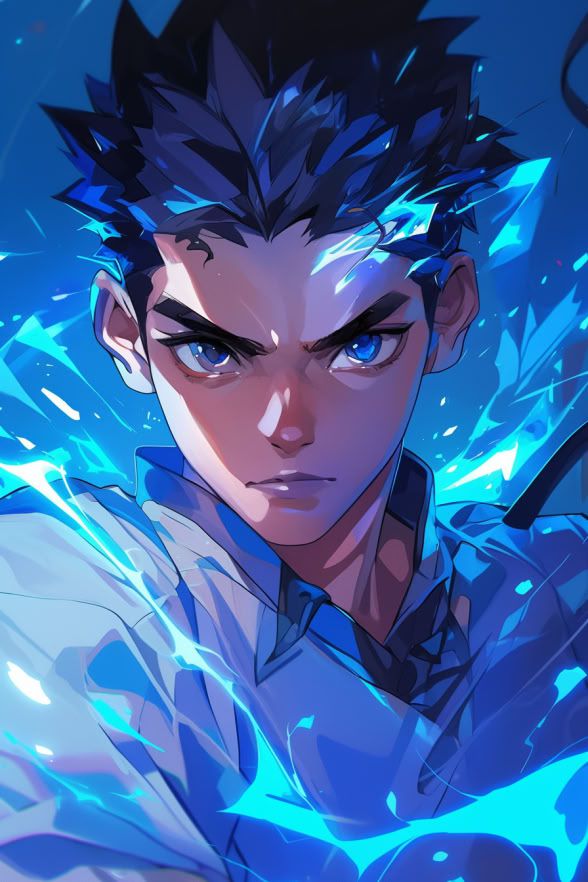
The blue light, originally far away on the horizon, was in the next instant already outside the hospital. Then a clap of thunder sounded, turning the night as bright as day. The blue light passed unhindered through brick, tile, and concrete, entering a room.
In that room, there was only a single hospital bed. The patient on the bed was covered in tubes, a ventilator attached to his mouth and nose, eyes tightly closed, looking just like a dead person.

