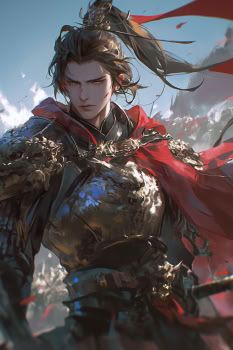
Chapter 12
This wave of cavalry was different from most others. The previous waves hadn’t lit their torches, and this group seemed to be hiding from something, galloping into the village. “Quick, tie up the horses well, everyone lie in ambush, stay alert, don’t let the Wuwan people discover us!”
Samuel Harris’s first thought was, “I can actually understand them?” He was momentarily stunned, not yet reacting, when the people lying beside him exclaimed in surprise, “Han army, it’s the Han army!” Their voices were full of joy. Fortunately, they were far enough from the cavalry not to be discovered.
“It’s the Han army, our Han army! Heaven has finally opened its eyes…” Matthew Cooper’s voice was trembling, showing just how excited he was.
John Morgan, though joyful, remained calm. “Let’s wait a bit, don’t expose ourselves. From what they said, there must be a large force of pursuers behind them!”
Among the group, Samuel Harris was the calmest. He was very unfamiliar with the Han army and didn’t have the sense of reliance the others did. The only thing he knew was that the appearance of Han cavalry at this time meant something unusual was about to happen.
After more than ten Han cavalry entered the village, they quickly concealed themselves. Not long after, the sound of many galloping horses came from afar, followed by lights—nearly fifty cavalrymen, torches in hand, charged in this direction. They stopped in front of the village, and over ten riders broke off from the main group to scout toward the village. The night grew stifling again, as if a careless moment would bring a sudden thunderclap!
The change was so sudden that Matthew Cooper and the others fell from joy into an icy pit. The hope of rescue was mercilessly shattered by the sudden appearance of the foreign cavalry, replaced by tension and despair.
Watching the dozen or so foreign cavalry approach the village with torches, everyone’s hair stood on end. Only then did they realize that the arrival of the Han cavalry hadn’t brought hope for survival, but rather executioners brandishing scimitars.
Everyone hid in the darkness, not daring to move. Even their breathing became unconsciously lighter, deeply afraid of attracting the attention of the foreign cavalry.
Samuel Harris felt bitter inside. He didn’t have much faith in the Han army’s combat strength. After nearly a month here, all he’d seen was the Han army being slaughtered by the Xiongnu, fleeing in disarray. From an encounter between Han and Xiongnu cavalry, he’d noticed the Han cavalry’s horsemanship was abysmal, far inferior to the Xiongnu who grew up on horseback. In hasty battles, the Han cavalry barely resisted before being wiped out.
After the dozen or so foreign cavalry entered the village, they didn’t dismount. Holding torches, they rode over the corpses on the ground. Once they had advanced about twenty meters into the village, a second wave of foreign cavalry moved forward another twenty meters, then a third wave followed, then a fourth and fifth, each group spaced about twenty meters apart.
Samuel Harris was not unfamiliar with this search method. The foreign cavalry were using a formation invented by Qin dynasty light cavalry, called “row formation”—a wave after wave, leaving only slight gaps, a carpet-style search. It was usually used for battle charges, but also very effective for searching for people, preventing ambushes. This tactic was still used in later generations; in Samuel Harris’s own paratrooper assault operations, each person would advance in waves, spaced several meters apart.
It was a strange night. The moonlight in the sky turned an unusually blood-red, shining over the ruins as if the world were painted in blood. The wind howled, torches flickered with a “whoosh” in the wind, and the foreign cavalry advanced steadily. The complex terrain limited their mobility, and the distance between each rider grew wider and wider.
Suddenly, the leader of the first wave of foreign cavalry shouted something, raising his scimitar toward the darkness ahead. Immediately, the dozen or so riders closed ranks and charged forward without pause. But because the ruins and broken walls made the terrain so complex, one foreign cavalryman’s horse stumbled over something, its front legs buckling. The rider was thrown off with a shriek, and the formation fell into chaos as the cavalry crashed into each other. The once-imposing charge formation instantly collapsed.
……
“Han army…”
A high-pitched voice exploded from the darkness!
“Fight to the death!!!”
The responding shouts were full of unyielding fighting spirit!
A figure stepped out from the darkness, raising his sword to the sky. “Men of the Great Han, kill the enemy invaders!” he shouted, then charged forward…
Behind him, more than ten Han soldiers ran out from the darkness, their voices hoarse as they roared, “Mighty Han army! Slay the enemy, defend our borders, fight to the death!!!”
The Han soldiers charged into the still-chaotic Wuwan cavalry formation, using the complex terrain to fight the Wuwan cavalry on foot. Taking them by surprise, they cut down several Wuwan who were frantically trying to control their horses. The Wuwan quickly reacted, dismounted, and a chaotic melee ensued.
Hearing the battle cries, Samuel Harris felt his blood heat up. He remembered this nation that never yielded to powerful enemies—no matter what hardships it suffered, it always stood up again after falling. For thousands of years, how many sons of this nation had charged toward death, shouting the battle cry to defend their homeland—they went to their deaths with courage!
“Han army!!!” That high-pitched voice rang out again. He was covered in blood, sword pointing at the Wuwan who were trying to encircle them, ready to strike.
“Mighty!” came the scattered response. After the melee, only seven Han soldiers were left standing, each wounded and covered in blood.

