Chapter 14
A group of people had just witnessed Samuel Harris's martial prowess; no one dared to mock Samuel Harris, taking it only as a way to vent after surviving.
Samuel Harris finished vomiting, propped himself up with his curved blade, and stood up, his eyes glowing green as he stared at everyone, looking extremely terrifying.
The two surviving Han soldiers only realized how tall Samuel Harris was when they approached him. They exchanged glances as they looked up at Samuel Harris, who was a full head taller than themselves. One of them, whose breastplate bore two indistinctly colored ‘shou’ (shou are long decorative strips woven from colored silk), couldn’t help but exclaim, “A true warrior indeed!”
Matthew Cooper, hearing someone praise his elder brother, pounded his own chest with a thumping sound: “My eldest brother is fierce enough to slay tigers; brave enough to kill a thousand enemies—this is nothing.” As he spoke, he grinned foolishly, his smile full of pride.
“Slay tigers?” The Han army squad leader who called himself Thomas Thompson stared blankly at the towering Samuel Harris...
Chapter 8: The Son of the Flying General
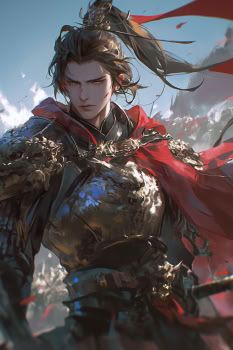
Thomas Thompson, about 1.89 meters tall, wore standard Han military armor, which was very similar to the standardized armor of the Qin dynasty: the upper body was clad in a cuirass, also known as ‘black armor’, with a very peculiar construction—almost the entire cuirass was forged from armor plates of various shapes, making it look extremely heavy. Around his waist was an armored skirt, made from several long plates forged together to protect the waist and thighs. The iron plates were perforated with various small round holes, through which complexly woven hemp ropes threaded the plates together. He also wore armored sleeves to protect his wrists and the backs of his hands. The military uniform was red, and the rank insignia and other military items were also red, making his whole appearance very imposing.
The other surviving Han soldier’s armor was much simpler and looked rougher compared to Thomas Thompson’s, with leather armor only at vital points.
The two of them stood there, covered in blood and wounds, but their bearing exuded the sharp aura of seasoned soldiers.
Thomas Thompson clasped his fists in salute: “Thomas Thompson of Longxi greets the brave warrior!” After the salute, he said in a deep voice, “My father is the ‘Flying General’ Li Guang. May I ask your name, brave one?”
According to Han customs, when introducing oneself, one would mention their place of origin and their father’s name, as a sign of courtesy and a desire to make friends.
“My lord is the squad leader of the ‘Cai Guan (infantry)’ in Right Beiping Commandery. With such valor, why not join the army and serve the country?” The other Han soldier also clasped his fists in greeting.
John Morgan, Matthew Cooper, and George Baker all showed surprised expressions. Having spent much time on the frontier, how could they not know the name of the ‘Flying General’ Li Guang? Li Guang had served as both Cavalry Commander and Prefect, a fierce and valiant general whose presence deterred the Xiongnu from invading, earning him the title of ‘Flying General’.
“So he’s the eldest son of the Flying General!” The three exchanged glances, becoming somewhat excited, and each reported their own names in turn.
At this moment, Samuel Harris also came to his senses. Hearing the name of the ‘Flying General’ Li Guang greatly surprised him. As a modern person, he had no reason not to know of the ‘Flying General’ from “The Bright Moon of Qin, the Passes of Han,” but he didn’t know what kind of person this Thomas Thompson was. He simply gave his name out of courtesy, then pondered whether to follow Thomas Thompson’s suggestion and join the army to serve the country.
Historically, after coming of age, Thomas Thompson served in Right Beiping Commandery (in what is now the northeastern part of Jinhai Road, Beijing, and present-day Hebei Province). He did not rely on his father’s fame, starting as an ordinary foot soldier. Coming from a family of generals and being brave in battle, he accumulated military merit over two years and was promoted to squad leader of the frontier army. Later, during Emperor Wu of Han’s reign, he was transferred to the palace as a court official. On one occasion, Han Yan (one of Liu Che’s childhood companions) was playing with Emperor Wu and behaved somewhat disrespectfully. Thomas Thompson, angered by this, stepped forward and drove Han Yan away, earning Liu Che’s appreciation. Because of this incident, Thomas Thompson’s name was recorded in the history books.
Samuel Harris did not know what kind of person he had just met. He was weighing his options in his mind, and at this moment, joining the army was undoubtedly a very good choice. According to Thomas Thompson, if Samuel Harris gathered the horses left behind by the Wuwan people and presented the heads of the Wuwan he had slain, he could immediately be appointed as a squad leader in the frontier army. Samuel Harris had no concept of what kind of official a squad leader was, so he just listened quietly.
Thomas Thompson went on to say that if Samuel Harris performed well in future battles, promotion and wealth would be very easy to achieve.
At the beginning of the Han dynasty, the military system inherited from the Qin placed great emphasis on military merit, taking pride in killing more enemies, and calculating merit based on the number of heads taken and spoils captured.
Matthew Cooper saw that Samuel Harris was just standing there in a daze and thought he was hesitating, so he became anxious: “Brother, refusing conscription is a serious crime!”
Indeed, at the beginning of the Han dynasty, in order to resist the invasion of the Hu people, a set of policies was established for the frontier commanderies that were completely different from those of the interior. The frontier people had to unconditionally obey the conscription orders of officials at the rank of county historian (above 200-dan and 100-dan) or higher. A commandery squad leader was exactly at the 100-dan rank, and was an officer who could conscript commoners into the army during wartime.
Samuel Harris could not refuse, so he had to perform the proper salute and respond with “yes.” This, however, caused a bit of a joke, as no one knew what kind of answer this “yes” was. While Samuel Harris was still confused, he saw Matthew Cooper and the other two respond with “nuo,” and only then did he realize that subordinates should answer superiors with “nuo.”

