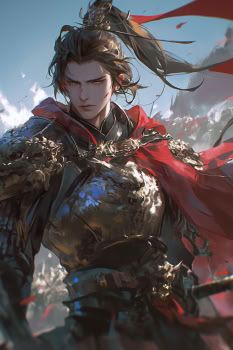
Chapter 15
A group of people confiscated a total of thirty-two warhorses from the Wuwan, beheaded thirty-six Wuwan leaders, and after finishing the count, out of fear that the fleeing Wuwan might bring pursuers, they hurried on their way through the night under the leadership of Thomas Thompson.
Because Samuel Harris was not accustomed to the riding style of this era—there were not yet saddles or stirrups, only bits and reins—people rode bareback, straddling the horse and needing to grip the reins and squeeze the horse’s belly with their legs to avoid falling off at full gallop. Precisely because there were no stirrups or saddles, Samuel Harris had no leverage and could only cling tightly to the reins. Sometimes, to keep from tilting and falling off, he even grabbed the horse’s mane, which caused his mount to lose control several times, veering off the road and crashing into the roadside grass or trees.
Thomas Thompson was very dissatisfied with this pace, but he did not voice any reproach. Horses were not common at this time; only cavalry in the army and horse breeders could ride skillfully. Out of fear of pursuit, he deliberately chose hidden paths, which meant less time riding and more time leading the horses on foot. This finally allowed Samuel Harris to breathe a sigh of relief.
After a night of torturous riding, Samuel Harris’s thighs were badly swollen and red from the intense friction with the horse’s belly. By the time daylight broke, they finally, under Thomas Thompson’s guidance, emerged from the complex terrain of the small paths and returned to the main road. On the straight road, they could ride at full speed, but before long, Thomas Thompson ordered everyone to dismount and hide in the grass, while he rode ahead alone.
“Sir is going to check if our army’s outpost ahead is safe. We’ll wait here for a while.” Robert Scott was the name of the surviving Han soldier, a man of great endurance. Though not old, he looked very aged. He had served as a county soldier for four years, and counting the year of training in his home county, he had served the country for five years in total.
Samuel Harris sat on the ground, exhausted, rubbing the inside of his thighs. At this moment, he wished for neither wealth nor promotion, only a stable place to think and to heal his wounds. But in his conversation with Robert Scott, he realized only one thing: being a border garrison soldier was extremely dangerous, almost a one-in-ten chance of survival.
Every year, the border would be reinforced with large numbers of “garrison soldiers” from Guanzhong, Guandong, or even more southern counties—new recruits who had received only basic training locally. But the reinforcements could never keep up with the losses; very few of the new soldiers from the interior survived the invasions of the nomads.
Someone like Robert Scott was relatively lucky and exceptional. Normally, after serving one year as a “garrison soldier,” one could apply to the local registrar to be transferred back inland. But Robert Scott volunteered to stay. For every additional year he served at the border, his benefits increased. He had served four years at the border: after the first year, he began to receive rations and pay; in the third year, regardless of military merit, he was automatically promoted to squad leader; in the fourth year, if he had military merit, the local authorities would introduce a local woman to be his wife. If he served more than ten years at the border without special military merit and without dying in battle, the local county would be responsible for helping him build a house after retirement and would provide him with a pension every year.
This was a rather unique military system in the early Han dynasty, designed to encourage men to serve the country at the border. Such benefits did not exist inland.
“All my subordinates have died in battle…” Robert Scott seemed to have grown used to it, showing no sadness.
Samuel Harris felt a bit uneasy. Only now did he understand why border county soldiers who served more than three years were automatically promoted to squad leader—it was because the casualty rate at the border was so high that replacements for junior officers could not keep up with the losses.
Robert Scott smiled indifferently. “As long as I survive another three years, the registrar will promote me to section leader. If I’m lucky, the patrol chief (village head, equivalent to today’s town mayor) in the border area will even build me a house. Then I won’t have to go to the battlefield anymore, just be responsible for catching thieves between the ‘pavilions.’”
Samuel Harris was speechless. These warriors who guarded the border for the country were always so selfless and uncomplaining, and their demands were always so simple. All they wanted was a house, a wife, children, and to pass on their bloodline.
Chapter 9: Where Can One Find Fierce Warriors
The registrar Robert Scott mentioned was an official who assisted the county magistrate, neither a civil nor a military officer. Above the registrar was a “deputy,” both of whom were officials of the hundred-stone rank.
He didn’t quite understand what Robert Scott meant by “pavilion.” When asked, Robert Scott was momentarily stunned and explained that every ten li (or hundred li) a pavilion would be set up for people to live in, with a pavilion chief appointed. There would be a market in the pavilion for villagers to trade, and the pavilion chief managed its affairs and was also responsible for supplying the frontline outposts with provisions. “Provisions” was the Han term for military supplies.
After that, Samuel Harris fell silent, leaving only Matthew Cooper introducing Samuel Harris’s bravery to Robert Scott. When it came to Samuel Harris fighting a tiger, Matthew Cooper’s face flushed with excitement. John Morgan and George Baker chimed in as well, the three of them vividly building up Samuel Harris’s reputation, which left Samuel Harris rather baffled.
Of course, Samuel Harris didn’t know that Matthew Cooper, George Baker, and John Morgan were trying to boost his status. The more famous Samuel Harris became, the better their own chances would be in the future. With that tiger skin as evidence, Robert Scott was willing to believe what the three said. He remarked that Samuel Harris was tall and must be extremely strong, and having witnessed Samuel Harris slaughter Wuwan people with his own eyes, he greatly admired Samuel Harris and was willing to recommend him to his superiors.

