Chapter 4
The changru was not the kind of long-sleeved robe worn by Confucian scholars that looked elegant and graceful; in fact, it was just a slightly longer short jacket. According to ancient descriptions, it was the kind of Hu-style clothing from King Wuling of Zhao’s “adopt Hu attire and practice horsemanship.”
The armor only had a few bronze plates of varying sizes inlaid on it. These metallic pieces, shimmering with a bluish light, came in different sizes—the largest being eight centimeters long and three centimeters wide—mainly protecting vital areas like the heart.
As for the leather helmet? It actually looked more like a leather cap, offering almost no defensive function.
Uncle glanced a few times, seeming quite satisfied, then shouted something loudly and quickly ran into the thatched hut to fetch a sword. He fussed around Brian Clark’s waist, then fastened the sword with a leather belt, stepped back two paces, bowed, cupped his fists, and shouted loudly!
“I... I...” Brian Clark finally understood. Now, dressed in armor, holding a halberd and a sword, “I... was struck by lightning and transmigrated!”
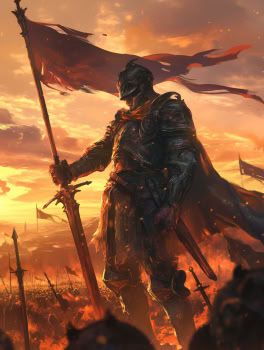
Qin soldiers wore changru, leather belts at the waist, short trousers, legs wrapped in gaiters (that is, leg bindings), shallow shoes on their feet, a round bun tied on the right side of the head, and carried bows, crossbows, halberds, spears, and other weapons—these were the light infantry!
Chapter 0003 Wild Imaginings
China has a long and rich history, vast territory, and countless dialects.
Each dynasty generally designated the language of its capital as the official language, which was the so-called “Mandarin.”
In times when even basic needs were hard to meet and knowledge was not widespread, it was difficult for the court to require all its subjects to learn a particular language, which made communication a problem.
Of course, officials of the court would usually make a special effort to improve their Mandarin pronunciation for the sake of their own careers.
Over thousands of years of inheritance and continuation, countless languages have disappeared, and many dialects have changed their accents and meanings through the sediment of history.
The dialect spoken by Uncle was actually the Shaanxi dialect of the Qin dynasty, so it was no wonder that Brian Clark couldn’t understand it.
Faced with this sudden turn of events, Brian Clark’s thoughts kept shifting. In this age of the internet, where he often read web novels to pass the time, he certainly knew what transmigration was—he just couldn’t be sure for the moment. He couldn’t just conclude it was transmigration because Uncle brought out this set of gear; for all he knew, Uncle might really be a relic smuggler!
If Brian Clark were familiar with the attire of Qin dynasty soldiers, he would have realized he was dressed exactly like a Qin warrior. Unfortunately, he only knew a little and was completely ignorant of the details. Well, he did know that the first emperor to unify China was Qin Shi Huang, Ying Zheng...
Actually, this great emperor’s formal title was not as simple as it appeared; it should have been Ying of the Zhao clan. The surname Ying, clan Zhao, was because, during the Warring States period, people mainly used the names of their fiefs (封邑, 食邑) as surnames.
What happened next left Brian Clark dumbfounded. He had barely changed into military gear, with almost no mental preparation, when Uncle led him out the door. They walked northeast for about two days, gradually joining up with more and more people, all heading in the same direction.
They didn’t pass through any large towns along the way, and only made brief stops when passing through villages.
These villages, as always, had no trace of modernity. The houses were mostly mud walls and thatched roofs; the wealthier families merely had fenced yards, with small gardens for growing vegetables or raising chickens and geese. The villagers’ attire looked familiar to Brian Clark, but he couldn’t recall which historical drama he’d seen it in. Though it was hard to believe, he finally realized that everything he saw was a constant reminder that he really had transmigrated!
Most of the people gathering were in military attire; those not in uniform were clearly there to see off their loved ones.
After heading northwest for another half a month, and with the group now numbering about seven hundred, Brian Clark began to feel utterly hopeless. The number of soldierly types kept increasing, and the expressions on people’s faces were both excited and grim—clearly, they were marching to a battlefield.
“Come on... I’m just a background extra, I can’t fight in a war!”
To be precise, Brian Clark was a member of the school basketball team, but since his skills weren’t great and he wasn’t very tall (compared to those over two meters), he could only go on court to run around when the main players were tired. Occasionally, if he was lucky, he might touch the ball, but shooting and scoring were jobs for the main players—he just wasn’t cut out for that.
Brian Clark wasn’t especially brave or timid; he was the type who dared to fight and bleed, but his legs would go weak. Now that he knew he was heading to the battlefield, his calves didn’t exactly go limp, but he couldn’t help his heart from pounding wildly.
Anyone who’s seen a movie knows how brutal cold weapon warfare is—blades flashing, swords clashing, halberds and spears thrusting in bloody scenes. Watching people’s blood spurt in movies is thrilling, and you might even mock an extra’s death scream for being unconvincing, but if it’s your own blood about to spurt, not fainting on the spot would already mean you’ve seen some real action.
Brian Clark really wanted to run away, but Uncle was right beside him, eyeing him like a tiger ready to pounce, looking like he’d spill blood within five steps, so Brian Clark didn’t dare make a move.
Listening to the people around him excitedly chatting in a language he couldn’t understand, Brian Clark, walking among the soldiers, felt absolutely miserable.

