Chapter 6
On the march, Brian Clark often saw large groups of people carrying baskets filled with earth along the way, and from time to time, soldiers on horseback would gallop past. This made him very curious.
Continuing northwest for about half a month, with new groups joining along the way, it seemed they had reached their destination? The entire troop stopped on a vast plain.
This unknown place was bustling with activity. Countless people were digging or leveling the land with all kinds of tools. When Brian Clark asked in his not-so-fluent “official language,” he learned that these people were building the Straight Road!
The officers ordered the camp to be set up, and the families of the soldiers could only be sent this far. Farewells could be seen everywhere. Yet, there didn’t seem to be much grief over life and death?
The elderly commoners loudly urged their young men to kill more enemies on the battlefield, promising that if they brought back a few heads, they would be married to the most beautiful wives upon returning home.
Wives, in a reassuring tone, told their husbands that since they already had children, they should fight desperately on the battlefield to collect more heads—for the sake of earning more land for their offspring!
Off to the side, the uncle quietly watched Brian Clark, as if he wanted to say something but gave up.
Since his transmigration, Brian Clark had always had the uncle by his side. In a strange environment, having someone even slightly familiar naturally led to a sense of dependence (this had nothing to do with gender). Now, as they were about to part, he felt like a chick about to leave its “mother hen”—was he nervous?
In the end, the uncle finally spoke. Brian Clark heard something like “stay alive on the battlefield,” which left him both stunned and surprised.
He had originally wanted to shout a few bold phrases in his awkward “dialect,” like “I will kill more enemies!” “For Great Qin, I would die nine times without regret!” “Even if I die, I’ll take the enemy with me!”—to bolster his own courage and stop his knees from shaking so much.
But the uncle… oh well, what a pity!
They parted. Farewell, dear bandit. He would never again see those straight eyebrows, or those thick, hairy toes…
The above is in the style of a chant.
In the distance, the “engineering personnel” who had been watching all along seemed to have odd expressions on their faces.
Someone nearby sneered with disdain: “Those people from a fallen nation, hmph!”
Indeed, Brian Clark noticed it too—their expressions, their eyes, their posture. The laborers were clearly drawing circles and cursing something. But he couldn’t quite relate, so he didn’t really understand why.
There wasn’t much sentimentality in the farewell scene. The soldiers about to step onto the bloody battlefield were more excited and expectant than anything else. Of course, Brian Clark was not among them.
After the commoners (the term for Qin’s people) left, it wasn’t long before the soldiers began to move on their own.
It was as if they knew exactly what to do. There was no shouting, no urging from officers. In an orderly fashion, they formed into large and small rectangular formations.
Brian Clark stood there, a bit confused, watching the others line up. Before he could react, a formation of about a hundred men had already taken shape directly in front of him. The soldiers stood in place, eyes wide, staring at him with murderous glares.
When he finally realized what was happening, he shivered. Gripping his ge tightly in his left hand, and raising his sword to the sky with his right, he shouted hysterically, “Victory! Victory! Long live Great Qin!”
The scene he expected—where the soldiers would echo his cry of “Victory!”—did not happen. The place fell silent, and most of the soldiers looked at Brian Clark with strange expressions. As he began to wonder if his “dialect” was off, the soldiers’ aura only grew more intense, scaring him so much he nearly collapsed on the spot. Truly, living in a society obsessed with formalities is harmful.
In fact, Brian Clark didn’t know that the Qin army never shouted slogans in battle. They always followed the officers’ orders, holding their breath in their chests, like ghost soldiers crawling out of the underworld—silent, bringing death to the enemy in silence, until they themselves died.
“You!”
Turning around, Brian Clark saw a middle-aged man glaring at him.
The middle-aged uncle raised his hand and pointed to a spot. Brian Clark, not being stupid, quickly ran over and stood tall and straight. This spot happened to be at the very front of the formation. Looking at his own gear—holding a ge, gripping a sword, wearing armor—it was clear this was where an officer should stand.
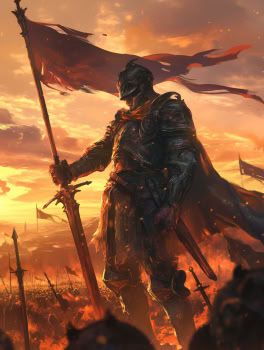
From above, one could see black rectangular infantry formations standing on the ochre land. Almost all of them wielded a ge, with only a few having a sword at their waist. The junior officers, holding both sword and ge, stood at the front row of the soldiers, while the mid-level officers, holding only swords, walked among the ranks, occasionally adjusting someone’s position.
Brian Clark quietly turned to look behind him. The soldiers standing there had stiff expressions and wore coarse black hemp clothes, with no armor at all. Looking down at his own bronze armor, he felt secretly pleased: “So I’m actually an officer?”
Officers generally had a lower chance of dying in battle. Feeling a bit safer, his knees stopped shaking, and he stood at attention with a very officer-like air, even a hint of pride on his face. Among the group of stern, expressionless soldiers, he looked completely out of place…
A deep, resonant chant, as if echoing from heaven to earth, rang out. Brian Clark’s head buzzed with a long hum, and his whole body bristled as if struck by thunder.

