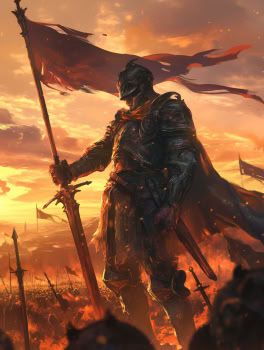
Chapter 7
Imagine the majestic sounds during the Republic’s military parade, the stirring and exhilarating bugles as the formations march by. Right now, it’s as if he’s been struck by some kind of spell, involuntarily excited, becoming exhilarated along with the crowd.
The soldiers are marching, the earth is trembling, and the footsteps that resonate with the soul make one’s breathing synchronize with their rhythm. Those present will understand that feeling—even the most comical person would become solemn and feel a sense of mission.
Large and small formations keep moving; even though the dazed Brian Clark doesn’t know how to command, he and the formation behind him, drifting along with the flow, somehow don’t fall into disorder.
Gradually, the trembling of the earth lessens, the hundreds of formations become ten, and Brian Clark, who thought he was an officer, doesn’t even know when he lost his “special position” and ended up lined up with the soldiers.
Throughout the series of formation adjustments, there is no noise—only the sound of synchronized marching. The soldiers know what they’re supposed to do, and even though Brian Clark has never experienced this before, he is guided into the correct position. The strict discipline of the Qin army is fully displayed at this moment, once again proving they truly deserve to be called a fierce and formidable force.
When all the soldiers’ formations come to a halt, Brian Clark, who lives in a society of formalism, finally snaps back to his senses. He guesses that now some high-ranking official should step up and deliver a string of “crackling” speeches, showing off their so-called authority. But… there isn’t! There is only another deep, resonant chant, and then the formations of soldiers, one after another, march into the barracks.
From beginning to end, Brian Clark doesn’t see a single high-ranking official—only grassroots and mid-level officers from various places guiding the way. The strict and orderly changes, from lining up to entering the camp, all seem so natural.
When he reaches the camp gate, Brian Clark turns his head. The migrant workers who had been cursing in circles before now show no trace of their previous resentment or malice. Their hands are trembling, and their faces are filled with fear.
For some reason, standing in the soldiers’ formation, Brian Clark feels a strange sensation rising in his heart—just like the comrades beside him—pride in being part of the group, and a sense of disdain for those whose faces show fear. Even if he isn’t really qualified…
Special note: In this chapter, there is no other implication regarding the migrant workers.
Chapter 0005: So That’s How It Is
“You’re saying they’re prisoners of war?”
“That’s right!”
Brian Clark understood—so those building the straight road were prisoners of war captured during the conquest of the Six Kingdoms. No wonder they would show open or hidden hostility when seeing the Qin army, and feel fear when the Qin army displayed its might.
But then he was confused again. Qin successively destroyed Han, Zhao, Yan, Wei, Chu, and Qi, taking a total of ten years. The youngest of those prisoners of war would be about seventeen, the oldest already over sixty. Now, how many years has it been since Qin destroyed the Six Kingdoms?
They had been traveling intermittently for about a month and a half. He calculated in his mind that they’d covered over three hundred kilometers. The corvée labor along the way wasn’t too harsh; judging from their clothes and expressions, life seemed fairly decent.
Combining this with everything he’d seen along the way—the commoners’ labor and service—there was no sign of chaos at all.
Of course, Brian Clark’s starting point was in Qin territory, not in newly conquered areas, so all the places and people he saw were from the old Qin heartland. He couldn’t know what things were like elsewhere.
He recalled the hostility of those building the straight road. Even a fool would understand that the people of the Six Kingdoms had only been conquered as a nation; in their hearts, they had not truly submitted.
Not knowing much about history, Brian Clark thought for a long time but couldn’t figure out one thing: why did the First Emperor, after conquering the Six Kingdoms, immediately mobilize troops north and south, ignoring the instability in the new territories?
At this time, not only was Qin mobilizing troops, but it also seemed to be building several straight roads at the same time?
If you’re not in the upper echelons of the state, you can’t understand why the ruling class would make such decisions. But since it happened, there must be a reason. The only question is, why would such a resource-draining endeavor occur under the wise leadership that managed to destroy the Six Kingdoms?
“Didn’t Meng Tian’s northern campaign against the Xiongnu happen in 221 BC?” (Not a typo—Meng Tian’s northern campaign was in 214 BC.)
Currently, Qin is mobilizing troops to the north, but it’s only mobilization; you can’t determine the date just by when the mobilization started.
The state of Qin was founded in 857 BC. Ying Zheng became King of Qin in 246 BC, and proclaimed himself emperor in 221 BC. So how many years after Ying Zheng’s ascension is it now?
At this thought, a bugle call sounded in Brian Clark’s ear, and he was momentarily stunned. Why? If you don’t count TV (or movies), this was the first time he’d ever heard such a long, lingering sound, as if it contained centuries of desolation.
This military camp, built beside the straight road under construction, was nothing like the glamorous ones in film and television. In fact, there was nothing colorful to be seen at all.
The entire irregularly shaped camp was surrounded by wooden stakes. To guard against possible enemy raids, several protruding corners had tall watchtowers, and the tents were set about 150 meters inside the fence, where rows of tents stood.

