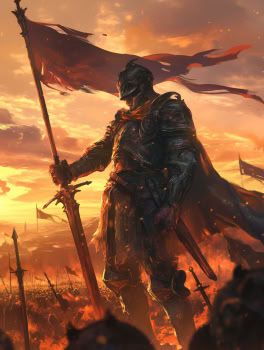
Chapter 13
In this way, Brian Clark was fine, but that burly man who stirred up trouble for no reason was surely hated by the prisoners of war. In fact, from this perspective, he could also be considered a ruthless and merciless character?
There was no begging for mercy—not out of bravery, but because these people knew it was useless. Numbly, they were escorted to the open ground. At the executioner's command of "behead," with a swift motion, fifty-six heads fell to the ground.
That should have been the end of it, but apparently, it wasn't over yet?
The commander seemed dissatisfied. He inspected all the squads. If he saw a squad leader who had killed too few, he would shout furiously; those who dared to speak up were slapped several times. The named squad leaders, whether out of shame or guilt, could only go back in and pick out more people for execution.
Though his mind was somewhat muddled, Brian Clark hurriedly bowed deeply when he saw the commander approaching, his expression respectful: "Master!"
The commander seemed satisfied with the number of heads, but instead of offering praise, he simply nodded and smiled slightly, then quickly went off to scold the other squad leaders.
What kind of era is this? Hundreds of lives, as insignificant as ants, crushed to death in an instant? When ants are stepped on, some may survive, but how could a person live after being beheaded by a sharp sword?
This is a cruel era. He was in the Qin army, and those people had brought death upon themselves—Brian Clark told himself this.
He didn't even know how he got back to the camp. As soon as he entered the tent—maybe because of the stuffy air or something—Brian Clark's face turned pale as he lay on the carpet. He felt a bit nauseous, strangely, but did not vomit.
In this era where human life is worth less than a dog's, he seriously doubted how long he could survive. If he hadn't forced himself to stay strong just now, seeing so many people beheaded for the first time, his legs would have given out and he would have collapsed.
"Hundreds of people... damn, that's terrifying!"
The tent flap was pulled open, and the sudden bright light made Brian Clark open his eyes instantly. In a daze, he saw Edward toss something over, and he caught it instinctively.
"Rice wine dregs!" Edward grinned honestly. "Drink it, you'll feel better."
Brian Clark didn't know what rice wine dregs were. The sheepskin pouch sloshed with liquid as he shook it. He pulled out the stopper and sniffed, catching only a sour smell.
"Not drinking?"
"I'll drink!"
Whatever it was, Brian Clark brought it to his lips, took a small sip first, found it not bad, and then drank deeply.
Edward probably had a surname, but unless you were close, who would go around telling everyone their full name? He watched, a bit pained, as his wine was about to run out. "Hey, hey, hey, leave some!" He quickly snatched back the sheepskin pouch. "There’s plenty at the quartermaster’s—if you want more, go buy it yourself."
Brian Clark licked his lips. "I have no money."
But don't say you have no money—at this time, the word "money" wasn't widely used yet. The so-called "gold" was actually a kind of copper knife coin, or cauldron coin, spade coin, or ring coin. There was no "Kong Fang Xiong" (the round coin with a square hole) in Great Qin; that was a currency used by the now-destroyed Yan state. At present, Great Qin had not yet unified laws, measurements, script, or currency, so the currencies in use were still a mixed bag, with knife coins being the most common.
Edward smiled indifferently. "Just wait. Next year, before we march to Shangjun, look for more chances to earn merit..."
Brian Clark didn't really hear what was said after that. When he heard the words "Shangjun," he finally realized where he was geographically, and for a moment, he was lost in thought again...
Chapter 0009: The Bloody Straight Road
The rain fell in fine threads, like curtains of water. Sometimes, when the wind gusted, the tiny droplets floating in the air would sway back and forth, the veils fluttering and tumbling, then slowly settling to the ground when the wind died down.
The tent was swaying, but there was no creaking sound. Its structure wasn't complicated: some wooden poles supported the four corners, with two not-so-thick crossbeams in the middle forming an X to reinforce the top. Some parts were sewn with hemp rope. The upright shape wasn't triangular, but more like a cube, with ropes at the four corners tying the wood, the loops extending outside the tent and firmly pegged into the ground.
Hundreds of grayish-white tents were arranged in formation, clustered or scattered, and in the rainy weather, there was an inexplicable poetic feeling to the scene.
The Qin army favored black, which had nothing to do with the Five Elements cycle. This was an era of a hundred schools of thought contending. Perhaps it also had nothing to do with color preference—black symbolized "sen zhong" (not a typo), meaning as dense as a forest, and black naturally represented the heaviness of bearing all things. On a deeper level, in any era, black also meant "death"—one's own death or dealing death to others. Perhaps that was the meaning they wanted to convey.
The era of great strife had just ended. Confucianism was now a philosophy so minor it could not be any smaller, and it was not accepted by most people. It made sense: in a chaotic world of constant war, where a nation or clan could be wiped out at any moment, who would believe in the Confucian ideals of benevolence, ritual, and humility? And it seemed that the states that had previously embraced Confucianism all mysteriously declined from strength, and were then destroyed by their enemies in a short time. The more Confucianism flourished, the faster the destruction came, and the more bizarre the process of destruction...
"Inner king, outer sage"—oh, heavens! What a bizarre theory of governance.
Who is the current Chief Historian of Shangjun? It's Sima Xin! Who is he? He would later become one of the three great generals of Zhang Han's corps, a famously fickle figure during the late Qin and Chu-Han period, and also a Confucian scholar.
Now, the Qin army where Brian Clark was stationed was about to march to Shangjun. This was the first time he had personally heard someone mention a historical figure he might actually see. Of course, the chance was slim—a squad leader seeing the prefect would only be able to catch a glimpse from afar.

