Chapter 1
At the end of the Eastern Han dynasty, warlords fought in chaos. So many stories of heroes were nothing more than struggles for power and profit, attacking each other. Perhaps they only saw the power of life and death in their hands from high above, but failed to see the exhaustion of the nation's very lifeblood.
With the Sima clan usurping the throne, the War of the Eight Princes opened the gates for the Hu people to move south, and the Central Plains entered a dark era.
Henry Clark arrived in the year 340 AD, a period in history commonly known as the "Five Barbarians Ravaging China." Facing a land overrun by Hu people and his own people on the verge of extermination, he had no choice but to rise up and fight for survival!
……
Do you not see, Han's Zhongjun, tying up the captives at a young age, asking for a long cord; do you not see, Ban Dingyuan, light cavalry urging the battle clouds in distant lands.
I have a system golden finger. Gentlemen, join me in killing the Hu, reclaiming the Han rivers and mountains, and restoring the glory of a strong Han!
Volume One: A Stranger in a Strange Land
Chapter 1: Kill the Hu! Kill the Hu!
"Run!!!"
Thousands scattered like rats and wolves, each caring for none but themselves.
Who were they? Long, long ago, they were called Han people; now, they are called Jin people.
That's right! For the Jin people, the once-mighty Han had long become a historical term. Not only was the spirit of "If the mighty Han is offended, even far away they must be punished" gone, but things had become even worse. So dire that thousands were being chased by only about thirty Hu cavalrymen. They seemed to have never considered that they were the ones with superior numbers, and that if they fought desperately, they could overwhelm their pursuers with sheer numbers.
Cries, wails, all kinds of chaotic noises filled the air. The Hu cavalry chasing the fleeing crowd laughed wildly, like cats toying with mice. They would catch up and cut down a few, and even had time to stop and torture their victims.
It was the year 340 AD: the sixth year of Xiankang in the Eastern Jin; the third year of Hanxing in Cheng Han; the twenty-eighth year of Jianxing in Former Liang; the sixth year of Jianwu in Later Zhao; the third year of the founding of Dai.
Later Zhao's campaign against Eastern Jin was unsuccessful, but the wars between the two sides created countless refugees. Shi Hu, ruler of Later Zhao, ordered that "nationals" could do as they pleased with the Jin people. Thus, after 316 AD, another great exodus began in the Central Plains.
The Jin people living in the Central Plains had no choice but to flee. In Later Zhao territory, they were the lowest of the low. Later Zhao openly issued laws stating that it was not a crime for nationals to rob Jin people, and that killing a Jin person could be atoned for with a sheepskin.
Who were the "nationals"? In the Western Zhou, it referred to city dwellers, or those eligible for military service. By the Sixteen Kingdoms period of the Eastern Jin, the term was introduced by Shi Le, the founding emperor of Later Zhao, because he considered "Hu" a derogatory term and forbade calling the Hu people "Hu," insisting they be called "nationals."
Shi Le himself was a Jie tribesman who had entered the Central Plains. After ascending the throne in Xiangguo (modern Xingtai, Hebei), he was furious at his people being called Hu. He issued a law: "Whether in speech or writing, the character 'Hu' is strictly forbidden. Offenders will be executed without pardon." Thus, the Hu could only be called "nationals."
Now, with Later Zhao's campaign against Eastern Jin going poorly, the Hu within the country began venting their anger on the Jin people, and a new round of massacres began. The Jin people dared not resist and could only flee.
A strange thing happened: as the Jin people of the Central Plains fled south, the Hu pursued and slaughtered them, and for reasons unknown, the Eastern Jin court refused to take in their fleeing kin. All manner of human tragedy began to unfold upon these pitiful people.
As they fled, anyone who ran even a little slower was already dead. Among the refugees, there were almost no elderly or children—most were young and strong.
No one knew why, but this massive fleeing crowd, though not gathered for just a day, never produced a leader. They were like a pile of loose sand.
After so long on the run, being hunted by the Hu, and rejected by the Eastern Jin court, they were already in despair. Their continued flight was nothing but a survival instinct.
The Hu cavalry were in no hurry to kill. They knew all too well the plight of their prey: rejected by the Eastern Jin, these people could only keep running. Since their victims had nowhere to go, no one to save them, and no will to resist, the Hu could take their time and enjoy the slaughter.
The fleeing people acted like a herd of sheep, simply following the fastest runners, never considering that there were only about thirty Hu cavalry chasing them. If they scattered, the Hu could never catch them all.
The Hu cavalry laughed and stopped their pursuit, treating the thousands as nothing. They dismounted, weapons in hand, and began chopping off the limbs of corpses. From their conversation, they were looking for a good spot to build a fire and roast them.
That's right! The Hu cavalry chasing the Jin refugees were Jie people—the very tribe in Chinese history that, brought from the Western Regions, West Asia, or some remote corner by the Xiongnu, were once the Xiongnu's lowliest slaves, but later overthrew the Xiongnu to become overlords of the Central Plains. The last cannibal tribe in Chinese history—the Jie!
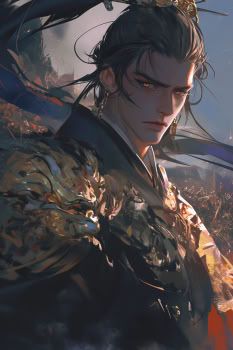
On a distant high slope, a man sat astride a warhorse, watching the flight and slaughter from afar. He wore a red battle robe, black armor, and no helmet, revealing a close-cropped head.

