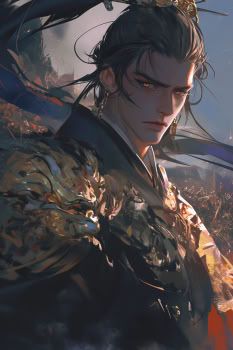
Chapter 3
Yes, that's right, it's combat power. Henry Clark's own combat power is 74. In "Age of Empires II: The Conquerors," there are several ages with different scores. In the "Dark Age," he has a "+5" bonus attribute, which becomes "+10" in the "Feudal Age." Then, for every military unit he produces, he gets an additional 0.001 boost, so now his combat power is close to 85.
According to Odin Technology's "Legend of the Three Kingdoms" settings, a combat power of 85 definitely qualifies as a first-rate general. Although it's not comparable to the super-class generals with combat power over 100, it's certainly more than enough to deal with ordinary soldiers.
After crossing over, this isn't Henry Clark's first time fighting. Nor is he charging alone—he's leading ten cavalrymen, and with the Hu people in chaos, there's no reason not to immediately charge in and kill.
The Hu people occupy the Central Plains, but they only know how to destroy, not produce. The thirty or so Hu chasing the fleeing Jin people aren't regular troops. They have plenty of warhorses but are extremely short on metal weapons; most of their weapons are just spiked clubs and the like.
Amid the thundering hooves, Henry Clark and his men faced the first wave of arrows—bone arrows shot by the Hu. Henry Clark only needed to protect his vital spots; even if the armored parts were hit by bone arrows, the bone arrowheads would just bounce off the armor and fall away, unable to pierce it at all. However, three of the other cavalrymen without armor were hit and fell from their horses.
Henry Clark, leading the remaining cavalry, charged at the front, with nearly three hundred infantry behind. The sudden appearance of such an armed force shocked the Hu, causing some to want to fight and others to want to flee, resulting in a real split.
Shrieking and shouting, about a dozen Hu cavalry chose to fight. In their head-on clash with Henry Clark and his cavalry, more than half of the Hu were unhorsed, while two men fell on Henry Clark's side.
【The system's scout cavalry really aren't up to par; I'll have to wait until the system upgrades to the "Castle Age" to produce professional cavalry units.】
It may sound slow, but it was actually fast. After the clash, Henry Clark and his men immediately charged at the other Hu who were still hesitating.
The sudden appearance of armed men fighting the Hu caused all sorts of emotions among the thousands of fleeing people—except no one chose to join in killing the Hu. Almost all of them were young and strong; if there had been elders or people knowledgeable in history, they would have recognized from Henry Clark's troops' crimson robes and black armor that these were the uniforms of the mighty Han army.
The current Eastern Jin army mostly wears white robes and lamellar armor. The thousands of fleeing people couldn't figure out where Henry Clark and his men came from, but they definitely didn't think they belonged to the Eastern Jin court.
Cavalry in front, infantry behind.
Henry Clark always jokingly called the various infantry units produced by the system "biochemical robots." What's the characteristic of robots? They obey orders unconditionally once given. They advanced in perfect formation: spearmen at the front, swordsmen split into left and right flanks, archers at the rear, all marching in step.
The Hu cavalry who had just clashed with Henry Clark and his men didn't get far before running straight into a hail of arrows.
The spearmen continued to charge forward. The Hu cavalry who hadn't been shot down by the arrows crashed into the wall of spears, both men and horses impaled. Yet the spearmen pressed on bravely and steadily; even if knocked down, as long as the wound wasn't fatal, they'd get up and quickly rejoin the advancing ranks.
The Jin soldiers charging alongside them were greatly inspired by their comrades' fearless bravery. Shouting "Kill the Hu! Kill the Hu!" they rushed at the Hu who had fallen but could still move, several men surrounding each and hacking away with their weapons.
The fighting didn't end quickly, but while Henry Clark and his men were engaged in battle, there were still people tending to the thousands of dazed refugees standing around.
Samuel Grant was among those calling out to the refugees, making it clear: anyone who wanted to survive could join the Han Division.
What was the Han Division? In fact, it was just that Henry Clark considered himself absolutely not a Jin, but a Han. The Jin literati, including Samuel Grant, had a different understanding of "Han"—all thanks to the Xiongnu leader Liu Yuan, who destroyed the Western Jin and founded the Han state.
The Han (Former Zhao) established by Liu Yuan had long since been destroyed, but the Xiongnu still called themselves Han, and the history of their Han state wasn't that distant. This led people everywhere to think that anyone now calling themselves Han must be referring to the Xiongnu's Han.
Henry Clark wasn't that familiar with the history of the Eastern Jin and the Sixteen Kingdoms. By calling himself Han, he was naturally assumed to be from the Xiongnu's Han. Since he hadn't founded a country, he could only be a Han Division, which was basically equivalent to a tribe or clan.
The Xiongnu were ruthless to the Jin people, but the Xiongnu's Han state (Former Zhao) had already been destroyed by the Jie leader Shi Le in 329 AD. The Jie, who became the new overlords of the Central Plains and founded Later Zhao, were even more brutal than the Xiongnu. Moreover, the surviving Jin people had fresh memories of the suffering they'd endured in recent years, so they didn't care whether the Han Division was really a Xiongnu tribe or not.
"We don't accept just anyone!" Samuel Grant, dressed as a scholar, raised his head slightly, his face full of arrogance. "Those with skills are given priority, those with families are given priority, those willing to become Han are given priority..." He listed several priorities, but that couldn't dampen the refugees' eagerness for the security of life.

