Chapter 12
It has already been proven that selecting soldiers from among the Jin people is quite a difficult task. It’s not that they can’t be trained, but rather that when the Jin people face the Hu, they become timid before they even do anything.
The more than one hundred Jin soldiers under Henry Clark's command had undergone over three months of special training. Only by having his system soldiers lead the charge with absolute superiority, and the Jin soldiers following behind, defeating the Hu again and again, did the Jin soldiers finally gain a bit of courage when facing the Hu.
To put it bluntly, as an ethnic group, the Jin people of the Central Plains and the North—aside from a very small minority—have had most of their courage and confidence worn away by one hardship after another.
If a person lacks courage and confidence, they are basically useless, and any harm suffered is limited to themselves or their family.
If an entire ethnic group loses its courage and confidence, even a small number of enemies can carry out massacres, killing them more easily than pigs or sheep. At least pigs and sheep are hard to herd, but people can be driven—even made to dig a pit, walk into it, and then be buried alive.
When a people lose their courage and confidence, just look at the current Jin people of the Central Plains and the North to see what that looks like: as the lowest class, they are constantly abused, killed, and even eaten. To put it extremely, if you don’t die fighting back, you’ll die in humiliation—it’s all your own doing!
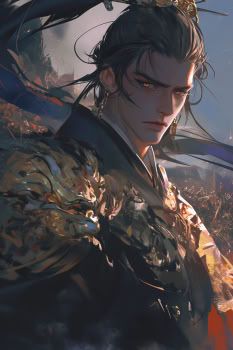
As for Henry Clark, his attitude toward the current Jin people is actually one of “pity for their misfortune, anger at their lack of resistance.” Many times, don’t expect him to treat this group… of his own people? with much kindness. In fact, when he’s truly infuriated and can’t hold back, aside from not killing anyone, he’s often resorted to punching, kicking, whipping, and beating with sticks.
Even so, the Jin people still feel that Henry Clark is incredibly benevolent, because at least he gives them food and drink, doesn’t kill them, and lets them work hard without complaint—just don’t expect to train too many soldiers to go to war.
Oh, and! Because the times are so chaotic, most Jin people don’t even have a full set of clothes. The vast majority only have a few rags or leaves to cover themselves, and many are completely naked. In fact, it’s not just the Jin people; the miscellaneous Hu among the Hu people are in the same situation. Only a few of the better-off Hu can wear a complete set of clothes.
Leading thirty thousand people (maybe not that many), it was still an impressive sight no matter what. It was under these circumstances that Henry Clark returned to the settlement.
The so-called settlement was a piece of land near the sea. Originally, it was a completely desolate area, but after nearly a year of development, it finally showed some signs of civilization.
The terrain of the settlement wasn’t particularly complex; it was fairly flat. But in these times, even on flat land, there were grasslands taller than a person everywhere, and plenty of dense forests.
For the settlement’s defenses, Henry Clark chose to build fences, surrounding the entire area with long stretches of fencing, and then constructing watchtowers (which could also serve as arrow towers). His original plan was to wait until he reached the “Feudal Age” to build city walls, but later he realized that building city walls was a massive project and he lacked the necessary resources.
Before Henry Clark started wandering around, there were over two thousand Jin people in the settlement. Now, bringing back thirty thousand at once, who knew what kind of impact that would have.
The settlement and the core town center of everything Henry Clark had were not in the same place. In fact, the settlement was chosen to guard the valley where the town center was located. To enter the valley, one would either have to break through the settlement or climb over steep mountains.
When the accompanying Jin people saw the long fence walls, they all visibly breathed a sigh of relief. When they were led to the entrance, where some fellow Jin people were preparing steaming hot food, many were instantly moved to tears.
The reason for crying was simple: seeing that their fellow Jin people seemed to be doing okay—at least their faces were rosy and they weren’t covered in wounds.
It’s important to understand that most Jin people in the Central Plains and the North are in a worse situation than wild animals. Being beaten and cursed is the least of it; many are often covered in wounds. The Jin people in charge of welcoming them, though a bit cautious, were not bloody, their faces were rosy, and seeing them in such a state, everyone thought the new master (Henry Clark) must be a benevolent person, right?
Of course, Henry Clark didn’t just rush everyone inside. He had everyone line up, and before entering, they had to go to a nearby stream to wash thoroughly. Only after washing could they receive a bowl of porridge and a number tag, and upon entering the settlement, someone would arrange a place for them to stay.
“Remember this carefully! The number tag is your symbol of identity; it’s crucial for your daily life and safety in the future!” Samuel Grant had managed to get the job of announcing this to the people, and naturally had his own little plans. He shouted loudly, “Those with families, remember to register specially!”
Chapter 7 My Territory

