Chapter 16
During the days waiting for the clay to settle, Henry Clark dug a furnace at the foot of the mountain, threw all of Mr. Steward's stockpile of thick firewood into it, and burned it. At the moment when the thick smoke was about to dissipate, he sealed both the chimney and the fire opening of the furnace with earth, then began to tidy up his rusty hammer and anvil.
Mr. Steward watched for a full five days, and finally couldn't hold back after Henry Clark's furnace had just taken shape.
"Aren't you going to forge iron? Why are you doing all this?" Mr. Steward looked at Henry Clark with a hint of pity. He understood that forging required charcoal, but as for the other things Henry Clark was doing, he was completely baffled.
"I am going to forge iron, mainly because I need a sharp knife and a sturdy awl to make myself a proper pair of boots."
Henry Clark's words were rather awkward, but Mr. Steward still understood his meaning. He felt a bit of disdain—after all, a true noble would never do such things.
Before Mr. Steward could bring up the matter of studying, Henry Clark opened his mouth and recited: "The reeds are lush, white dew becomes frost. The one I long for is on the other side of the water. I follow the winding stream, the road is long and hard. I swim against the current, she seems to be in the center of the water.
The reeds are thick, white dew not yet dried. The one I long for is at the water's edge. I follow the winding stream, the road is steep and hard. I swim against the current, she seems to be on a sandbar in the water.
The reeds are abundant, white dew still lingers. The one I long for is at the water's end. I follow the winding stream, the road turns right and is hard. I swim against the current, she seems to be on an islet in the water.
Mr. Steward, I can already recite all fifteen poems of Qin Feng."
Upon hearing this, Mr. Steward sighed, put his hands behind his back, and left. "Qin Feng" was something he had deliberately chosen to make things difficult for Henry Clark after discovering his strong learning ability, but it hadn't worked.
Chapter 9: Striving to Become a Lowly Man
Henry Clark looked at his mud-covered hands and laughed. Frequently doing things that Mr. Steward didn't expect would be very beneficial for their long-term relationship.
With the furnace finished, the next step was naturally to bake it and then keep it warm, otherwise the furnace would explode.
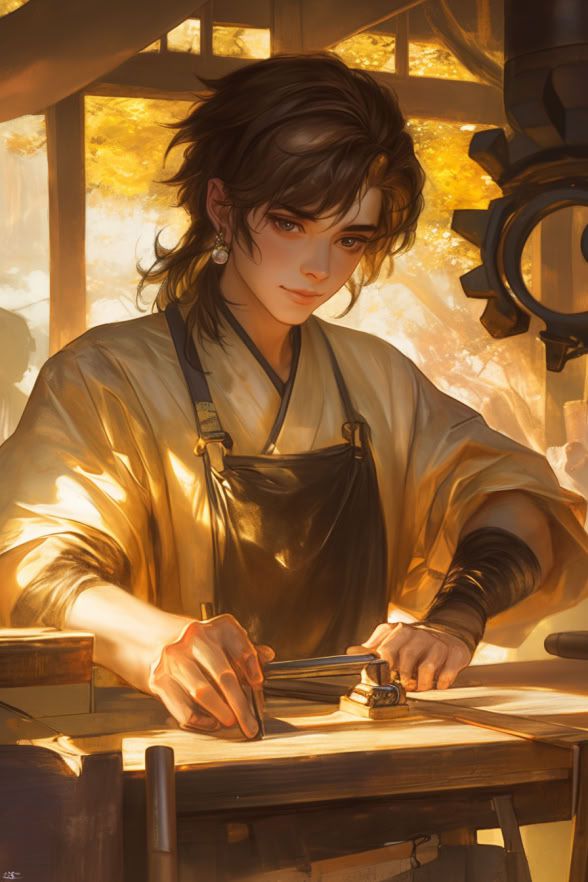
Mr. Steward watched as Henry Clark coiled strips of clay to make a strange-looking furnace, and was quite surprised. His craftsmanship was very skillful, as if he often did this kind of work.
Henry Clark worked through the whole night. Mr. Steward saw him go out countless times, and only at dawn did he collapse onto the bamboo slips and fall into a deep sleep.
Mr. Steward got up very early, sitting by the hearth and whittling wooden tablets with a knife. Recently, since Henry Clark had arrived, there were many things that needed to be recorded.
Standing barefoot on the cold stone would drive anyone mad. Henry Clark wrapped his feet in two pieces of wolf skin, but still shivered from the cold.
After he dug out the furnace, which was completely covered in ash, his mood improved a bit.
The furnace was well-fired, with no cracks, and the inner chamber was small, but sufficient for Henry Clark's needs.
After all, he only wanted to make a small knife and a few awls. If possible, he also wanted to make a decent kitchen knife.
With Mr. Steward's help, Henry Clark set the anvil on a thick wooden stump, at just the right height for his current stature.
The charcoal kiln had cooled long enough, and when opened, it still emitted waves of heat.
No wonder the tiger and the doe had liked to sleep on top of the charcoal kiln these past few nights.
Seeing that Henry Clark had made charcoal, Mr. Steward let out a long sigh, took out a piece of finished charcoal, and said to Henry Clark: "The exquisite skills of craftsmen are of great benefit to the state—this is a truth known to all. In the past, in our great Qin, all craftsmen were under state control. The Grand Artisan, with the rank of sixteenth upper noble, managed all the craftsmen. One cannot say that craftsmen were not valued. Unfortunately, most who practiced the crafts were household slaves. Once you succeed me, Mr. Steward, you will rise to the ninth rank of the five-dafu nobility. If you continue to dabble in these lowly trades, you will offend the Left Shuzhang and invite the ridicule of others."
While adding charcoal to the furnace, Henry Clark laughed and said, "Right now I need a pair of shoes. Before making shoes, I need to make a suitable awl. At the moment, it's just the two of us. In front of you, I have nothing to hide. As long as I'm comfortable, I can do anything."
Mr. Steward sighed again and said, "What worries me is your easygoing nature. A scholar-official is the son of a thousand gold; he does not sit under a sagging roof. Even if he drinks from a ladle and eats from a basket, he must uphold his dignity, and would rather die than change his resolve. Without such determination, even if you become a marquis, you are nothing but a monkey in a crown."
Henry Clark looked at his blackened hands, then at the raggedly dressed Mr. Steward, and couldn't see any difference between the two.
"Should one starve to death rather than abandon the dignity of a scholar-official?"
"There are sages on Mount Shouyang."
"Should one refuse to drink from a thief's spring even when thirsty?"
"Nonsense! Our great Qin is founded on law. From fathers, sons, brothers, and sisters not being allowed to sleep on the same kang, to the entire country using standardized measures of sheng, dou, jin, and liang.
Then, ten households are grouped together to supervise each other. If one family breaks the law and the others conceal it, all nine are punished.
Furthermore, those who engage in land reclamation are exempt from land tax for nine years. Those who are especially good at farming and weaving, and who store up much grain, are exempt from taxes and corvée labor.
Disputes between people are brought to the authorities; private duels are forbidden. In battle, rewards are given based on the number of enemy heads taken; only those who achieve merit in war can be promoted. Nobles and merchants, if they have no military merit, cannot serve as government officials.
Every rule, every type of conduct has laws to follow. Everyone acts according to the law. Slaves make a living by crafts, scholar-officials advise the state, and rule over the people for a living. Each follows their own path, and none may overstep their bounds."

